Pacers vs Lakers Match Player Stats
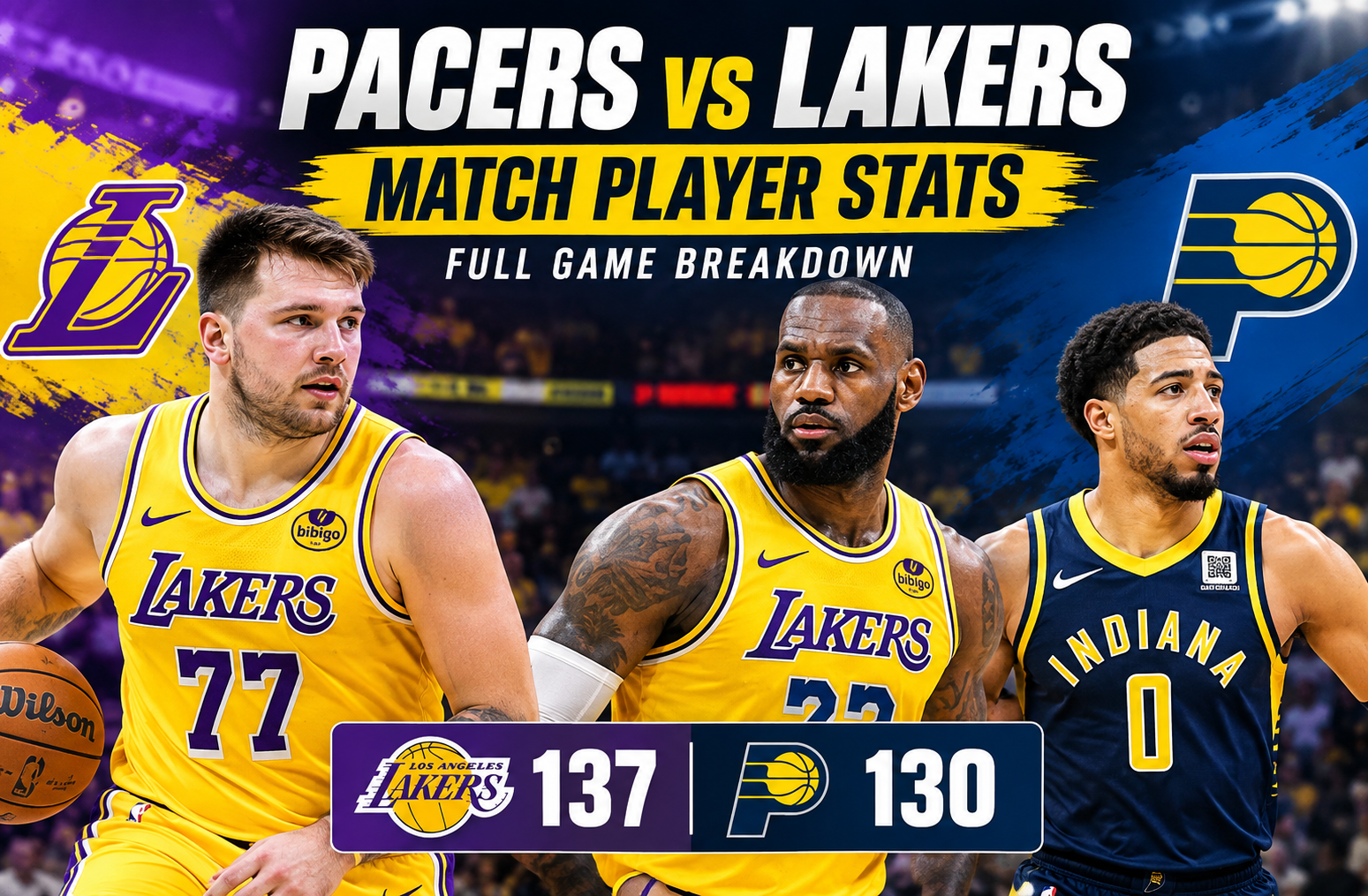
The pacers vs lakers match player stats from the March 25, 2026 matchup tell the story of a high-scoring game in which the Los Angeles Lakers defeated the Indiana Pacers 137-130 at Gainbridge Fieldhouse. Luka Dončić led Los Angeles with 43 points, while Austin Reaves added 25, LeBron James contributed 23, and Jaxson Hayes posted 21 points and 10 rebounds. Indiana stayed competitive throughout the night, especially in the fourth quarter, but its early deficit proved too difficult to erase.
The final score alone does not fully explain how this game developed. Los Angeles built a 17-point halftime advantage after scoring 45 points in the opening quarter, while Indiana responded with a 45-point fourth quarter. The Lakers ultimately protected enough of their lead to secure the seven-point victory.
This breakdown examines the complete player production, shooting efficiency, playmaking, rebounding, turnovers, quarter-by-quarter scoring, and the statistical details that shaped the result.
Pacers vs Lakers Match Player Stats
The Lakers finished the game shooting 50-of-89 from the field, good for 56.2 percent, while Indiana made 48 of 86 shots for 55.8 percent. Both teams were therefore highly efficient overall, but Los Angeles created more scoring opportunities through its combination of free throws, interior scoring, and transition production.
| Category | Lakers | Pacers |
| Final Score | 137 | 130 |
| Field Goals | 50-89 | 48-86 |
| Field Goal % | 56.2% | 55.8% |
| 3-Point Shooting | 9-23 | 16-39 |
| 3-Point % | 39.1% | 41.0% |
| Free Throws | 28-34 | 18-23 |
| Free Throw % | 82.4% | 78.3% |
| Rebounds | 39 | 34 |
| Assists | 30 | 35 |
| Turnovers | 13 | 18 |
| Steals | 15 | 7 |
| Blocks | 4 | 2 |
The statistical contrast is important. Indiana actually made more three-pointers and recorded more assists, but Los Angeles compensated with superior free-throw production, fewer turnovers, more rebounds, and significantly more steals.
That combination gave the Lakers more possessions and more reliable scoring opportunities despite Indiana’s strong perimeter shooting.
Luka Dončić Leads Los Angeles With 43 Points
Luka Dončić was the central offensive figure of the game. He scored 43 points in 37 minutes and 30 seconds, shooting 15-of-30 from the field, 4-of-11 from three-point range, and 9-of-10 from the free-throw line. He also finished with six rebounds, seven assists, one steal, and five turnovers.
The scoring total was particularly significant because Dončić generated points in several different ways.
His 15 made field goals accounted for 30 points, while his four three-pointers added another 12. He then converted nine free throws, giving him an additional nine points from the line.
That scoring mix meant Indiana could not simply defend one area of the floor and expect to eliminate his influence.
Dončić also remained a major facilitator. His seven assists helped produce the Lakers’ 30 total assists, and his presence as a high-volume creator allowed teammates such as Reaves and James to operate without carrying the entire offensive burden.
His five turnovers were the main statistical blemish in an otherwise dominant offensive performance. Even so, Los Angeles finished with only 13 turnovers as a team, meaning the Lakers generally protected the ball effectively around their primary creator.
The NBA’s official box score records Dončić’s 43-point performance and identifies him as the game’s leading scorer.
LeBron James Provides All-Around Production
LeBron James scored 23 points in 34 minutes and 28 seconds. He shot 9-of-17 from the field and made all five of his free throws.
His influence went beyond scoring.
James collected nine rebounds and nine assists, putting him one rebound and one assist short of a triple-double. He also recorded one steal and committed only one turnover. His plus/minus of +24 was the highest figure among Lakers players in the ESPN box score.
The nine assists were particularly valuable because Los Angeles did not need Dončić to create every successful possession. James’ passing helped maintain ball movement and gave the Lakers another player capable of initiating offense.
His nine rebounds also helped Los Angeles finish with a 39-34 advantage on the glass.
This is one reason raw scoring totals do not completely describe his performance. Dončić supplied the largest scoring output, but James affected several statistical categories simultaneously.
Austin Reaves Adds 25 Points
Austin Reaves finished with 25 points, making him the Lakers’ third-leading scorer.
He played 37 minutes and 58 seconds and shot 7-of-16 from the field. Reaves also connected on two of seven three-point attempts and was perfect at the free-throw line, making all nine attempts.
His eight assists were another important part of the performance.
Reaves therefore contributed as both a scorer and secondary creator. His 25 points kept defensive pressure from being concentrated entirely on Dončić and James.
His two steals also contributed to Los Angeles’ team total of 15 steals.
The free-throw numbers deserve particular attention. Reaves attempted nine free throws and made every one, which helped the Lakers establish an advantage at the line even though Indiana shot a higher percentage from three-point range.
Jaxson Hayes Delivers Efficient Interior Scoring
Jaxson Hayes produced one of the most efficient individual performances in the game.
He scored 21 points while making nine of his 11 field-goal attempts, an 81.8 percent shooting rate. He also grabbed 10 rebounds and recorded two steals and two blocks.
Hayes did not need a high number of attempts to make a major scoring contribution.
His 9-of-11 shooting indicates that much of his offensive production came from high-efficiency opportunities close to the basket. His 10 rebounds also gave Los Angeles an important interior presence.
The double-double was especially valuable because Los Angeles was without starting center Deandre Ayton, who was sidelined by back soreness, according to the Pacers’ official game recap.
Hayes’ performance therefore helped offset the absence of a regular starting frontcourt player.
Lakers Supporting Cast
The Lakers received useful contributions from several role players.
Jake LaRavia scored six points while shooting 3-of-3 from the field. He also recorded five rebounds, four steals, and one block. His four steals were tied for the highest individual total on Los Angeles.
Luke Kennard scored eight points in 28 minutes, making both of his three-point attempts and both free throws. His 2-of-2 shooting from three gave the Lakers efficient perimeter production.
Jarred Vanderbilt scored five points while making both of his field-goal attempts. He also hit his only three-point attempt.
Bronny James scored four points in 13 minutes and 22 seconds. He added one rebound, one assist, two steals, and one block.
Maxi Kleber played 11 minutes and scored two points, while also contributing four rebounds and two steals.
These contributions illustrate an important feature of the Lakers’ performance. The offensive load was concentrated around Dončić, James, Reaves, and Hayes, but the supporting group supplied defensive plays and efficient shooting when opportunities appeared.
Indiana Pacers Player Stats
Indiana had five players score at least 14 points, showing that its offense was not dependent on a single scorer.
Pascal Siakam led the Pacers with 20 points. Jay Huff scored 18, T.J. McConnell added 17, while Jarace Walker and Obi Toppin each scored 15. Andrew Nembhard and Aaron Nesmith both finished with 14 points.
The distribution of scoring helped Indiana produce 130 points despite falling behind early.
The Pacers’ bigger problem was not a lack of offensive contributors. Instead, the challenge was maintaining control after allowing Los Angeles to build its opening advantage.
Pascal Siakam’s 20-Point Performance
Pascal Siakam finished with 20 points, eight rebounds, one assist, and one steal.
He shot 7-of-15 from the field and made one of two three-point attempts. He also converted five of seven free throws.
Siakam was one of Indiana’s main interior scoring options, and his eight rebounds helped the Pacers compete on the glass.
However, his four turnovers were among the higher individual turnover totals on Indiana’s roster. Los Angeles’ defensive pressure contributed to a game in which the Pacers committed 18 turnovers.
Jay Huff Provides Efficient Scoring
Jay Huff was one of Indiana’s most efficient scorers.
He scored 18 points on 7-of-10 shooting and made two of his five three-point attempts. He also converted both of his free throws.
Huff added six rebounds and one block while committing only one turnover. His +6 plus/minus was also the best among Indiana’s starters in the ESPN box score.
His perimeter shooting was particularly useful because it forced the Lakers to respect a big player away from the basket.
Huff’s two early three-pointers also helped Indiana settle after Los Angeles opened the game with a 10-0 run. The Pacers’ official recap notes that Huff answered the early Lakers burst with consecutive triples.
Andrew Nembhard Sets Up the Offense
Andrew Nembhard produced one of the game’s most notable playmaking performances.
He finished with 14 points and 19 assists, along with two rebounds and two turnovers. He shot 3-of-9 from the field, 2-of-6 from three, and made all six of his free throws.
The 19 assists were crucial because Indiana finished with 35 assists as a team.
That means Nembhard accounted for more than half of the Pacers’ total assists.
His passing helped Indiana generate quality offensive possessions even while the team was playing from behind. The problem was that Los Angeles had enough offensive firepower to continue scoring at a very high rate.
T.J. McConnell Gives Indiana a Strong Bench Scoring Push
T.J. McConnell scored 17 points in only 14 minutes and 26 seconds.
He shot 8-of-10 from the field and added three assists, one steal, and one block. His efficiency was exceptional, particularly considering the limited playing time.
McConnell’s 17 points represented an important bench contribution.
Indiana also received 15 points from Obi Toppin, who shot 7-of-10 from the field. Ben Sheppard added 13 points while making four of five three-point attempts.
These numbers show why Indiana was able to score 130 points despite losing.
The Pacers had several efficient offensive performances throughout the rotation. Their problem was sustaining enough defensive resistance against Los Angeles’ primary scorers.
Jarace Walker and Aaron Nesmith
Jarace Walker scored 15 points on 5-of-9 shooting and made four of eight three-point attempts. He also collected six rebounds and four assists.
Aaron Nesmith finished with 14 points, three rebounds, one assist, and one steal. He shot 6-of-13 from the field and 2-of-8 from three.
Walker was particularly important as a floor-spacing forward. His four made three-pointers gave Indiana another perimeter threat alongside Huff, Sheppard, and Nembhard.
Nesmith’s contribution was more mixed from an efficiency perspective because he made only two of eight three-point attempts.
Quarter-by-Quarter Breakdown
The game was essentially shaped by the difference between the first three quarters and the fourth.
| Quarter | Lakers | Pacers | Lakers Margin |
| 1st | 45 | 28 | +17 |
| 2nd | 30 | 31 | -1 |
| 3rd | 30 | 26 | +4 |
| 4th | 32 | 45 | -13 |
| Final | 137 | 130 | +7 |
Los Angeles scored 45 points in the first quarter, creating the game’s largest early separation.
Indiana responded in the second quarter by outscoring Los Angeles 31-30, but that one-point advantage did little to erase the 17-point opening-quarter deficit.
The Lakers then extended their advantage slightly in the third quarter.
The fourth quarter was completely different.
Indiana scored 45 points and outscored Los Angeles by 13, turning what had been a comfortable Lakers advantage into a seven-point final margin.
This late surge explains why the final score looks closer than the early game suggested.
Why the Lakers Won
The Lakers’ victory can be traced to several statistical advantages rather than one isolated category.
1. The Opening Quarter Created Separation
A 45-28 first quarter gave Los Angeles a 17-point advantage immediately.
That margin provided a cushion that became extremely important when Indiana rallied late.
2. Los Angeles Protected the Ball Better
The Lakers committed 13 turnovers compared with 18 for Indiana.
That five-turnover difference matters in a game decided by only seven points.
Los Angeles also converted those possessions into defensive pressure, finishing with 15 steals compared with Indiana’s seven.
3. The Lakers Got More Free-Throw Attempts
Los Angeles attempted 34 free throws and made 28.
Indiana attempted 23 and made 18.
That produced a 10-point advantage in made free throws for the Lakers.
Even though both teams shot above 78 percent from the line, the volume difference gave Los Angeles a meaningful scoring advantage.
4. Los Angeles Controlled the Glass
The Lakers collected 39 rebounds compared with 34 for Indiana.
The difference was not enormous, but it gave Los Angeles additional possessions and helped limit Indiana’s second-chance opportunities.
5. The Lakers Had Multiple High-Level Scorers
Dončić scored 43.
Reaves scored 25.
James scored 23.
Hayes scored 21.
Four Lakers players therefore combined for 112 points.
That concentration of high-end production made it difficult for Indiana to compensate with perimeter shooting alone.
Why Indiana Stayed Within Seven Points
The Pacers’ fourth-quarter response was one of the strongest features of the game.
Indiana scored 45 points in the final period, compared with 32 for Los Angeles.
The Pacers also finished with 35 assists, five more than the Lakers.
Their 16 made three-pointers were another major offensive advantage.
Indiana shot 41.0 percent from three-point range compared with Los Angeles’ 39.1 percent.
The Pacers also had several efficient individual performances. Huff shot 7-of-10, McConnell shot 8-of-10, Toppin shot 7-of-10, and Sheppard made four of five three-point attempts.
Those numbers explain how Indiana generated 130 points.
The issue was that Los Angeles produced enough offense to stay ahead.
Shooting Efficiency vs. Shot Volume
One of the most interesting aspects of this matchup is that the teams were almost identical in overall field-goal percentage.
Los Angeles shot 56.2 percent.
Indiana shot 55.8 percent.
That is only a 0.4 percentage-point difference.
Indiana was actually better from three, shooting 41.0 percent compared with Los Angeles’ 39.1 percent.
So why did Los Angeles score seven more points?
The answer comes from volume and free throws.
The Lakers attempted 89 field goals compared with 86 for Indiana. They also attempted 34 free throws compared with 23 for the Pacers.
That extra free-throw volume mattered.
Los Angeles also made 28 free throws, compared with 18 for Indiana.
When shooting percentages are nearly identical, free throws, turnovers, rebounds, and possession count can become decisive.
That is exactly what happened here.
Assists and Ball Movement
Indiana finished with 35 assists, five more than Los Angeles.
Andrew Nembhard’s 19 assists were the centerpiece of that production.
This makes the result particularly interesting because the team with more assists did not win.
That does not mean assists were unimportant. Instead, it demonstrates that one statistical advantage does not necessarily determine a basketball game.
Los Angeles combined 30 assists with fewer turnovers.
The Lakers’ assist-to-turnover relationship was therefore supported by stronger ball security.
Indiana’s 35 assists were impressive, but the Pacers’ 18 turnovers reduced some of the benefit created by their excellent passing.
Turnovers and Defensive Activity
Turnovers were one of the clearest areas where the Lakers gained an advantage.
Los Angeles committed 13 turnovers.
Indiana committed 18.
The Lakers also recorded 15 steals, more than twice Indiana’s seven.
That defensive activity helped Los Angeles create additional opportunities while disrupting Indiana’s offensive rhythm.
Jake LaRavia recorded four steals by himself, while James, Hayes, and Reaves also contributed multiple defensive plays.
Indiana had only seven team steals despite producing 35 assists and shooting efficiently.
The result was a game in which Los Angeles’ defense created enough disruption to offset Indiana’s superior three-point volume.
What the Player Stats Reveal About the Matchup
The pacers vs lakers match player stats show that this was not simply a case of one team shooting better.
The teams were remarkably close in overall field-goal percentage.
Indiana had more assists.
Indiana had more made three-pointers.
Indiana scored 45 points in the fourth quarter.
Yet Los Angeles still won because its offensive stars generated a larger concentration of scoring, its defense created more turnovers, and it earned significantly more free throws.
The Lakers also benefited from having several players contribute across different areas.
Dončić supplied elite scoring and playmaking.
James provided scoring, rebounding, and passing.
Reaves contributed scoring and ball handling.
Hayes provided efficient interior offense and rebounding.
That combination created a balanced statistical profile around the team’s primary stars.
A Closer Look at Plus/Minus
Plus/minus should always be interpreted in game context rather than treated as a standalone measure of individual performance.
For Los Angeles, James posted +24, Reaves +14, Dončić +6, and Hayes +2 according to the ESPN box score.
Among Indiana’s starters, Jay Huff recorded +6, Andrew Nembhard +4, Aaron Nesmith +11, Jarace Walker -9, and Siakam -20.
These numbers illustrate how individual scoring totals and on-court results can tell different stories.
Siakam led Indiana with 20 points, but his -20 plus/minus occurred during a game in which the Lakers built their early advantage.
Meanwhile, Nesmith scored 14 points but finished +11.
Plus/minus is influenced by lineup combinations, opponent units, game situation, and minutes, so it works best when combined with the rest of the box score.
The Importance of the Lakers’ 137-Point Output
Scoring 137 points in an NBA game is significant because it places enormous pressure on the opposing offense.
Indiana answered with 130, which was enough to make the contest competitive until the final period.
The Lakers’ 137 points came from:
- 50 made field goals
- 9 made three-pointers
- 28 made free throws
- 30 assists
- 39 rebounds
Los Angeles also produced 70 points in the paint compared with Indiana’s 54.
That 16-point advantage in the paint is particularly useful when evaluating the offensive structure of the game.
The Lakers were not dependent entirely on three-point shooting.
They generated substantial scoring inside the arc while also converting enough perimeter shots and free throws to reach 137.
Indiana’s Fourth-Quarter Comeback Attempt
The fourth quarter deserves separate attention because it changed the shape of the final score.
Indiana scored 45 points during the period.
The Pacers’ offensive efficiency, combined with Los Angeles scoring 32, cut the deficit substantially.
But the Lakers had already created too much separation during the opening three quarters.
This is a useful reminder when interpreting final scores. A seven-point victory can come from a game that was much more one-sided for long stretches.
In this case, Los Angeles entered the fourth quarter with enough margin to withstand Indiana’s late offensive surge.
Key Statistical Takeaways
The most useful numbers from this matchup are not limited to the scoring leaders.
The game can be summarized through several statistical relationships:
- Dončić scored 43 points, the highest individual total in the game.
- Nembhard recorded 19 assists, leading all players.
- Hayes recorded 21 points and 10 rebounds, providing an efficient double-double.
- James produced 23 points, nine rebounds, and nine assists.
- Los Angeles shot 56.2 percent, narrowly ahead of Indiana’s 55.8 percent.
- Indiana made 16 three-pointers, seven more than Los Angeles.
- Los Angeles made 28 free throws, 10 more than Indiana.
- Indiana committed 18 turnovers, compared with 13 for Los Angeles.
- Los Angeles recorded 15 steals, compared with seven for Indiana.
- Indiana won the fourth quarter 45-32, but still lost by seven.
Together, these numbers provide a much more complete picture than the final score alone.
What Fans Should Look For in Similar Matchups
When evaluating future Lakers-Pacers games, several categories are especially useful.
Primary scorer efficiency
A high scoring total is more meaningful when paired with efficient shooting and limited wasted possessions.
Free-throw differential
Free throws can create a significant scoring gap even when teams shoot similarly from the field.
Turnover margin
A team that protects the ball while forcing turnovers can gain extra possessions without necessarily shooting better.
Three-point volume
Indiana demonstrated how a team can stay competitive by creating substantial perimeter production.
Rebounding
Extra possessions and defensive rebounds can become increasingly important when both teams are shooting at a high percentage.
Fourth-quarter performance
A team’s ability to protect a lead can be evaluated separately from its ability to build one.
These categories provide a practical framework for reading a box score without relying solely on points per game.
Frequently Asked Questions
Who scored the most points in the Lakers vs Pacers game?
Luka Dončić led all players with 43 points for the Los Angeles Lakers. He shot 15-of-30 from the field and made nine of his 10 free throws.
What was the final score of Lakers vs Pacers on March 25, 2026?
The Los Angeles Lakers defeated the Indiana Pacers 137-130 at Gainbridge Fieldhouse in Indianapolis.
How many points did LeBron James score against the Pacers?
LeBron James scored 23 points. He also recorded nine rebounds and nine assists.
Who led the Pacers in scoring?
Pascal Siakam led Indiana with 20 points. Jay Huff followed with 18 points, while T.J. McConnell scored 17.
How many assists did Andrew Nembhard have?
Andrew Nembhard recorded 19 assists, along with 14 points, two rebounds, and two turnovers.
Did the Pacers win any quarter?
Yes. Indiana won the second quarter 31-30 and the fourth quarter 45-32. Los Angeles won the first quarter 45-28 and the third quarter 30-26.
Conclusion
The March 25, 2026 meeting between Los Angeles and Indiana was a high-scoring game with two very different statistical stories.
The Lakers won 137-130 because they established a major early advantage and then had enough offensive production to withstand Indiana’s fourth-quarter comeback.
Luka Dončić’s 43 points were the headline performance, but the victory was supported by Austin Reaves’ 25 points, LeBron James’ 23 points with nine rebounds and nine assists, and Jaxson Hayes’ 21-point, 10-rebound performance.
Indiana’s statistics show why the game remained competitive. The Pacers shot 55.8 percent from the field, made 16 three-pointers, recorded 35 assists, and scored 45 points in the fourth quarter.
The decisive statistical differences were Los Angeles’ 28 made free throws compared with Indiana’s 18, its 13 turnovers compared with Indiana’s 18, its 39 rebounds compared with 34, and its 15 steals compared with seven.
For readers analyzing the pacers vs lakers match player stats, the biggest lesson is that shooting percentage alone does not explain the outcome. Possession control, free-throw opportunities, defensive activity, rebounding, and the timing of scoring runs all contributed to the final result.
The official NBA box score provides the complete player-by-player statistical record for this matchup. NBA official box score for Lakers vs Pacers, March 25, 2026