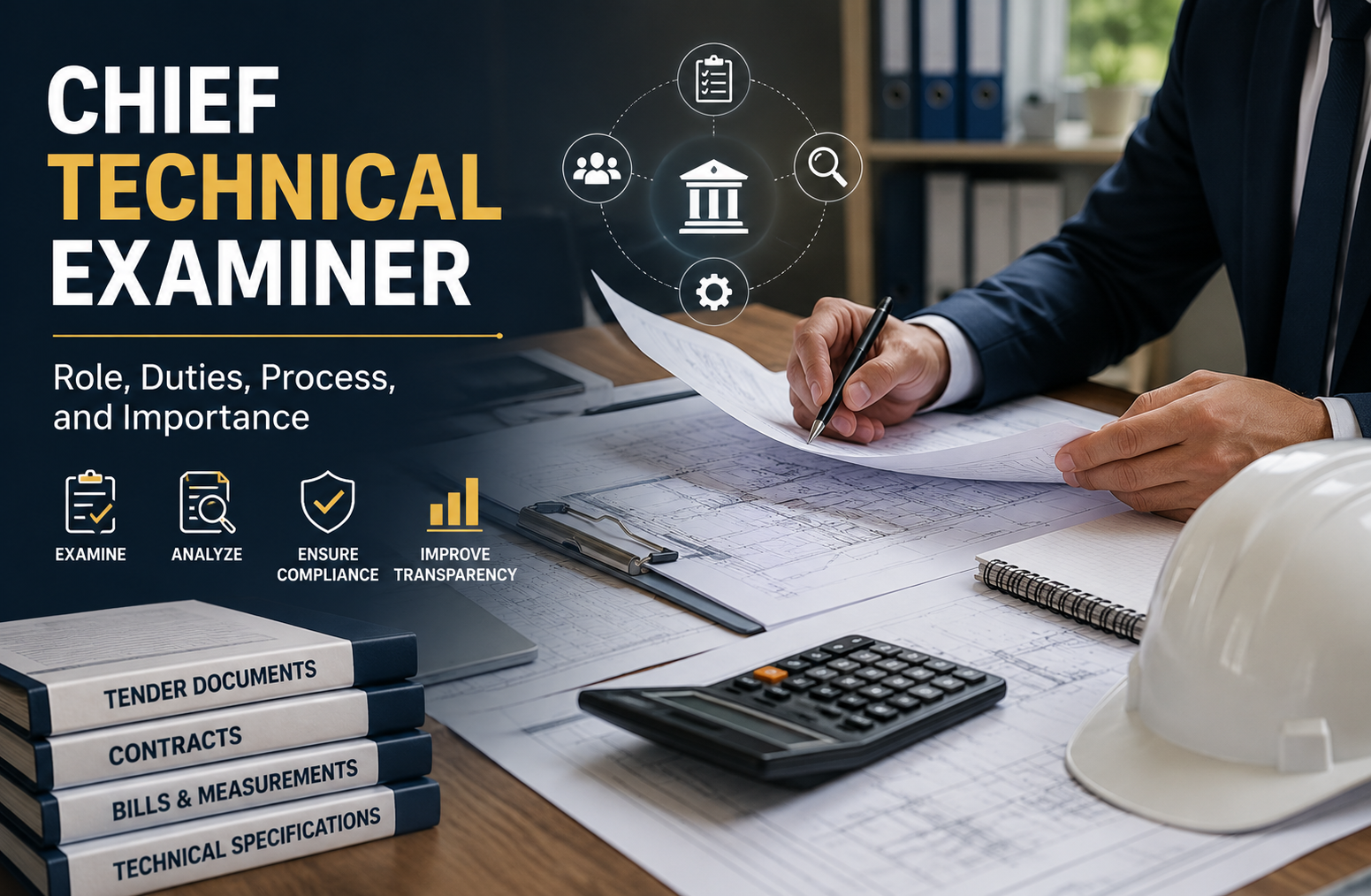
Chief Technical Examiner: Role, Duties, Process, and Importance
The chief technical examiner is a senior technical oversight role that sits at an important point between engineering expertise, procurement, contract administration, financial control, and public accountability. In India, the term has a particularly specific meaning because it is closely associated with the Chief Technical Examiners’ Organisation, or CTEO, under the Central Vigilance Commission.
For someone searching for the meaning of this position, the most useful distinction is this: a chief technical examiner does not simply inspect whether a project exists or whether construction has been completed. The examination can involve the entire chain of technical and contractual decisions, including planning, specifications, tendering, execution, measurements, quality, payments, variations, and compliance.
The role therefore matters wherever large amounts of public money are committed to technical work. A road, building, electrical installation, equipment purchase, IT procurement, consultancy contract, or service agreement can all contain technical and financial risks that are difficult to identify through ordinary administrative review alone.
This article explains what the position means, what the officer actually does, how technical examinations work, which skills are important, what the process can reveal, and why independent technical scrutiny remains valuable in modern public procurement.
What Is a Chief Technical Examiner?
A chief technical examiner is a senior technical official responsible for leading or overseeing detailed examination of selected procurement and technical activities.
The exact authority and duties can differ between organisations and jurisdictions. However, in the Indian central government context, the position is connected with the CTEO, the technical wing of the Central Vigilance Commission.
The CVC’s 2024 Annual Report states that the CTEO undertakes intensive examination of procurement involving works, goods, and services by organisations under its jurisdiction. It also describes the CTEO as comprising two Chief Technical Examiners at Chief Engineer level, supported by Technical Examiners, Assistant Technical Examiners, Junior Technical Examiners, and other staff.
That makes the role broader than conventional engineering inspection.
A technical examiner may need to understand:
- Engineering drawings and specifications
- Cost estimates and schedules
- Tender documents
- Contract conditions
- Bills and measurements
- Quality-control records
- Procurement procedures
- Payment records
- Contract variations
- Project delays
- Material testing
- Technical standards
- Financial implications of technical decisions
- Public procurement principles
The central idea is comparison.
The examiner compares what was approved, what was contracted, what was recorded, what was paid for, and what was actually delivered or executed.
That comparison can reveal weaknesses that are invisible when documents are reviewed separately.
Chief Technical Examiner in the Indian Government Context
The term has a particularly established meaning in India’s public-sector vigilance framework.
The Chief Technical Examiners’ Organisation was established in 1957 under the then Ministry of Works, Housing and Supply. Its original purpose was to introduce technical and administrative audit of Central Public Works Department works and improve economy and technical and financial control.
Following recommendations of the Santhanam Committee, its jurisdiction was expanded, and the organisation came under the administrative control of the Central Vigilance Commission in 1964.
Over time, the scope of technical examination expanded beyond conventional civil construction.
The modern examination framework can cover areas such as:
- Civil and horticultural works
- Electrical contracts
- Mechanical contracts
- Supply contracts
- IT procurement
- Consultancy services
- Transport contracts
- Goods procurement
- Service contracts
- Other centrally funded contractual activities
This evolution is important because government procurement has changed dramatically.
A technical examination today may involve a conventional construction bill, but it can also involve complex technology procurement, outsourced services, specialised equipment, or contracts where the most important evidence exists in digital records rather than on a physical construction site.
What Does a Chief Technical Examiner Actually Do?
The simplest description is that the officer examines whether technical and procurement activities have been carried out properly.
In practice, that means asking difficult questions.
Was the requirement properly defined?
Was the estimate reasonable?
Were the tender conditions appropriate?
Was competition handled fairly?
Did the selected bidder meet the stated requirements?
Was the work executed according to the contract?
Were quantities measured correctly?
Did the materials meet the specified quality?
- Were payments supported by actual work?
- Were variations properly justified?
- Were delays handled according to the contract?
- Were completion certificates supported by evidence?
These questions demonstrate why the position requires both technical knowledge and professional judgment.
Reviewing Technical Specifications
Specifications form the foundation of many procurement decisions.
A poorly written specification can create problems before a contractor or supplier even begins work.
An examiner may therefore look at whether specifications were:
- Clear
- Technically appropriate
- Consistent with the actual requirement
- Measurable
- Compatible with applicable standards
- Properly reflected in the tender
- Free from unnecessary restrictions
The important point is that a specification should describe what the organisation genuinely needs.
A technically complicated specification is not automatically a better specification. In some situations, unnecessary technical conditions can reduce competition or make procurement unnecessarily expensive.
Examining Cost Estimates
Cost estimation is another important area.
An estimate provides a financial expectation for the work or procurement. If the underlying quantities, rates, assumptions, or scope are weak, the tender process may begin with an unreliable financial foundation.
A technical examination can therefore consider:
- How quantities were calculated
- Which rates were used
- Whether rates were current and appropriate
- Whether the scope was complete
- Whether major items were omitted
- Whether unusual provisions were included
- Whether the estimate reflected actual site conditions
- Whether subsequent changes were foreseeable
The purpose is not simply to find that the final cost was higher than the estimate.
A higher final cost does not automatically mean that something went wrong. Changes can arise from genuine circumstances.
The more useful question is why the cost changed and whether the reason was technically and contractually justified.
Reviewing Tender Documents
Tender documents determine how potential suppliers or contractors understand the opportunity.
An examiner may assess whether tender conditions were clear, consistent, and appropriate for the procurement.
Potential warning signs can include:
- Contradictory clauses
- Ambiguous technical requirements
- Unclear eligibility conditions
- Inconsistent quantities
- Weak performance requirements
- Missing quality provisions
- Conditions that appear unnecessarily restrictive
A good examination looks at the procurement as a system rather than isolating one sentence from a large document.
Examination of Actual Work
Paperwork alone cannot always establish whether a project was properly executed.
For physical works, site examination can provide essential evidence.
The examiner may compare the physical work with:
- Approved drawings
- Contract specifications
- Measurement records
- Bills
- Test reports
- Completion documents
- Quality-control records
- Photographic evidence
- Site instructions
- Approved variations
This is where technical expertise becomes particularly valuable.
A project may look complete from a distance while still containing significant deviations from the approved requirements.
Conversely, a document may appear inconsistent even though a legitimate technical explanation exists.
Professional examination requires evidence rather than assumptions.
Checking Measurements and Payments
One of the most important functions of technical scrutiny is connecting physical work to financial records.
Consider a simple example.
Suppose a contract provides for a specified quantity of concrete. The records show that the contractor was paid for that quantity. An examiner can compare the payment documentation with measurement records and, where appropriate, the physical work.
The objective is not to assume that the payment was wrong.
The objective is to establish whether the payment is adequately supported.
This distinction is fundamental to responsible technical auditing.
Issues may arise from:
- Incorrect measurements
- Unsupported quantities
- Duplicate entries
- Incorrect rates
- Payments for incomplete work
- Work that does not meet the specification
- Unsupported variations
- Payments outside contractual provisions
Historical parliamentary material describing the functions of technical examination similarly identifies inspection of works, checking contracts, reviewing bills against measurement records, and checking quality and execution as important parts of the function.
Quality Control and Technical Compliance
Quality is not simply a visual judgment.
A technically competent examination may require review of test results, material records, specifications, laboratory reports, inspection records, and other evidence.
Depending on the type of project, this could involve questions about:
- Material strength
- Dimensions
- Installation requirements
- Equipment specifications
- Manufacturing standards
- Testing procedures
- Workmanship
- Functional performance
- Safety requirements
For example, a completed structure can appear satisfactory while still failing a specified technical requirement.
Likewise, a document saying that testing was completed does not by itself establish that the correct test was performed under appropriate conditions.
This is why evidence quality matters as much as document quantity.
Contract Variations and Deviations
Large technical projects rarely proceed exactly as originally planned.
Site conditions can change. Requirements can evolve. Design problems can emerge. Government priorities can shift.
The existence of a variation therefore does not automatically indicate an irregularity.
The important questions are:
- Why was the variation necessary?
- Was the reason documented?
- Was the change technically justified?
- Was the approval obtained from the appropriate authority?
- Was the financial effect properly assessed?
- Did the variation materially alter the original procurement?
- Was the change handled according to the contract?
This is one area where experienced technical judgment is particularly important.
A mechanical application of rules can miss genuine engineering realities. At the same time, accepting every explanation without evidence can weaken financial control.
A good examiner works between those two extremes.
Why the Role Is Important
The value of a chief technical examiner goes beyond finding individual mistakes.
The deeper purpose is to strengthen the system.
If an examination discovers that several projects repeatedly suffer from weak estimates, the lesson may not be limited to one project officer.
It could indicate a broader process problem.
Similarly, repeated findings involving incomplete quality records may point toward weak internal controls rather than one isolated oversight.
This makes technical examination valuable in at least five ways.
1. Protecting Public Resources
Public procurement involves substantial financial commitments.
Technical errors can translate into financial consequences through overpayment, defective work, inefficient specifications, unnecessary variations, or poor contract management.
Independent examination can help identify such weaknesses.
2. Improving Technical Quality
The cheapest procurement is not necessarily the most economical procurement.
A low initial price can become expensive if quality is poor, maintenance costs rise, or the asset fails prematurely.
Technical examination helps keep attention on value, not merely initial expenditure.
3. Strengthening Accountability
Clear technical records make it easier to determine who approved what, what was delivered, and why a particular decision was made.
That creates stronger accountability.
4. Identifying Systemic Weaknesses
A single irregularity can be important.
A repeated irregularity is often more important because it may reveal a process failure.
The best examinations therefore look for patterns.
5. Supporting Preventive Vigilance
Technical examination can help organisations improve their procedures before the same weakness appears in future contracts.
This preventive function is one of the most useful aspects of the framework.
What Recent Data Shows
The scale of the work helps explain why this function matters.
According to the Central Vigilance Commission’s 2024 Annual Report, the CTEO conducted 81 intensive examinations covering 64 organisations during 2024. The procurement cases examined had a combined value of more than ₹33,514.68 crore.
The report also states that CTEO observations contributed to recoveries of ₹116.75 crore by organisations from contractors, suppliers, and service providers.
In addition, the organisation provided advice in 137 vigilance and complaint cases during the year.
These figures illustrate an important point.
Technical examination is not a theoretical administrative exercise. Findings can have direct financial and operational consequences.
The same report also describes CTEO’s role in capacity building, including technical inputs and training related to procurement, estimation of rates, contracting, and other areas.
How a Technical Examination Typically Works
The exact procedure can vary depending on the organisation, contract, and applicable rules, but a useful general model looks like this.
Step 1: Selecting the Procurement or Project
Not every contract can receive the same level of intensive examination.
Organisations submit procurement information, and selected cases can be examined using relevant parameters.
The selection process helps focus limited technical resources on areas where examination can provide meaningful value.
Step 2: Reviewing the Records
The examination team studies available documentation.
This may include:
- Administrative approvals
- Technical sanctions
- Estimates
- Tender documents
- Bid information
- Comparative statements
- Agreements
- Drawings
- Measurement books
- Bills
- Test reports
- Payment records
- Completion certificates
The goal is to understand what the project was supposed to achieve.
Step 3: Understanding the Contract
The team then examines the contractual framework.
This is essential because a finding cannot be properly assessed without knowing what the parties actually agreed to.
The examiner may establish:
- Scope of work
- Contract price
- Completion period
- Quality requirements
- Measurement method
- Payment terms
- Variation provisions
- Penalty or liquidated-damages provisions
- Warranty obligations
Step 4: Physical or Technical Verification
Where relevant, the team examines the actual work, materials, equipment, or service.
This is where documentary claims can be compared with physical or operational reality.
Step 5: Comparing Evidence
The examination becomes more meaningful when different evidence sources are compared.
For example:
Contract quantity → Measurement record → Bill → Payment → Physical quantity
If these five points align, confidence increases.
If they do not align, the difference requires explanation.
Step 6: Recording Observations
Findings should be specific.
A useful technical observation should normally make clear:
- What requirement applied
- What evidence was reviewed
- What was actually observed
- What the difference was
- Why the difference matters
- What financial or technical implication exists
- What clarification or corrective action may be required
This is much stronger than simply writing that “irregularities were found.”
Step 7: Seeking Responses
The concerned organisation or responsible officials may be given an opportunity to respond.
This matters because technical examination should distinguish between a documented irregularity and a matter that initially appears unusual but has a legitimate explanation.
Step 8: Follow-Up
Where findings require action, the relevant authority may pursue correction, recovery, procedural improvement, investigation, or other action according to the applicable framework.
The CVC’s 2024 report notes that intensive examination reports are forwarded to the concerned Chief Vigilance Officer after approval, and cases involving perceived vigilance angles can be referred for detailed vigilance investigation.
Skills Required for the Role
A senior technical examiner needs more than engineering qualifications.
The role combines technical analysis with investigation, documentation, communication, and judgment.
Engineering Knowledge
A strong technical foundation remains essential.
The examiner must understand the type of work being reviewed well enough to identify meaningful deviations without confusing normal project variation with genuine technical failure.
Contract Knowledge
Engineering decisions frequently have contractual consequences.
Understanding contract clauses, scope, measurements, variations, payment provisions, and performance obligations is therefore extremely useful.
Procurement Awareness
Procurement is not merely purchasing.
The examiner should understand how requirements are translated into specifications, how competition works, how bids are evaluated, and how contractual commitments are established.
Financial Awareness
The officer does not necessarily function as a conventional financial auditor, but technical findings can have significant financial implications.
Being able to connect technical observations with quantities, rates, payments, and financial consequences is important.
Analytical Thinking
The strongest examiners do not stop at the first inconsistency.
They ask:
Why did this happen?
Then:
Does the explanation fit the evidence?
And finally:
Could the same weakness happen again elsewhere?
That last question is what transforms inspection into system improvement.
Communication
Technical findings often need to be understood by people who are not specialists in the same engineering field.
Reports therefore need to be precise without becoming unnecessarily complicated.
Common Challenges Faced by Technical Examiners
Technical examination is demanding because projects are rarely simple.
Incomplete Records
Missing records can make it difficult to reconstruct decisions.
A missing document is not automatically evidence of misconduct, but it can create an accountability gap.
Complex Contracts
Modern procurement can involve multiple contractors, subcontractors, consultants, technology vendors, and specialised suppliers.
Understanding responsibility becomes more difficult when several parties are involved.
Changing Technical Conditions
Construction and engineering projects can encounter unexpected conditions.
A fair examiner must distinguish legitimate adaptation from unjustified deviation.
Limited Physical Access
Some assets are difficult to inspect after completion.
For example, parts of a structure may become inaccessible after construction.
That makes contemporaneous inspection and reliable documentation particularly important.
Digital Procurement
Modern procurement creates large quantities of electronic records.
This improves traceability in many situations, but it also means technical reviewers increasingly need to understand digital procurement systems and data.
Balancing Independence and Practical Reality
A technical examiner must remain objective while understanding that real-world projects involve uncertainty.
Independence does not mean ignoring context.
It means allowing context to influence the analysis only when the evidence supports it.
Technical Examination Is Not the Same as Project Management
This distinction is often misunderstood.
A project manager is responsible for delivering the project.
A contractor is responsible for performing contractual obligations.
A consultant may be responsible for design, supervision, or specialist advice.
A quality-control team may perform routine testing and inspections.
A technical examiner has a different function.
The examiner independently reviews available evidence and assesses whether the technical and contractual requirements appear to have been followed.
That separation matters.
If the same person is responsible for delivering a project and independently certifying every aspect of its performance, there may be an inherent risk of reduced independence.
Independent examination provides another layer of scrutiny.
Technical Examiner vs Auditor
The two roles overlap, but they are not identical.
An auditor may focus heavily on financial records, controls, compliance, and financial reporting.
A technical examiner brings deeper technical scrutiny to engineering work, specifications, quantities, quality, execution, and technical procurement decisions.
In large infrastructure projects, these perspectives complement each other.
A payment may be financially recorded correctly but still relate to work that does not satisfy the technical specification.
Conversely, technically satisfactory work may still have a financial or contractual problem.
The strongest oversight systems therefore use different forms of review rather than expecting one examination to answer every question.
Real-World Applications
The principles behind technical examination can be applied across many project environments.
Roads and Highways
Examination may involve:
- Pavement specifications
- Quantities
- Material testing
- Earthwork measurements
- Drainage
- Contract variations
- Progress claims
- Quality records
Buildings
Review can cover:
- Structural specifications
- Reinforcement
- Concrete
- Finishes
- Electrical systems
- Plumbing
- Measurements
- Bills
- Completion records
Electrical and Mechanical Projects
The focus may shift toward:
- Equipment specifications
- Capacity
- Installation
- Testing
- Commissioning
- Warranty
- Maintenance requirements
- Energy performance
IT Procurement
Technical examination can become quite different.
Instead of inspecting concrete or physical quantities, the reviewer may need to understand:
- System requirements
- Software specifications
- Licences
- Service-level commitments
- Implementation milestones
- Security requirements
- User acceptance
- Deliverables
- Support obligations
This illustrates why the modern role requires adaptability.
What Organisations Can Learn From Technical Examination
One of the most valuable outputs of an examination may not be a recovery or a disciplinary case.
It may be a better procedure.
Suppose several projects repeatedly show weak estimates.
The long-term solution is not simply to criticise individual estimates. The organisation might need:
- Better estimating guidance
- Standardised templates
- Stronger technical review
- Better historical cost data
- Improved training
- Independent checks for major estimates
Likewise, repeated problems with completion certificates may suggest the need for stronger verification procedures.
This is the difference between correcting an incident and improving a system.
How Technology Is Changing Technical Examination
Technology is changing both procurement and examination.
Digital records can make it easier to trace decisions, approvals, payments, and communications.
Other technologies can support technical verification, including:
- Digital measurement systems
- Geographic information systems
- Building Information Modeling
- Digital photographs
- Drones
- Electronic procurement platforms
- Data analytics
- Automated document comparison
However, technology should support professional judgment rather than replace it.
A data system can identify an unusual payment pattern.
It cannot automatically determine whether the underlying engineering explanation is legitimate.
Similarly, a drone can capture visual evidence, but an engineer still needs to understand whether what is visible satisfies the relevant technical specification.
The future of technical examination is therefore likely to involve a combination of engineering expertise, procurement knowledge, digital evidence, and analytical tools.
How to Prepare for a Technical Examination
Organisations responsible for public procurement can reduce problems by preparing records continuously rather than waiting for an examination.
A practical internal checklist includes:
Before Procurement
- Define the requirement clearly
- Prepare a defensible estimate
- Use appropriate technical specifications
- Confirm approvals
- Review tender conditions
- Maintain a clear procurement trail
During Contract Execution
- Record measurements accurately
- Maintain quality documentation
- Document site instructions
- Record reasons for variations
- Track milestones
- Verify deliverables before payment
- Preserve supporting evidence
Before Completion
- Confirm that contractual requirements have been met
- Verify quantities
- Review testing records
- Confirm outstanding defects
- Check completion documentation
- Ensure payment records are consistent with actual performance
After Completion
- Preserve records
- Track warranties
- Document defects and corrections
- Review lessons learned
- Improve procedures where recurring weaknesses are identified
This approach turns technical examination from a defensive exercise into a continuous quality-control process.
What Makes a Strong Technical Examination Report?
A strong report should allow an independent reader to understand the issue without needing to reconstruct the entire investigation.
Good reports generally have several characteristics.
They Are Evidence-Based
Every significant observation should have supporting evidence.
They Are Specific
“Work quality was poor” is weak.
A stronger observation identifies the applicable requirement, the observed condition, the evidence, and the specific deviation.
They Separate Facts From Conclusions
The report should make it clear which information was directly observed and which conclusion was reached from that evidence.
They Explain Consequences
Where possible, the report should explain the technical, financial, contractual, or operational significance of an observation.
They Avoid Unnecessary Assumptions
A technical examiner should not automatically attribute intent to an error.
The evidence should establish what happened before broader conclusions are drawn.
They Identify System Improvements
Where the evidence indicates a recurring weakness, the report should help the organisation understand how to reduce the chance of recurrence.
Career Perspective: Is This a Purely Engineering Role?
No.
Engineering knowledge is central, but the work sits at the intersection of several disciplines.
A professional interested in this area should consider developing knowledge in:
- Engineering
- Public procurement
- Contract administration
- Cost estimation
- Quality assurance
- Technical auditing
- Government procedures
- Financial controls
- Documentation
- Investigation methods
- Data analysis
The most valuable professional skill is often not knowing every technical detail personally.
It is knowing which question needs to be asked, what evidence can answer it, and how much confidence that evidence deserves.
That is a transferable skill across almost every form of technical oversight.
The Difference Between Finding Fault and Finding Risk
This is one of the most important concepts in technical examination.
- Not every deviation is corruption.
- Not every mistake causes financial loss.
- Not every cost increase is improper.
And not every technically acceptable outcome means the procurement process was well designed.
A mature examination therefore considers several dimensions at once:
Compliance: Was the rule or contract followed?
Technical quality: Was the work technically satisfactory?
Financial impact: Did the issue affect public expenditure?
Process integrity: Was the procurement decision properly supported?
Risk: Could the weakness create a larger problem in future?
System improvement: What can be changed to reduce recurrence?
This broader approach produces more useful oversight than simply counting irregularities.
Why Independence Matters
Technical findings can have serious consequences.
They may influence recovery decisions, administrative action, vigilance proceedings, contract decisions, or changes to organisational procedures.
That is why independence is important.
The examiner should be able to report an uncomfortable technical fact even when the finding concerns a large project, an influential contractor, or an established internal process.
Independence does not mean hostility toward the project team.
In fact, the most useful technical examination is objective enough to recognise both problems and legitimate explanations.
A Practical Example
Imagine a government organisation awards a contract for construction of a large facility.
The original estimate is based on a defined quantity of structural material.
During execution, the contractor submits additional quantities.
The project team approves the variation.
Payment is subsequently made.
At first glance, there may be nothing obviously wrong.
A technical examination could reconstruct the sequence:
- What quantity was in the original estimate?
- What quantity appeared in the tender?
- What quantity was included in the contract?
- Why did the required quantity increase?
- Was the variation supported by an approved drawing?
- Was the variation authorised?
- Were measurements accurate?
- Was the additional material actually incorporated?
- Was the applicable rate correct?
- Did the change affect the fundamental nature of the procurement?
The examiner is not starting with the assumption that the variation was improper.
The examiner is testing whether the evidence supports it.
That mindset is central to credible technical oversight.
The Future of the Chief Technical Examiner Role
The role is likely to become more data-driven without becoming less dependent on human expertise.
Public procurement is increasingly digital.
Projects generate large quantities of information through electronic tendering, contract-management platforms, financial systems, digital drawings, inspection records, and other sources.
This creates opportunities for earlier risk detection.
For example, analytical tools may help identify:
- Unusual price variations
- Repeated contract extensions
- Concentrated supplier activity
- Large changes between estimated and awarded values
- Repeated variations
- Delayed milestones
- Unusual payment patterns
- Inconsistent records
But these indicators are only starting points.
An unusual pattern is a reason to investigate, not proof of wrongdoing.
The future technical examiner will therefore need to combine traditional engineering judgment with increasingly sophisticated information analysis.
Frequently Asked Questions
What is a chief technical examiner?
A chief technical examiner is a senior technical official who oversees or conducts detailed examination of selected technical and procurement activities. In India’s central vigilance framework, the role is associated with the CTEO under the Central Vigilance Commission.
What does a chief technical examiner check?
The examination can include technical specifications, estimates, tender documents, contracts, measurements, quality, quantities, payments, variations, completion records, and compliance with applicable requirements.
Is a chief technical examiner only involved in construction?
No. In the Indian CTEO context, technical examination extends beyond civil works to areas including goods, services, electrical and mechanical contracts, IT procurement, consultancy, and transport contracts.
Why is technical examination important?
It can identify technical deficiencies, unsupported payments, contract weaknesses, procurement problems, quality issues, and systemic weaknesses. It can also support improvements in procurement and contract-management practices.
Does every technical deviation mean corruption?
No. A deviation may have a legitimate technical or contractual explanation. A proper examination should establish the facts and evidence before drawing conclusions about responsibility or intent.
How is a technical examiner different from a project engineer?
A project engineer generally has responsibilities connected with planning, supervision, execution, or delivery of the project. A technical examiner performs an independent examination of selected work or procurement activity and evaluates it against relevant evidence and requirements.
Conclusion
The chief technical examiner represents an important form of independent technical oversight, particularly within India’s public procurement and vigilance framework.
The role is much broader than checking whether construction has been completed. It can involve examining estimates, specifications, tenders, contracts, measurements, quality records, payments, variations, and actual performance.
Its greatest value is not simply identifying individual errors.
A well-conducted technical examination can show where a procurement process is vulnerable, where contract administration needs improvement, where quality controls are weak, and where organisational procedures should change.
Recent CVC data demonstrates the practical scale of this work. During 2024, the CTEO conducted 81 intensive examinations across 64 organisations involving procurement cases valued at more than ₹33,514.68 crore, while organisations reported ₹116.75 crore in recoveries linked to examination observations.
For professionals, contractors, engineers, procurement officials, and anyone studying public-sector accountability, the central lesson is straightforward: technical oversight works best when decisions are supported by clear specifications, reliable measurements, complete records, sound contract administration, and independent professional judgment.






5 Comments