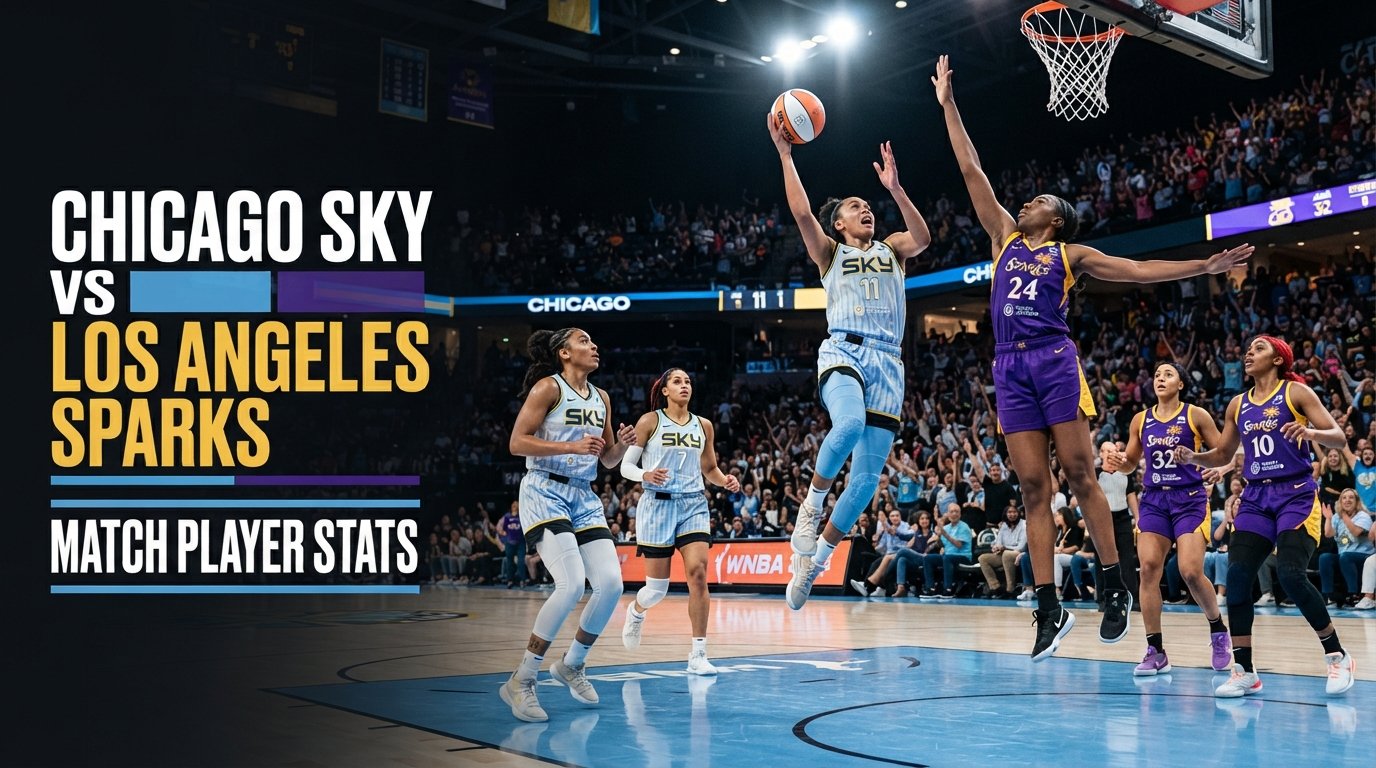
Chicago Sky vs Los Angeles Sparks Match Player Stats
The chicago sky vs los angeles sparks match player stats reveal how the Los Angeles Sparks secured an impressive 102-87 victory over the Chicago Sky in their WNBA regular-season meeting on July 11, 2026. The contest at Crypto.com Arena featured excellent individual performances, efficient perimeter shooting, and a decisive fourth-quarter display from Los Angeles. Nneka Ogwumike led the Sparks with 25 points, 12 rebounds, and 5 assists, while Dearica Hamby, Ariel Atkins, Rae Burrell, and Erica Wheeler provided valuable scoring support. Chicago received strong contributions from Kamilla Cardoso, Gabriela Jaquez, and Sydney Taylor, but its struggles from three-point range made it difficult to keep pace with the home team.
The final score did not tell the entire story. Chicago started confidently and finished the opening quarter with a one-point advantage. However, Los Angeles gradually improved its offensive execution, moved the ball more effectively, and created better shooting opportunities. The Sparks eventually took control in the fourth quarter, outscoring Chicago 29-17 to establish a comfortable winning margin.
This breakdown examines the final score, individual player contributions, team statistics, shooting efficiency, important game sequences, and tactical differences that influenced the result.
Game information note: The matchup was played on Friday, July 10, in Los Angeles local time. The official game listing also displays July 11 in some date and time references. The analysis below follows the July 11 date commonly associated with the published game recap.
Chicago Sky vs Los Angeles Sparks Match Player Stats: Final Score and Game Overview
WNBA regular season | July 11, 2026 | Crypto.com Arena, Los Angeles
Chicago Sky Scores, Stats and Highlights – ESPN
Chicago Sky
87
Defeated
Los Angeles Sparks 2026 Roster | StatMuse
Los Angeles Sparks
102
Winners
Winning margin
15 points
Attendance
11,827
Venue
Crypto.com Arena
Leading scorer
Nneka Ogwumike (25)
The Sparks finished with 102 points, their offense producing consistent results throughout the second half. Chicago reached 87 points but could not match Los Angeles in shooting accuracy or passing efficiency.
Quarter-by-Quarter Score
| Quarter | Chicago Sky | LA Sparks |
| First | 29 | 28 |
| Second | 19 | 25 |
| Third | 22 | 20 |
| Fourth | 17 | 29 |
| Final | 87 | 102 |
The scoring progression explains how the game developed.
- First quarter: Chicago established an early offensive rhythm and finished the period ahead 29-28.
- Second quarter: Los Angeles responded with 25 points, taking a five-point halftime advantage.
- Third quarter: Chicago scored 22 points and reduced some of the pressure, but Los Angeles maintained its overall lead.
- Fourth quarter: The Sparks delivered their strongest offensive performance, scoring 29 points while limiting Chicago to 17.
The final period was the most important statistical difference between the teams. Los Angeles created separation through improved shot selection, additional scoring contributions, and stronger defensive pressure.
Los Angeles Sparks Player Stats and Individual Performances
Los Angeles won because several players contributed rather than relying entirely on one offensive option. Five Sparks players reached double figures, creating multiple scoring threats for Chicago’s defense.
Nneka Ogwumike: The Leading Performer
New York Liberty v Los Angeles Sparks
Nneka Ogwumike
Game’s leading scorer
25 PTS
12 REB | 5 AST | 1 STL | 1 BLK
Nneka Ogwumike delivered the most complete individual performance of the contest. She finished with 25 points, 12 rebounds, and five assists, recording a double-double that highlighted her importance to the Sparks’ offensive structure.
Her shooting numbers were equally impressive:
- Field goals: 9-of-16
- Three-pointers: 3-of-7
- Points: 25
- Rebounds: 12
- Assists: 5
- Steals: 1
- Blocks: 1
Ogwumike’s 56.3% field-goal accuracy helped Los Angeles maintain offensive efficiency. Her ability to score from inside and outside the paint also made defensive assignments more complicated for Chicago.
She was particularly valuable during the decisive fourth quarter. Her three-pointer helped Los Angeles establish a 90-80 advantage, creating a meaningful separation when Chicago was attempting to remain competitive.
Another important achievement came when Ogwumike reached 3,000 career field goals early in the fourth quarter. That milestone added historical significance to an already outstanding performance.
Her contribution was not limited to scoring. Twelve rebounds helped Los Angeles secure important possessions, while five assists demonstrated her ability to involve teammates.
Dearica Hamby: Consistent Scoring and Defensive Pressure
Phoenix Mercury v Los Angeles Sparks
Dearica Hamby
17 PTS
7 REB | 3 AST | 3 STL
Dearica Hamby was another important part of Los Angeles’ offensive success. She scored 17 points while collecting seven rebounds, three assists, and three steals.
Her shooting performance included:
- Field goals: 7-of-13
- Field-goal percentage: 53.8%
- Points: 17
- Rebounds: 7
- Assists: 3
- Steals: 3
Hamby’s ability to attack the basket gave the Sparks another dependable scoring option. Her contributions were especially valuable when Chicago attempted to concentrate defensive attention on Ogwumike.
Her defensive activity also deserves attention. Three steals demonstrated her ability to disrupt Chicago’s offensive possessions.
A particularly important moment came late in the fourth quarter. Hamby scored a reverse layup to give Los Angeles a 97-87 lead with 1:36 remaining. She then blocked Courtney Vandersloot’s shot on the opposite end.
That sequence demonstrated how Hamby influenced both ends of the floor during the closing minutes.
Erica Wheeler: Excellent Playmaking
Chicago Sky v Los Angeles Sparks
Erica Wheeler
15 PTS
8 AST | 2 REB | 3 STL
Erica Wheeler provided one of the most valuable backcourt performances for Los Angeles. She scored 15 points and recorded eight assists, helping the Sparks maintain offensive movement throughout the contest.
Her shooting statistics included:
- Field goals: 6-of-10
- Three-pointers: 3-of-6
- Points: 15
- Assists: 8
- Rebounds: 2
- Steals: 3
Wheeler’s eight assists were especially important because they reflected Los Angeles’ ability to generate opportunities through teamwork.
The Sparks finished with 32 assists, compared with Chicago’s 21. Wheeler played a significant role in that difference.
Her three steals also helped the team create additional offensive opportunities. Combining scoring, passing, and defensive pressure made her one of the most influential guards in the matchup.
Ariel Atkins: A Reliable Scoring Contribution
Chicago Sky v Los Angeles Sparks
Ariel Atkins
17 PTS
6 AST | 3 STL | 3 REB
Ariel Atkins contributed 17 points, six assists, and three steals. Her offensive production gave Los Angeles another player capable of taking advantage of defensive openings.
Atkins made seven of her 13 field-goal attempts, finishing with a 53.8% shooting percentage.
Her performance was important for two reasons.
First, she prevented Chicago from focusing exclusively on Ogwumike and Hamby. Second, her six assists helped maintain the passing rhythm that made the Sparks difficult to defend.
Atkins also contributed defensively, recording three steals. Her balanced performance supported the team’s overall approach.
Rae Burrell: Perimeter Shooting Impact
Los Angeles Sparks v New York Liberty
Rae Burrell
17 PTS
4 AST | 1 REB | 2 BLK
Rae Burrell supplied another important scoring performance with 17 points and four assists.
Her most notable contribution came from outside the three-point line.
- Field goals: 6-of-13
- Three-pointers: 4-of-6
- Points: 17
- Assists: 4
- Rebounds: 1
- Blocks: 2
Burrell converted 66.7% of her three-point attempts. That efficiency helped Los Angeles stretch Chicago’s defensive coverage.
Her four successful three-pointers were especially valuable because Chicago struggled to produce similar results from long range.
Burrell also contributed two blocked shots, showing that her influence extended beyond perimeter shooting.
Los Angeles Sparks Bench Contributions
The Sparks received additional production from their bench, helping the starting lineup maintain its offensive momentum.
| Player | Points | Rebounds | Assists |
| Emma Cannon | 9 | 4 | Not specified |
| Kate Martin | 2 | 2 | 1 |
| Kiana Williams | 0 | Not specified | 5 |
| Jihyun Park | 0 | Not specified | Not specified |
| Alissa Pili | 0 | Not specified | Not specified |
| Chance Gray | 0 | Not specified | Not specified |
Emma Cannon provided nine points and four rebounds, making her a useful scoring option outside the starting lineup.
Kate Martin added two points, two rebounds, and one assist. Kiana Williams did not score but contributed five assists and one steal.
The important takeaway is that scoring was distributed across the Sparks roster. Los Angeles had multiple players capable of creating offense, while its leading performers continued to deliver efficient results.
Chicago Sky Player Stats and Individual Performances
Chicago had several productive individual performances despite losing by 15 points. The team reached 87 points and received contributions from its frontcourt players, guards, and bench.
However, individual scoring success did not translate into the same overall offensive efficiency as Los Angeles.
Kamilla Cardoso: Strong Frontcourt Performance
Kamilla Cardoso 2025 Season Recap
Kamilla Cardoso
15 PTS
8 REB | 2 AST | 1 BLK
Kamilla Cardoso was among Chicago’s most productive players. She finished with 15 points, eight rebounds, two assists, and one blocked shot.
Her shooting numbers were particularly efficient:
- Field goals: 6-of-9
- Field-goal percentage: 66.7%
- Points: 15
- Rebounds: 8
- Assists: 2
- Blocks: 1
Cardoso’s ability to convert opportunities around the basket helped Chicago remain competitive.
Her eight rebounds also demonstrated her importance in the paint. She provided interior scoring and rebounding support, although the team struggled to match Los Angeles’ overall shooting production.
Gabriela Jaquez: Valuable Scoring Support
Chicago Sky v Los Angeles Sparks
Gabriela Jaquez
15 PTS
5 REB
Gabriela Jaquez contributed 15 points and five rebounds. She converted six of her 12 field-goal attempts, producing a 50% shooting percentage.
Her scoring helped Chicago maintain offensive pressure, particularly when the team needed additional contributions beyond its primary options.
Jaquez’s performance was an encouraging part of the Sky’s offensive effort, but Chicago needed more consistent production across the entire lineup to overcome Los Angeles.
Sydney Taylor: Important Perimeter Scoring
Sydney Taylor
15 PTS
2 3PM | 2 AST
Sydney Taylor recorded 15 points and two assists. Her perimeter scoring offered Chicago another offensive option.
She made two three-pointers, but the team’s overall three-point percentage remained a significant problem.
Taylor’s contribution showed that Chicago had players capable of producing points. The bigger issue was maintaining that production consistently across different positions and game situations.
Azura Stevens: Rebounding and Interior Defense
Chicago Sky v Los Angeles Sparks
Azura Stevens
10 PTS
8 REB | 2 AST | 1 BLK
Azura Stevens finished with 10 points, eight rebounds, two assists, and one block.
She made four of seven field-goal attempts, demonstrating efficient shooting.
Stevens’ contribution was valuable because Chicago needed frontcourt players who could score while also competing for rebounds.
Her eight rebounds tied Cardoso’s total among the listed Chicago performers, giving the Sky a useful presence around the basket.
Natasha Cloud: Playmaking and Defensive Activity
Los Angeles Sparks v Chicago Sky
Natasha Cloud
9 PTS
7 AST | 2 REB | 2 STL
Natasha Cloud recorded nine points, seven assists, two rebounds, and two steals.
Her seven assists demonstrated her value as a playmaker. She helped create opportunities for teammates and contributed to Chicago’s offensive organization.
However, the Sparks’ defensive pressure and stronger overall ball movement helped them maintain an advantage.
Cloud’s performance illustrates an important distinction between individual playmaking and team offensive efficiency. A guard can create several scoring opportunities, but the team must convert enough of those opportunities to keep pace with its opponent.
Jacy Sheldon: Productive Bench Scoring
Jacy Sheldon
10 PTS
2 AST | 2 STL
Jacy Sheldon provided 10 points off the bench, along with two assists and two steals.
Her defensive activity was useful for Chicago, particularly when the team needed to generate momentum through stops.
The challenge was maintaining that energy throughout the game. Los Angeles continued finding scoring opportunities, eventually creating a substantial difference in the fourth quarter.
Courtney Vandersloot: Experience and Ball Distribution
Courtney Vandersloot finished with six points, three rebounds, and four assists.
Although her scoring output was relatively limited, her experience and passing ability remained important to Chicago’s backcourt.
Her four assists contributed to the team’s offensive organization. However, the Sparks’ pressure made it difficult for Chicago to maintain the same level of offensive rhythm.
Other Chicago Sky Contributions
| Player | Points | Other contributions |
| Aicha Coulibaly | 7 | 1 rebound |
| Elizabeth Williams | 0 | Appeared off the bench |
| Rachel Banham | 0 | Appeared off the bench |
These contributions completed the broader picture of Chicago’s offensive effort.
The Sky had several players reaching double figures, but the team struggled to combine individual scoring with efficient perimeter shooting and consistent possession management.
Complete Player Statistics Comparison
The following table highlights the principal individual performances recorded in the supplied game statistics.
| Los Angeles Sparks | PTS | REB | AST |
| Nneka Ogwumike | 25 | 12 | 5 |
| Dearica Hamby | 17 | 7 | 3 |
| Ariel Atkins | 17 | 3 | 6 |
| Rae Burrell | 17 | 1 | 4 |
| Erica Wheeler | 15 | 2 | 8 |
| Emma Cannon | 9 | 4 | – |
| Kate Martin | 2 | 2 | 1 |
| Kiana Williams | 0 | – | 5 |
| Chicago Sky | PTS | REB | AST |
| Kamilla Cardoso | 15 | 8 | 2 |
| Gabriela Jaquez | 15 | 5 | – |
| Sydney Taylor | 15 | – | 2 |
| Azura Stevens | 10 | 8 | 2 |
| Jacy Sheldon | 10 | – | 2 |
| Natasha Cloud | 9 | 2 | 7 |
| Aicha Coulibaly | 7 | 1 | – |
| Courtney Vandersloot | 6 | 3 | 4 |
A dash indicates that the corresponding statistic was not specified in the supplied player summary. It should not be interpreted as a confirmed zero.
Several important differences emerge from these numbers.
- Ogwumike was the clear individual scoring leader.
- Los Angeles had four players with 17 points or more.
- Wheeler recorded the highest assist total among the listed players.
- Cardoso and Stevens provided Chicago with strong rebounding contributions.
- Chicago received 15 points each from three different players.
- The Sparks had a more balanced combination of scoring, passing, and defensive activity.
Team Statistical Comparison: Where Los Angeles Had the Advantage
Individual performances explain part of the result, but team statistics provide a clearer picture of why Los Angeles won.
| Statistical category | Chicago Sky | LA Sparks |
| Total points | 87 | 102 |
| Field goals | 31/71 | 39/76 |
| Field-goal percentage | 44% | 51% |
| Three-pointers | 6/25 | 14/31 |
| Three-point percentage | 24% | 45% |
| Free throws | 19/22 | 10/15 |
| Free-throw percentage | 86% | 67% |
| Assists | 21 | 32 |
| Steals | 5 | 11 |
| Blocks | 3 | 4 |
| Offensive rebounds | 8 | 5 |
| Defensive rebounds | 28 | 27 |
| Personal fouls | 20 | 20 |
The comparison highlights five major areas that influenced the final result.
1. Better Field-Goal Efficiency
Los Angeles converted 39 of 76 field-goal attempts, producing a shooting percentage of approximately 51%.
Chicago made 31 of 71 attempts, finishing at approximately 44%.
This difference meant that the Sparks generated more points from their overall shooting opportunities.
The gap was not simply a result of taking more shots. Los Angeles converted a larger proportion of its attempts, demonstrating better offensive execution.
2. Three-Point Shooting Created Separation
The most noticeable difference appeared beyond the three-point line.
Los Angeles converted 14 of 31 attempts, while Chicago made just six of 25.
Three-point shooting comparison
Successful three-pointers in the July 2026 matchup.
The Sparks made eight more three-pointers than Chicago.
That difference represents 24 additional points from successful three-point shots alone. It was a major contributor to the final scoring gap.
Chicago’s 24% three-point accuracy also made it harder to punish Los Angeles for defensive rotations or collapsed interior coverage.
Los Angeles, meanwhile, received productive perimeter shooting from Burrell, Wheeler, Ogwumike, and other contributors.
3. Ball Movement Favored the Sparks
Los Angeles recorded 32 assists compared with Chicago’s 21.
Team assists
Recorded assists by each team.
The 11-assist difference is significant.
It suggests that Los Angeles generated more scoring opportunities through passing and coordinated offensive movement.
Wheeler’s eight assists and Atkins’ six assists were particularly important.
Chicago also had productive playmakers, including Cloud and Vandersloot, but its overall assist total remained lower.
4. Defensive Pressure Created Extra Opportunities
Los Angeles recorded 11 steals, compared with Chicago’s five.
The Sparks also committed fewer turnovers in the supplied game summary.
Steals can change the momentum of a basketball game because they prevent opponents from completing possessions and sometimes create opportunities for quick transition points.
The Sparks’ defensive activity helped them maintain pressure when Chicago attempted to build momentum.
5. Chicago Was More Effective at the Free-Throw Line
One statistical category favored Chicago.
The Sky made 19 of 22 free throws, compared with Los Angeles’ 10 of 15.
Chicago converted approximately 86% of its free throws, while the Sparks finished around 67%.
This demonstrates that the Sky were not inefficient in every area.
Their free-throw accuracy was strong, but it could not overcome the difference in field-goal and three-point shooting.
The broader lesson is that excellent performance in one category does not always compensate for weaknesses in several other areas.
Tactical Analysis: Why the Sparks Won the Game
The 102-87 result was influenced by more than shooting percentages. Los Angeles executed its offensive approach more consistently, created better opportunities through passing, and applied defensive pressure at important moments.
Los Angeles Used Multiple Scoring Options
One of the biggest advantages for Los Angeles was its balanced scoring attack.
Ogwumike led the team with 25 points, but Hamby, Atkins, and Burrell each contributed 17. Wheeler added another 15.
This distribution made it difficult for Chicago to concentrate its defensive attention on one player.
When a defense focuses heavily on the leading scorer, other offensive players can benefit from additional space. Los Angeles took advantage of that situation by creating opportunities for different players.
Chicago Struggled to Match the Perimeter Threat
Chicago’s biggest offensive weakness was its three-point shooting.
The Sky converted only six of 25 attempts from outside the arc. That 24% shooting percentage limited their ability to keep pace with Los Angeles.
In modern basketball, perimeter shooting can influence defensive positioning even when shots are not successful. However, Chicago did not convert enough attempts to consistently make the Sparks pay for defensive adjustments.
Los Angeles made 14 three-pointers, creating a substantial scoring advantage.
Ball Movement Improved Los Angeles’ Offensive Rhythm
The Sparks recorded 32 assists, demonstrating how effectively they involved multiple players.
Their passing created opportunities for:
- Open perimeter shots.
- Interior scoring opportunities.
- Better offensive spacing.
- More balanced shot distribution.
- Easier scoring opportunities against defensive rotations.
Chicago recorded 21 assists, which was a respectable contribution but still considerably below Los Angeles’ total.
The difference suggests that the Sparks were more successful at turning individual offensive opportunities into coordinated team possessions.
Defensive Pressure Changed the Momentum
Los Angeles recorded 11 steals, more than twice Chicago’s five.
That difference reflected the Sparks’ ability to disrupt offensive possessions and create additional opportunities.
The defensive performance became especially important in the fourth quarter, when Chicago needed to generate consistent scoring to stay within reach.
Los Angeles maintained pressure and prevented the Sky from building a successful late comeback.
Fourth-Quarter Breakdown: The Turning Point
The fourth quarter was the defining period of the matchup.
Chicago entered the final period still within reach, but Los Angeles produced a 29-17 scoring advantage.
Fourth-quarter scoring
The Sparks outscored Chicago by 12 points in the final period.
The 12-point difference in the final period explains much of the final margin.
Several elements contributed to the result.
Ogwumike’s scoring continued to matter. Her three-pointer helped Los Angeles establish a 90-80 advantage.
Hamby delivered an important late basket. Her reverse layup created a 97-87 lead with 1:36 remaining.
Hamby followed with a defensive play. She blocked Vandersloot’s shot, helping prevent Chicago from reducing the deficit.
Los Angeles maintained offensive balance. Rather than relying on a single scorer, the Sparks continued receiving contributions from different players.
The final quarter showed how important execution becomes when a game enters its closing stages. Chicago needed a strong offensive response, but Los Angeles controlled the period on both ends of the floor.
What the Game Revealed About Both Teams
The matchup offered several useful observations about the strengths and weaknesses displayed by each side.
What Worked for the Los Angeles Sparks?
The Sparks demonstrated five major strengths.
- Balanced scoring: Five starters reached double figures, reducing dependence on one offensive player.
- Efficient shooting: Los Angeles converted 51% of its field-goal attempts.
- Perimeter production: Fourteen successful three-pointers created a substantial scoring advantage.
- Effective passing: Thirty-two assists demonstrated strong offensive coordination.
- Defensive activity: Eleven steals helped disrupt Chicago’s offensive rhythm.
The combination of these factors made Los Angeles difficult to contain.
What Chicago Could Have Improved
Chicago also showed positive signs, but several areas needed improvement.
- Three-point accuracy: Converting six of 25 attempts was not enough against an opponent shooting 45% from outside.
- Defensive rotations: Los Angeles found opportunities to generate open shots and move the ball effectively.
- Possession management: Chicago needed to limit the opportunities created by defensive mistakes.
- Fourth-quarter execution: The 17-point final period was insufficient to respond to Los Angeles’ 29 points.
- Offensive consistency: Chicago needed to maintain its scoring rhythm beyond individual performances.
These observations do not diminish the efforts of Chicago’s leading players. Cardoso, Jaquez, Taylor, and Stevens all contributed meaningful production.
The main issue was the team’s inability to combine those contributions into a sufficiently efficient overall performance.
The Importance of Individual Player Statistics in WNBA Analysis
Understanding basketball statistics requires more than looking at the final point totals.
Different statistical categories reveal different aspects of a player’s contribution.
Points: Measuring Scoring Production
Points are the most visible measure of offensive production.
Ogwumike’s 25 points made her the leading scorer in this matchup. However, points alone do not explain how efficiently a player performed.
A player scoring 15 points on six successful field goals may have a different impact from someone requiring considerably more attempts to reach the same total.
Rebounds: Understanding Possession Control
Rebounds measure a player’s ability to recover the basketball after a missed shot.
There are two major categories:
- Offensive rebounds create additional scoring opportunities.
- Defensive rebounds help end the opponent’s possession.
Cardoso and Stevens each collected eight rebounds, demonstrating their importance to Chicago’s interior play.
Ogwumike’s 12 rebounds were another major contribution for Los Angeles.
Assists: Evaluating Playmaking
Assists measure passes that directly lead to successful field goals.
Wheeler’s eight assists were particularly valuable because they helped Los Angeles generate scoring opportunities through teamwork.
Cloud also made an important contribution with seven assists for Chicago.
A high assist total can indicate effective passing, but it should always be considered alongside shooting accuracy and overall offensive performance.
Steals: Measuring Defensive Disruption
Steals provide an indication of a player’s ability to disrupt the opposition’s possession.
Hamby, Wheeler, and Atkins each recorded three steals for Los Angeles.
These contributions helped the Sparks create additional defensive pressure.
Shooting Percentages: Measuring Efficiency
Shooting percentages help explain how successfully players convert their attempts.
The most useful categories include:
- Field-goal percentage.
- Three-point percentage.
- Free-throw percentage.
These statistics should be considered together because different players have different offensive responsibilities.
A perimeter shooter may be judged more heavily on three-point efficiency, while a center’s contribution may depend more on interior scoring and rebounding.
How to Read the Official Match Box Score
Readers looking for reliable basketball information should use the official game record rather than depending entirely on headlines or short recaps.
The official WNBA game page and box score provides access to the matchup’s game information and statistical sections.
When reviewing a box score, pay attention to these details:
- Confirm the final score and date.
- Check each player’s points, rebounds, and assists.
- Review field-goal attempts and successful shots.
- Compare three-point shooting between the teams.
- Examine turnovers and steals.
- Review quarter-by-quarter scoring.
- Consider minutes played when evaluating individual production.
Minutes played are particularly important when comparing players. Someone producing 15 points in limited playing time may have a different statistical profile from a player requiring considerably more minutes.
Another useful practice is separating confirmed statistics from interpretation.
For example, Los Angeles’ 14 successful three-pointers are a measurable fact. Saying that perimeter shooting helped create offensive spacing is an analytical interpretation.
Keeping those two things separate makes basketball analysis more transparent and trustworthy.
Frequently Asked Questions (FAQs)
1. Who won the Chicago Sky vs Los Angeles Sparks game in July 2026?
The Los Angeles Sparks defeated the Chicago Sky 102-87 on July 10, 2026, in Los Angeles. The Sparks secured the 15-point victory through efficient shooting and a dominant fourth-quarter performance.
2. Who was the leading scorer in the matchup?
Nneka Ogwumike was the leading scorer with 25 points. She also recorded 12 rebounds and five assists, finishing with a double-double.
3. How many points did Kamilla Cardoso score against the Sparks?
Kamilla Cardoso scored 15 points for Chicago. She also collected eight rebounds, two assists, and one block while making six of nine field-goal attempts.
4. Which team made more three-pointers?
The Los Angeles Sparks made more three-pointers. They converted 14 of 31 attempts, while Chicago made six of 25 attempts.
5. How many assists did the Sparks record?
Los Angeles recorded 32 assists, compared with Chicago’s 21. Erica Wheeler led the Sparks with eight assists, while Natasha Cloud recorded seven for Chicago.
6. What was the biggest difference between the two teams?
Three-point shooting was one of the biggest differences. Los Angeles converted 45% of its three-point attempts, while Chicago managed 24%. The Sparks also recorded more assists and steals.
Conclusion
The Chicago Sky and Los Angeles Sparks matchup on July 11, 2026, demonstrated the importance of shooting efficiency, balanced scoring, and effective team coordination in professional basketball.
Los Angeles earned its 102-87 victory by combining excellent perimeter shooting with strong individual performances. Nneka Ogwumike led the way with 25 points, 12 rebounds, and five assists, while Dearica Hamby, Ariel Atkins, Rae Burrell, and Erica Wheeler provided additional offensive production.
Chicago also had several impressive individual performances. Kamilla Cardoso, Gabriela Jaquez, and Sydney Taylor each scored 15 points, while Azura Stevens and Jacy Sheldon added 10 points apiece. However, the Sky struggled to match the Sparks’ three-point shooting and overall offensive efficiency.
The fourth quarter ultimately determined the outcome. Los Angeles scored 29 points compared with Chicago’s 17, turning a competitive contest into a comfortable 15-point victory.
The most important statistical lessons from this matchup were:
- Los Angeles demonstrated superior field-goal efficiency.
- The Sparks made eight more three-pointers than Chicago.
- Better ball movement helped Los Angeles record 32 assists.
- Nneka Ogwumike delivered the game’s most complete individual performance.
- Chicago’s free-throw accuracy was strong, but its perimeter shooting remained a weakness.
- The fourth-quarter scoring difference played a decisive role in the final result.
Overall, the game provided a clear example of how individual talent becomes more effective when supported by efficient shooting, coordinated passing, and consistent defensive execution.