Texas Challenge Coins: A Practical Guide to Meaningful Designs for Teams, Ceremonies, and Events
Key Takeaways
- Define the coin’s purpose and main message before designing it.
- Use Texas landmarks, traditions, or symbols that have meaning for the recipients.
- Keep the front focused and use the back for supporting details.
- Choose materials, finishes, colors, and detail levels based on the coin’s purpose and budget.
- Avoid excessive text, weak contrast, and overly complicated imagery.
- Check names, dates, logos, colors, and proportions carefully before production.
- Let intended recipients or trusted stakeholders review the design proof.
- Plan the coin around the event, ceremony, or recognition moment where it will be presented.
- Meaning comes from the story and shared experience behind the coin, not just its appearance.
In Texas, a challenge coin can carry more than a logo. It can honor a retirement after decades of service, celebrate a championship season, thank disaster-relief volunteers, or mark the opening of a new local program. Thoughtful custom challenge coins give Texas teams and communities a tangible way to recognize the people and moments that helped shape their shared story. From the Panhandle to the Gulf Coast, Texas organizations often have strong local identities to draw from. A well-designed coin can reflect a hometown landmark, a ranching tradition, a public-safety mission, a school mascot, or the values that hold a group together. The goal is not to add every possible detail. It is to make each detail feel intentional.
Why Challenge Coins Still Matter
Digital certificates and public announcements have their place, but a coin has physical presence. It can be held, displayed, passed down, or carried as a reminder of a meaningful experience. For a Texas fire department, nonprofit, business team, club, school, or veterans organization, that small keepsake can recognize commitment without requiring an oversized or impersonal gift. Coins are especially effective when the presentation matters as much as the object. Giving one after a difficult project, at an awards banquet, or during a retirement ceremony turns the moment into a memory. The best result comes from connecting the design to the people receiving it.
A Brief History of the Tradition
Challenge coins are closely associated with military culture, although their precise origin is not settled. The history of challenge coins includes several competing accounts, rather than a single definitive story. Over time, coins became a way to reinforce unit identity, recognize service, and mark shared experiences. Today, that tradition reaches far beyond military settings. Texas groups use commemorative coins for anniversaries, promotions, volunteer recognition, fundraising events, athletic milestones, first-responder appreciation, and leadership programs. The shared principle remains simple: a coin should represent belonging, achievement, or gratitude.
Define the Coin’s Purpose Before Designing It
Strong coin designs begin with a clear purpose. Before selecting metal finishes or colors, write a short brief that answers four questions:
- What event, achievement, or group is being honored?
- What feeling should the recipient have, such as pride, unity, gratitude, or remembrance?
- Who will receive the coin, and how will it be presented?
- What is the one message the design must communicate?
This exercise prevents a familiar problem: trying to fit an entire organization’s history onto a small piece of metal. A coin becomes clearer when it has one central idea.
Choose Symbols That Tell a Story
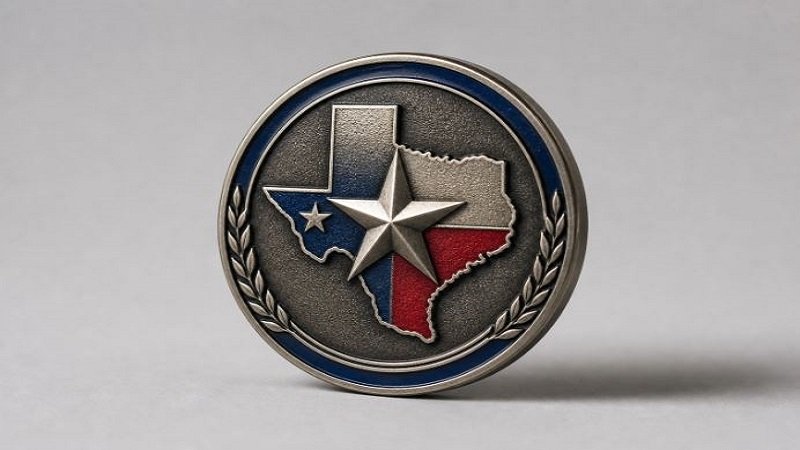
Texas offers a wide visual vocabulary, but the most meaningful symbols are specific to the group. A local skyline, river, bridge, courthouse silhouette, ranch gate, oilfield tool, native landscape, compass, animal, motto, or founding date can all contribute to the story. Use symbols that recipients will recognize quickly and can explain easily. For example, a volunteer group serving communities along the coast might use a compass to represent direction, a bridge to represent connection, and restrained blue enamel to suggest water. A West Texas organization might instead choose an open horizon, a windmill, or a familiar local landmark. Generic icons are less memorable when a real place or shared tradition can do the work.
Plan the Front, Back, and Edge
Front Design
The front should carry the primary emblem, figure, or message. Make the central image bold enough to remain recognizable at coin size. If a design only works when enlarged on a computer screen, simplify it before production.
Back Design
Use the reverse to provide supporting context: a date, recipient group, anniversary years, a short mission statement, or location. A quieter reverse often complements a detailed front better than repeating the same artwork.
Edge Design
Raised rims, textured borders, edge lettering, or sequential numbering can add dimension. However, edge details should support the design, not compete with it. Prioritize readability over adding extra features.
Compare Materials, Finishes, and Detail
Material choices affect both appearance and practicality. Consider these options in relation to the coin’s purpose and budget:
- Flat versus raised detail: Flat areas suit clean graphics, while raised or sculpted detail adds depth to emblems, landmarks, and figures.
- Polished finishes: These create a bright, formal appearance that can suit ceremonial recognition.
- Antique or brushed finishes: These can make recessed lines and texture easier to see, especially on detailed artwork.
- Enamel color: Color can separate important shapes, but too many colors may make a small design feel crowded.
- Engraving and recessed sections: These can add names, dates, or contrast without overwhelming the main image.
More detail can increase cost, weight, production time, and the risk of tiny elements becoming unclear. Choose the level of detail that the finished coin can carry well.
Avoid Common Design Mistakes
- Too much text: Use only the words needed to identify the event, group, date, or message.
- Weak contrast: Important symbols and lettering need to stand apart from the background.
- Small lettering: Readability on a screen does not guarantee readability on metal.
- Mixed messages: Keep one clear theme instead of combining unrelated images.
- Unclear symbolism: Every major image should connect to the group’s real experience.
- No recipient review: Ask several likely recipients what they notice first in the proof.
Build a Simple Ordering Process
- Gather approved logos, photos, sketches, dates, and exact wording.
- Create a brief that identifies the audience, theme, quantity, size, budget, and deadline.
- Review the digital proof from a distance as well as up close.
- Check spelling, names, dates, colors, proportions, and symbols before approval.
- Have intended recipients or trusted stakeholders review the final concept.
- Plan presentation, storage, or display so the coin arrives as part of a complete recognition moment.
Ideas for Texas Teams, Events, and Milestones
- Team achievements: Recognize a major project, season, deployment, or shared operational goal.
- Service recognition: Thank mentors, volunteers, public-safety personnel, and community leaders.
- Anniversaries: Pair a founding year with imagery tied to the organization’s Texas roots.
- Retirements: Combine a career milestone with a personal symbol and a concise message of appreciation.
- Fundraising events: Offer supporters a keepsake that connects them to the mission.
- School and club programs: Use mascots, colors, traditions, and memorable achievements.
A Design Checklist
- Is the purpose immediately clear?
- Can the main image be understood at a glance?
- Does the wording fit comfortably within the available space?
- Are all names, dates, and logos correct?
- Do the colors and finishes create enough contrast?
- Would the design still look strong in a single-metal finish?
- Have likely recipients reviewed the proof?
- Does the schedule leave room for revisions before the event?
Common Questions
What Makes a Challenge Coin Meaningful?
Meaning usually comes from the story, timing, and relationship behind the coin, not from its size or cost. A simple design tied to a real Texas experience can be more powerful than an elaborate design with no clear connection.
Should a Coin Have the Same Design on Both Sides?
It can, particularly when a logo is the main focus. In many cases, a different reverse provides useful room for a date, message, or detail that gives the front design more context.
What Should Be Checked Before Production?
Verify every word, date, color, symbol, edge treatment, and proportion. Once the design is approved, careful proofreading is the easiest way to protect the meaning the coin is meant to carry.
Conclusion
A meaningful Texas challenge coin does more than display an emblem or recognizable design. It can capture a specific moment, honor a shared value, recognize an achievement, or represent a connection between people, organizations, and places. The most effective designs begin with a clear purpose so that the shape, colors, lettering, symbols, and other visual details work together rather than competing for attention. Choosing appropriate materials, finishes, dimensions, and edge details can also affect how the coin looks and feels when it is handled or displayed. Whether the coin is created for a military unit, organization, event, memorial, business, or personal milestone, the design should reflect the meaning behind the occasion. When purpose comes first, and every visual choice supports the story, the finished coin can become more than a commemorative item. It can serve as a tangible keepsake that recipients can carry, display, share, and keep as a lasting reminder of the people, experiences, and places behind it.