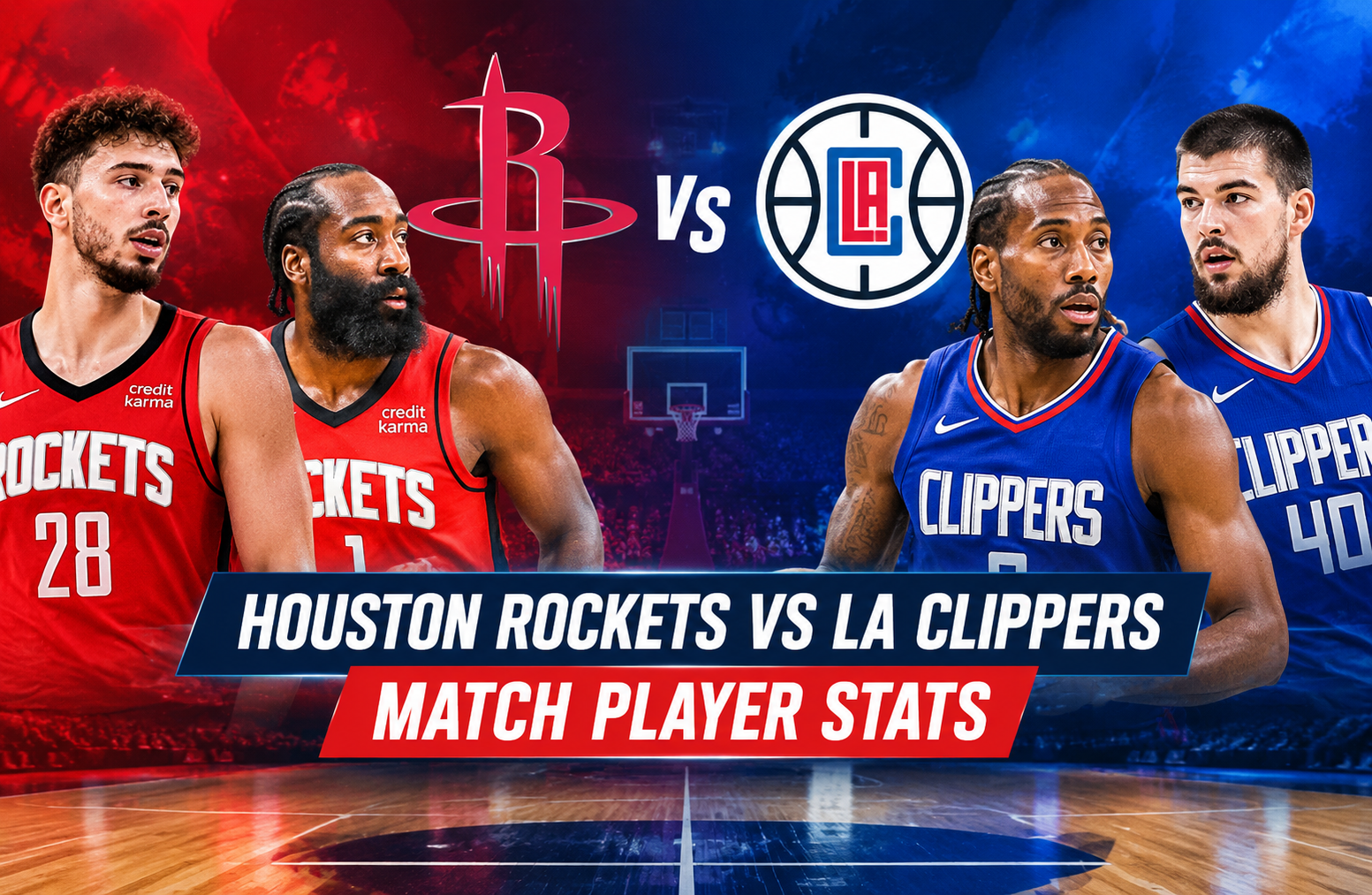
Houston Rockets vs LA Clippers Match Player Stats
The Houston Rockets vs LA Clippers match player stats tell the story of a tightly contested game that Houston won 115-113 at Toyota Center. Played on December 11, 2025, with the game listed in some records as December 12 because of the late-night timing, the matchup featured strong individual performances from Ivica Zubac, Alperen Sengun, Amen Thompson, Kawhi Leonard, and James Harden. Houston finished the night with a 16-6 record, while the Clippers dropped to 6-19. The final score was close, but the underlying numbers reveal why Houston managed to survive a game in which Los Angeles shot 50% from the field.
Houston Rockets vs LA Clippers Match Player Stats: Game Overview
The Rockets entered the matchup with one of the stronger home records in the Western Conference, while the Clippers were trying to stop a difficult stretch of results. Houston eventually secured a 115-113 victory, but this was not a game decided by a comfortable fourth-quarter lead.
The teams were separated by only two points at the final buzzer. The Clippers actually shot more efficiently from the field, converting 39 of 78 attempts for 50%. Houston made 43 of 93 shots, or 46.2%.
That difference makes the final result particularly interesting.
Houston did not win because it simply shot better. Instead, the Rockets created more opportunities through rebounding, second-chance possessions, interior scoring, and fast-break offense. The official box score records Houston with 51 rebounds compared with 28 for Los Angeles, while Houston also produced 56 points in the paint and 24 fast-break points.
The Clippers had the more efficient shooting night, but Houston generated enough extra possessions to offset that advantage.
Final Score
| Team | Q1 | Q2 | Q3 | Q4 | Final |
| LA Clippers | 29 | 25 | 28 | 31 | 113 |
| Houston Rockets | 29 | 22 | 29 | 35 | 115 |
The game was tied after the first quarter at 29-29. Los Angeles took a three-point lead into halftime, 54-51, before Houston gradually regained control.
The fourth quarter ultimately decided the contest.
Houston scored 35 points in the final period, compared with 31 for Los Angeles. That four-point advantage was enough to erase the Clippers’ late push and secure the two-point victory.
The official NBA record confirms the 115-113 final score, the Toyota Center venue, the 18,055 attendance figure, and the three officials: Mark Lindsay, Karl Lane, and J.T. Orr.
Key Player Performances
The most useful way to understand this matchup is to look beyond the final score and examine which players affected the game in different ways.
Ivica Zubac was the Clippers’ leading scorer. Alperen Sengun controlled the glass for Houston. Amen Thompson provided one of the most complete performances of the night. Kawhi Leonard and James Harden supplied veteran scoring for Los Angeles, while Jabari Smith Jr. gave Houston an important interior and rebounding presence.
Ivica Zubac Leads the Clippers With 33 Points
Zubac was arguably the most efficient scorer on the floor.
The Clippers center finished with:
- 33 points
- 13-of-14 shooting
- 7 rebounds
- 1 assist
- 1 steal
- 1 block
- 1 turnover
- 34:32 of playing time
His 13-of-14 shooting performance translates to an outstanding 92.9% field-goal percentage.
That efficiency was critical because Houston’s defense made life difficult for several of Los Angeles’ perimeter players.
Zubac did not need a high number of attempts to produce his 33 points. He scored efficiently around the basket and converted seven of his 11 free throws.
His performance also highlights one of the most interesting statistical contrasts from this game. Los Angeles had a highly efficient primary interior scorer, but Houston dominated the overall rebounding battle.
That difference eventually mattered more than Zubac’s individual scoring advantage.
Alperen Sengun Controls the Glass
Sengun was Houston’s leading scorer with 22 points, but his biggest influence came through his all-around production.
He recorded:
- 22 points
- 15 rebounds
- 5 assists
- 4 steals
- 5 turnovers
- 9-of-22 shooting
- 4-of-6 free throws
- 36:01 minutes
The 15 rebounds were the most by any player in the matchup.
His five assists also show that Houston did not rely exclusively on him as a scorer. Sengun functioned as a central offensive hub while also contributing heavily on the boards.
His four steals were another important detail.
When evaluating a box score, it is easy to focus only on points. Sengun’s performance demonstrates why rebounds, playmaking, and defensive activity can be just as important in a close game.
Amen Thompson Delivers a Complete Performance
Amen Thompson had one of the most balanced stat lines of the game.
He finished with:
- 20 points
- 9 rebounds
- 8 assists
- 8-of-12 shooting
- 4-of-4 free throws
- 1 steal
- 1 turnover
- 41:28 minutes
Thompson was especially effective because he contributed across multiple areas.
His 20 points came on 66.7% shooting from the field. He also grabbed nine rebounds and distributed eight assists.
That combination made him one of the most influential players on the Houston side.
The final possession was particularly important. Thompson converted a late putback and subsequent free throw to put Houston ahead 113-110 with 17.2 seconds remaining, according to the official NBA game recap.
That sequence illustrates why box-score analysis should consider context. A player can have strong numbers throughout a game, but late-game possessions often carry disproportionate importance.
Kawhi Leonard’s 24-Point Performance
Kawhi Leonard finished with 24 points for Los Angeles.
His complete line included:
- 24 points
- 9 rebounds
- 4 assists
- 5 steals
- 1 block
- 9-of-22 shooting
- 3-of-10 from three-point range
- 3-of-3 free throws
- 40:48 minutes
Leonard played a major workload and remained involved in several areas.
His five steals were particularly notable. However, his shooting efficiency was less impressive than Zubac’s. Leonard made nine of 22 field-goal attempts, or 40.9%.
The Clippers needed more efficiency from their perimeter stars because Houston’s rebounding advantage created additional possessions.
Leonard’s nine rebounds and five steals helped compensate, but the overall team result still favored Houston.
James Harden Adds 22 Points and 7 Assists
Harden produced another important veteran performance.
He recorded:
- 22 points
- 7 assists
- 3 rebounds
- 3 steals
- 4 turnovers
- 7-of-18 shooting
- 4-of-10 from three
- 4-of-5 free throws
- 40:22 minutes
His seven assists were the most among Clippers players.
Harden also made four three-pointers, giving Los Angeles an important source of perimeter scoring.
However, he committed four turnovers, and the Clippers had 15 turnovers overall.
In a two-point game, every lost possession becomes more significant. The Clippers did enough offensively to remain competitive, but they could not consistently turn their shooting efficiency into a decisive advantage.
Jabari Smith Jr. Provides Important Support
Jabari Smith Jr. finished with 18 points and 10 rebounds.
His line included:
- 18 points
- 10 rebounds
- 4 assists
- 6-of-14 shooting
- 2-of-8 from three
- 4-of-4 free throws
- 36:55 minutes
Smith’s double-double was valuable because Houston needed multiple players contributing on the glass.
His three offensive rebounds helped extend possessions, while his seven defensive rebounds limited second chances for Los Angeles.
Although his three-point shooting was only 25%, his overall contribution was still significant.
This is a good example of why a player’s impact cannot be judged solely by shooting percentage.
Kevin Durant’s Uneven but Important Contribution
Kevin Durant scored 16 points for Houston.
He shot 5-of-14 from the field and made three of five three-point attempts.
His shooting line was not among the most efficient on the Rockets, but his third-quarter performance helped Houston change the game’s momentum.
Durant scored 13 of his 16 points in the third quarter, according to the NBA’s game recap.
That timing mattered.
Houston entered halftime down 54-51 but outscored Los Angeles 29-28 in the third quarter and then exploded for 35 points in the fourth.
Durant’s third-quarter scoring helped Houston maintain offensive pressure while other players handled more of the rebounding and playmaking responsibilities.
Houston Rockets Player Stats Breakdown
The Houston starting lineup consisted of Kevin Durant, Jabari Smith Jr., Alperen Sengun, Josh Okogie, and Amen Thompson.
| Player | PTS | REB | AST | FG | 3PT | FT |
| Alperen Sengun | 22 | 15 | 5 | 9-22 | 0-3 | 4-6 |
| Amen Thompson | 20 | 9 | 8 | 8-12 | 0-3 | 4-4 |
| Jabari Smith Jr. | 18 | 10 | 4 | 6-14 | 2-8 | 4-4 |
| Kevin Durant | 16 | 1 | 3 | 5-14 | 3-5 | 3-3 |
| Josh Okogie | 8 | 3 | 2 | 3-6 | 1-3 | 1-2 |
| Steven Adams | 4 | 6 | 2 | 2-4 | 0-0 | 0-0 |
| Reed Sheppard | 10 | 4 | 2 | 4-9 | 2-5 | 0-0 |
| Aaron Holiday | 13 | 1 | 0 | 4-9 | 4-7 | 1-2 |
| Clint Capela | 4 | 2 | 0 | 2-3 | 0-0 | 0-0 |
Houston’s scoring was relatively balanced.
Sengun led the team with 22 points, but Thompson had 20, Smith had 18, Durant had 16, and Holiday added 13.
That distribution is important in a close matchup because the Rockets did not need one player to carry the entire offense.
LA Clippers Player Stats Breakdown
The Clippers started Kawhi Leonard, John Collins, Ivica Zubac, James Harden, and Kris Dunn.
| Player | PTS | REB | AST | FG | 3PT | FT |
| Ivica Zubac | 33 | 7 | 1 | 13-14 | 0-0 | 7-11 |
| Kawhi Leonard | 24 | 9 | 4 | 9-22 | 3-10 | 3-3 |
| James Harden | 22 | 3 | 7 | 7-18 | 4-10 | 4-5 |
| John Collins | 9 | 0 | 2 | 3-7 | 0-3 | 3-3 |
| Kris Dunn | 9 | 1 | 6 | 3-7 | 3-7 | 0-0 |
| Bogdan Bogdanovic | 10 | 5 | 2 | 2-4 | 2-3 | 4-4 |
| Nicolas Batum | 6 | 3 | 2 | 2-5 | 2-5 | 0-0 |
| Kobe Sanders | 0 | 0 | 1 | 0-0 | 0-0 | 0-0 |
| Brook Lopez | 0 | 0 | 0 | 0-1 | 0-0 | 0-0 |
Zubac, Leonard, and Harden combined for 79 points.
That means the Clippers received nearly all of their offensive production from their primary three scorers.
No other Clippers player reached double figures except Bogdan Bogdanovic, who scored 10.
The imbalance becomes important when comparing the two teams’ scoring depth.
Team Shooting Comparison
The shooting numbers make this game especially interesting.
| Category | Clippers | Rockets |
| Field Goals | 39-78 | 43-93 |
| FG% | 50.0% | 46.2% |
| Three-Pointers | 14-38 | 12-34 |
| 3PT% | 36.8% | 35.3% |
| Free Throws | 21-26 | 17-21 |
| FT% | 80.8% | 81.0% |
Los Angeles had the better field-goal percentage and slightly better three-point percentage.
Houston, however, attempted 15 more field goals.
That is a major difference.
The Rockets made 43 field goals on 93 attempts. The Clippers made 39 on 78 attempts.
Houston therefore attempted 15 more shots from the field while also generating additional opportunities through offensive rebounds.
This is one of the clearest explanations for the final result.
The Rebounding Battle Decided the Game
The rebounding numbers are among the strongest indicators of what happened.
Houston recorded 51 rebounds, while the Clippers finished with 28.
That is a 23-rebound advantage.
Houston also had 22 offensive rebounds, according to the official box score, compared with eight for Los Angeles.
That difference generated extra opportunities.
In a game decided by two points, offensive rebounding can be more valuable than a modest shooting advantage.
The Rockets did not have to shoot at 50% to win because they repeatedly created additional possessions.
Second-Chance Scoring
Houston scored 23 second-chance points.
Los Angeles scored 12.
That 11-point advantage almost perfectly illustrates the value of Houston’s work on the offensive glass.
The Rockets also scored 56 points in the paint compared with 46 for the Clippers.
Houston’s advantage was therefore not limited to rebounding totals. It translated into actual scoring opportunities.
Turnovers and Defensive Activity
The turnover battle went the other way.
Houston committed 18 turnovers.
Los Angeles committed 15.
The Clippers also recorded 15 steals, compared with nine for Houston.
That is significant because Los Angeles was active defensively and forced Houston into several mistakes.
Yet the Clippers could not turn that advantage into a win.
This is another important lesson from the box score: winning one statistical category does not guarantee victory.
Houston lost the turnover battle but dominated rebounding.
The Rockets also produced 24 fast-break points compared with nine for Los Angeles.
The result was a game in which Houston exchanged some offensive possessions for greater control of the glass and transition game.
Why Houston Won Despite Shooting 46.2%
At first glance, a 46.2% shooting performance against a team shooting 50% might not look like a winning formula.
The deeper numbers tell a different story.
Houston benefited from:
- A 23-rebound advantage.
- A 14-rebound offensive advantage.
- An 11-point edge in second-chance scoring.
- A 15-point advantage in fast-break scoring.
- A 10-point advantage in points in the paint.
- More total field-goal attempts.
- Strong free-throw shooting at 81%.
This combination allowed Houston to overcome its lower shooting percentage.
The Rockets were not necessarily more efficient on every possession. They simply created more opportunities.
That distinction is essential when interpreting basketball statistics.
The Fourth Quarter Was the Turning Point
The first three quarters produced a very close game.
Los Angeles led 54-51 at halftime.
Houston then entered the final period trailing by one point, 82-81.
The fourth quarter changed the result.
Houston scored 35 points while Los Angeles scored 31.
That four-point advantage was enough to turn a one-point deficit into a two-point victory.
The final period also showed the importance of late-game execution.
Neither team dominated for long stretches, and the game featured only two lead changes and six ties.
That means the margin was extremely thin.
The Rockets ultimately made the most important plays when the game was closest.
The Importance of Amen Thompson’s Late Play
Thompson’s late putback was one of the defining moments of the game.
Houston was tied with Los Angeles at 110-110 when Thompson converted a putback opportunity with 17.2 seconds remaining.
He was then fouled and completed the three-point play.
That sequence gave Houston a 113-110 lead.
The Clippers still had opportunities afterward, but Houston held on.
This is where Thompson’s nine rebounds become even more meaningful.
His rebounding was not simply a box-score addition. His activity helped Houston create possessions and eventually produced the decisive moment.
What the Player Stats Reveal About Both Teams
The numbers show two very different approaches to the game.
Los Angeles relied heavily on efficient individual scoring.
Zubac was nearly automatic from the field. Leonard and Harden provided veteran shot creation. The Clippers also shot 50% as a team.
Houston relied more on collective activity.
Sengun controlled the boards. Thompson filled multiple statistical categories. Smith provided a double-double. Durant supplied a major third-quarter scoring burst. Holiday added 13 points off the bench.
The result was a team performance that was less dependent on shooting efficiency.
Most Important Statistical Takeaways
Best Scorer
Ivica Zubac, 33 points
Zubac produced the highest scoring total of the game and did it on 13-of-14 shooting.
Best Rebounder
Alperen Sengun, 15 rebounds
Sengun controlled the glass and added 22 points.
Best Playmaker
Amen Thompson, 8 assists
Thompson also scored 20 points and collected nine rebounds.
Best Clippers Playmaker
James Harden, 7 assists
Harden combined his seven assists with 22 points.
Most Efficient High-Volume Scorer
Ivica Zubac
His 13-of-14 shooting was easily the most efficient major scoring performance in the game.
Most Complete All-Around Performance
Amen Thompson
His 20 points, nine rebounds, eight assists, and efficient 8-of-12 shooting gave him one of the most balanced statistical profiles.
Houston Rockets vs LA Clippers Match Player Stats and Advanced Interpretation
The Houston Rockets vs LA Clippers match player stats are most useful when viewed as a connected story rather than as isolated numbers.
For example, Houston’s 51 rebounds are not just a team statistic.
They help explain:
- Why Houston attempted more shots.
- Why the Rockets produced more second-chance points.
- Why their lower shooting percentage did not prevent them from scoring 115.
- Why their interior offense remained productive.
- Why Amen Thompson and Alperen Sengun had such important games.
Likewise, Zubac’s 33 points do not automatically mean he had the greatest overall impact.
His scoring was outstanding, but Los Angeles still lost because Houston’s collective possession advantage was larger than the Clippers’ shooting advantage.
This is why serious player-stat analysis needs context.
What Basketball Fans Should Look For in Similar Games
When analyzing future matchups, several statistical categories can provide more information than the final score alone.
Field-Goal Attempts
A team that shoots more often can sometimes overcome a lower field-goal percentage.
Offensive Rebounds
Offensive rebounds create extra possessions and can dramatically affect close games.
Free-Throw Attempts
Free throws provide efficient scoring opportunities, particularly late in games.
Turnovers
Turnovers can erase otherwise strong offensive possessions.
Points in the Paint
Interior scoring often reveals how effectively a team is attacking the defense.
Fast-Break Points
Transition scoring can indicate whether a team is turning defense or rebounds into immediate offense.
Fourth-Quarter Scoring
Close games are often decided by execution rather than overall statistical dominance.
Official Box Score and Data Reliability
For readers who want to verify individual minutes, shooting totals, rebounds, assists, steals, blocks, turnovers, plus/minus figures, and team totals, the official NBA game record is the strongest reference point for this matchup. Official NBA box score for Clippers vs. Rockets
Using an official box score is especially important when comparing player performances because secondary databases can occasionally differ in formatting, rounding, game date labeling, or the way team rebounds are displayed.
For this game, the official scorer’s report lists the matchup as Thursday, December 11, 2025, at Toyota Center, with the game information also appearing under December 12 in the NBA’s game information section because of the late-night timing.
Frequently Asked Questions
Who scored the most points in the Rockets vs Clippers game?
Ivica Zubac led all scorers with 33 points for the LA Clippers. He shot 13-of-14 from the field and added seven rebounds.
Who led the Houston Rockets in scoring?
Alperen Sengun led Houston with 22 points. He also recorded 15 rebounds, five assists, and four steals.
How many points did Amen Thompson score?
Amen Thompson scored 20 points. He also had nine rebounds and eight assists while shooting 8-of-12 from the field.
What was the final score between the Rockets and Clippers?
The Houston Rockets defeated the LA Clippers 115-113 at Toyota Center.
Which team had more rebounds?
Houston had 51 rebounds compared with 28 for Los Angeles. The Rockets also grabbed 22 offensive rebounds.
Why did Houston win despite shooting worse?
Houston created more opportunities through its major rebounding advantage, second-chance scoring, fast-break offense, and points in the paint. The Rockets attempted 15 more field goals than Los Angeles.
Conclusion
The Houston Rockets vs LA Clippers match player stats show how a two-point NBA game can be decided by factors that are easy to miss when looking only at scoring.
Ivica Zubac delivered the game’s highest-scoring performance with 33 points and remarkable 13-of-14 shooting. Kawhi Leonard added 24 points, while James Harden contributed 22 points and seven assists for Los Angeles.
Houston answered with a balanced attack led by Alperen Sengun’s 22 points and 15 rebounds, Amen Thompson’s 20 points, nine rebounds, and eight assists, and Jabari Smith Jr.’s 18-point, 10-rebound double-double.
The most decisive difference was on the glass. Houston’s 51 rebounds and 22 offensive rebounds helped create additional possessions and second-chance opportunities. The Rockets also finished with advantages in points in the paint, fast-break scoring, and fourth-quarter production.
The Clippers shot 50% from the field, but Houston’s ability to create extra opportunities allowed the Rockets to overcome that efficiency gap.
In the end, the 115-113 result was a strong example of why player statistics should be analyzed together. Individual scoring tells only part of the story. Rebounding, playmaking, defensive activity, efficiency, turnovers, shot volume, and late-game execution all contributed to the final result.
2 Comments