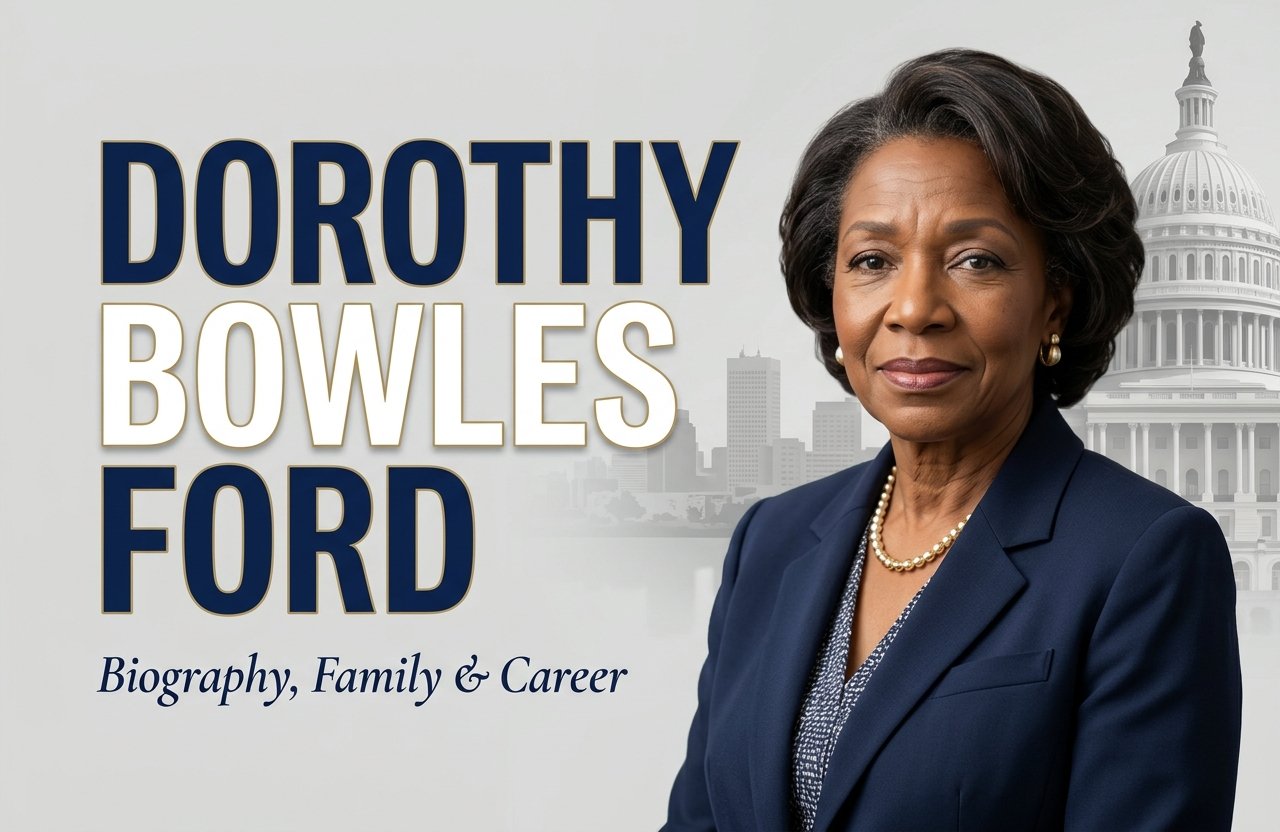
Dorothy Bowles Ford: Biography, Family, Career, and Life Story
Dorothy Bowles Ford is best known as the former wife of Harold Ford Sr., a former Tennessee congressman, and the mother of Harold Ford Jr., who represented Tennessee’s Ninth Congressional District in the U.S. House of Representatives from 1997 to 2007. The story of Dorothy Bowles Ford offers a closer look at the family behind two generations of congressional leadership, her reported career in government service, and the personal life of a woman who has largely remained outside the public spotlight.
Unlike her former husband and eldest son, Dorothy has maintained a relatively private profile. As a result, many details about her life are not fully documented in reliable public records. Her birth date, exact age, educational background, current residence, and financial circumstances have not been conclusively established. Understanding her biography therefore requires separating established family history from claims that appear in secondary online accounts without clear supporting evidence.
Her story is also connected to the political history of Memphis, Tennessee, where the Ford family became a prominent name in African American public life. By examining her family relationships, reported employment, marriage, and place in this wider history, readers can better understand why she attracts interest despite having comparatively little public biographical documentation of her own.
Who Is Dorothy Bowles Ford?
Dorothy Bowles Ford is an American woman associated with the Ford political family of Memphis, Tennessee. She was married to Harold Eugene Ford Sr., who served in the U.S. House of Representatives from 1975 to 1997, and is the mother of their three sons: Harold Ford Jr., Newton Jake Ford, and Sir Isaac Ford.
Her public recognition comes primarily from these family connections rather than from a documented career in elected office. Available biographical accounts describe her as a former or longtime government employee, with employment at the U.S. Department of Agriculture (USDA) reported in the information available for this profile. However, detailed employment records, her exact position, and the duration of her service have not been established here.
It is important to distinguish being connected to a political family from holding an official political position. There is no reliable evidence establishing that Dorothy herself served as an elected official. Similarly, claims that she directed political campaigns or acted as a formal adviser should not be treated as confirmed facts without supporting documentation.
Her biography is best understood through three themes:
- Family: Her marriage to Harold Ford Sr. and her role as the mother of three sons.
- Professional life: Reports of government employment, alongside limited publicly verified information about her career.
- Privacy: Her decision, or personal circumstances, that have kept many aspects of her life outside public reporting.
These themes explain much of the continuing interest in her background while also highlighting the limits of what can responsibly be stated about her.
Dorothy Bowles Ford Biography at a Glance
The following table summarizes the principal biographical details available for this article. Estimates and uncertain claims are identified rather than presented as established facts.
| Biographical detail | Information |
| Full name | Dorothy Bowles Ford |
| Nationality | American |
| Birthplace | Not conclusively documented; associated with Memphis, Tennessee |
| Date of birth | Not publicly verified |
| Estimated birth year | Around 1949 in some secondary accounts; unverified |
| Estimated age in 2026 | Approximately 76 to 77, if the estimated birth year is correct |
| Profession | Reported former or longtime government employee |
| Reported employer | U.S. Department of Agriculture |
| Other reported employment | Potomac Electric Power Company (PEPCO), not independently verified |
| Education | Not conclusively documented |
| Former husband | Harold Eugene Ford Sr. |
| Marriage date | February 10, 1969 |
| Divorce year | 1999 |
| Children | Three sons |
| Eldest son | Harold Ford Jr. |
| Second son | Newton Jake Ford, known as Jake Ford |
| Youngest son | Sir Isaac Ford |
| Political affiliation or office | No verified record of elected office held by Dorothy |
| Current residence | Not publicly confirmed |
| Current relationship status | Unknown |
| Remarriage | Not conclusively documented |
| Net worth | No verified public estimate |
This overview should not be mistaken for a complete official biography. In particular, an estimated age calculated from an unverified birth year is not equivalent to a confirmed date of birth. The same caution applies to claims about schooling, employment, and personal finances.
Early Life and Family Background
Birthplace and Childhood
Publicly available biographical accounts do not conclusively establish Dorothy Bowles Ford’s date of birth, birthplace, or childhood circumstances. Memphis, Tennessee, is associated with her story because of her connection to the Ford family, but that association alone does not establish where she was born or spent her early years.
Some secondary sources place her birth around 1949. If accurate, that estimate would make her approximately 76 or 77 in 2026. However, without a dependable birth record or a credible biographical source confirming the date, this figure should remain an estimate.
The lack of reliable information about her childhood also means that details about her parents, siblings, upbringing, and early ambitions cannot be stated confidently. Online biographies sometimes fill these gaps with specific-sounding details, but repetition across websites does not necessarily make a claim accurate.
A careful account of her early life should therefore focus on what can be established about the environment in which she later became publicly known, rather than inventing a personal history to fill documentary gaps.
Growing Up in a Changing American Society
The period in which Dorothy is believed to have grown up was significant for African American communities across the United States. The civil rights movement challenged racial segregation, expanded the national debate over equal political participation, and helped reshape public institutions.
Memphis was an especially important setting in this history. The city had a strong tradition of African American community leadership, labor activism, business ownership, and civic engagement. In 1968, Memphis became the site of the sanitation workers’ strike and the assassination of Martin Luther King Jr., events that remain central to the city’s historical identity.
These events provide relevant context for understanding the public environment surrounding the Ford family’s later political prominence. They do not, however, establish Dorothy’s personal participation in particular civil rights activities. No specific role should be attributed to her without reliable evidence.
Education and Schooling
Dorothy Bowles Ford’s educational history has not been conclusively documented in the sources identified for this profile. Some secondary accounts claim that she attended Geeter High School in Memphis, but this detail requires independent verification.
There is insufficient reliable information to establish her college attendance, degree qualifications, professional training, or academic achievements.
This distinction matters because education is frequently included in celebrity biographies even when the underlying evidence is weak. A responsible profile should not turn an unverified school name into a confirmed fact simply because it appears in multiple online summaries.
Her reported employment suggests that she had a professional life beyond her family’s political connections. Nevertheless, the nature of her training and the route through which she entered government service remain unclear.
Marriage to Harold Ford Sr.
Who Is Harold Ford Sr.?
Harold Eugene Ford Sr. is a former Democratic member of the U.S. House of Representatives who represented Tennessee’s Ninth Congressional District from 1975 to 1997. His congressional career made the Ford name widely recognized in Memphis and national politics.
Ford Sr. became the first African American elected to the U.S. House of Representatives from Tennessee in the twentieth century, according to historical accounts of his congressional career. His election represented an important development in the state’s political representation during a period of continuing change in American electoral politics.
His career placed the family within the public life of Memphis for more than two decades. Yet the historical record of an elected representative should not automatically be treated as a record of every family member’s professional or political activities.
Dorothy’s association with Ford Sr. is an important part of her biography, but the available evidence does not justify assigning her specific official duties or campaign responsibilities that have not been documented.
Their Wedding in 1969
Available biographical information places Dorothy Bowles Ford and Harold Ford Sr.’s marriage on February 10, 1969. The couple remained married for approximately three decades before divorcing in 1999.
Their marriage began during a period of significant social and political change. African American representation in government was developing in the aftermath of the civil rights movement, and Memphis was an important center of political organization and community activism.
The timing offers useful historical context, but it does not reveal the private details of their relationship. Publicly accessible accounts provide limited reliable information about their courtship, wedding ceremony, or personal life during the early years of their marriage.
It is therefore more accurate to focus on the documented timeline and family relationships than to speculate about private conversations, motivations, or emotional experiences.
Life During a Congressional Career
Harold Ford Sr.’s service in Congress extended from 1975 through 1997. During this period, he represented a district centered on Memphis and became a recognizable figure in Tennessee’s political history.
Being married to a member of Congress can bring public attention, demanding schedules, and a greater degree of scrutiny to family life. However, these general circumstances should not be confused with evidence about how Dorothy personally experienced them.
There is limited independently verified information about her daily responsibilities during her former husband’s congressional years. Claims about her managing campaign operations, influencing legislative decisions, or serving as a political strategist should be treated cautiously unless supported by contemporary reporting, official records, or firsthand testimony.
What can be said is that her marriage connected her household to a prominent political career at a time when the Ford family was becoming an established name in Memphis public life.
Divorce in 1999
Dorothy Bowles Ford and Harold Ford Sr. divorced in 1999, ending a marriage that had lasted approximately 30 years.
The divorce is a significant milestone in the public timeline of her life. Beyond that basic fact, reliable information about the reasons for the separation, legal arrangements, or personal consequences is limited.
Without credible documentation, it would be inappropriate to attribute the divorce to a particular disagreement, political event, or personal circumstance. Divorce records and public biographies do not always disclose the full private context of a relationship, and the absence of a public explanation should not be filled with speculation.
Her relationship status after 1999 is also not conclusively established. There is no sufficiently verified information here to confirm a later marriage or describe her present romantic life.
The most accurate account recognizes the end of the marriage while respecting the distinction between public history and private matters.
Children of Dorothy Bowles Ford
Dorothy and Harold Ford Sr. had three sons: Harold Ford Jr., Newton Jake Ford, and Sir Isaac Ford. Their children are an important part of her publicly documented family story, although each has a different level of visibility in public life.
Harold Ford Jr.
Harold Eugene Ford Jr. was born on May 11, 1970. He followed his father’s path into electoral politics and became a member of the U.S. House of Representatives, representing Tennessee’s Ninth Congressional District from 1997 to 2007.
His congressional service began in 1997, the same year his father’s long tenure in the House ended. This transition made the Ford family particularly notable in discussions of political succession and representation in Memphis.
Ford Jr. later ran for the U.S. Senate in 2006, challenging Republican Bob Corker. He lost the election, but the campaign brought him wider national attention.
His career subsequently expanded beyond elected office into financial services, public commentary, and media appearances. These later professional activities helped maintain his visibility after his congressional career ended.
For readers researching Dorothy Bowles Ford, her eldest son’s public career is a major reason her name appears in biographical searches. However, his achievements and professional decisions belong to his own record. They should not automatically be attributed to his mother’s direct influence without supporting evidence.
Newton Jake Ford
Newton Jake Ford, commonly known as Jake Ford, is the second son of Dorothy Bowles Ford and Harold Ford Sr. Available biographical information gives his birth date as October 1, 1972.
Compared with his older brother, Jake Ford has maintained a less prominent public profile in national political reporting. This difference helps explain why fewer widely documented biographical details are available about him.
Information about a person’s family role does not establish their education, occupation, financial position, or private circumstances. Where reliable public documentation is limited, those details should remain unspecified rather than being inferred from the family’s political status.
Jake Ford’s place in the family is nevertheless important to an accurate account of Dorothy’s life. She was the mother of three sons, not solely the mother of the son who later became a national political figure.
Sir Isaac Ford
Sir Isaac Ford is the youngest of Dorothy Bowles Ford’s three sons. His reported birth date is January 6, 1975.
Like his brother Jake, he has not received the same level of sustained national attention as Harold Ford Jr. Public information about his personal and professional life is consequently more limited.
A balanced biography should acknowledge all three children without assuming that their public visibility reflects their importance within the family. The available record supports identifying Sir Isaac as Dorothy’s youngest son, but it does not provide enough dependable information to construct a detailed account of his private life.
Family Relationships and Public Attention
The Ford family illustrates how political prominence can affect the public visibility of relatives. When a parent serves in Congress and a child later enters the same institution, public interest often extends beyond the officeholders themselves.
That attention can create a lasting demand for biographical information about spouses, siblings, and children. It can also produce an uneven public record in which the careers of elected officials are documented extensively while the lives of their relatives remain largely private.
Dorothy’s biography reflects this pattern. Her connection to two generations of congressional leadership is well established, but the public record does not provide equal detail about her independent identity, work history, or personal interests.
Recognizing that imbalance is essential to understanding her story fairly.
Dorothy Bowles Ford’s Career and Professional Life
Reported Employment With the U.S. Department of Agriculture
One of the most significant details about Dorothy’s professional identity is her reported employment with the U.S. Department of Agriculture. This information appears in the federal historical publication Black Americans in Congress, 1870-2007, which identifies her as a longtime USDA employee in its account of Harold Ford Jr.’s background.
This is an important distinction because it places her professional life beyond the political careers of her former husband and eldest son. Although the Ford family became known nationally through congressional service, Dorothy’s reported government employment represents a separate aspect of her background.
The historical record does not provide a detailed account of her precise job title, department, duties, salary, or length of service. It would therefore be misleading to assign her a particular senior position or describe responsibilities that have not been documented.
Government employment can involve a wide range of work, from administrative support to specialist and managerial roles. Without a reliable employment record, however, none of these possibilities should be presented as her specific experience.
What Government Service Means in Her Biography
Dorothy’s reported USDA employment adds an important dimension to her biography. It suggests that her professional identity was not limited to being the spouse of a congressman or the mother of a political figure.
Federal agencies employ people in many occupations that support public programs, administration, research, agriculture, and other government functions. These careers can be meaningful even when employees do not hold public-facing positions or receive media attention.
In Dorothy’s case, the available evidence supports acknowledging her connection to the USDA. It does not support a detailed narrative about her daily work or professional achievements.
Readers interested in verifying this aspect of her life can consult official federal histories, archived newspaper reports, and available public records. The distinction between an official historical account and an unsourced online biography is particularly important when researching someone whose personal records are not widely published.
Was She Employed by PEPCO?
Some secondary online biographies also associate Dorothy Bowles Ford with Potomac Electric Power Company, commonly known as PEPCO. However, this claim has not been independently verified in the information available for this article.
It should not be treated as a confirmed part of her employment history without a dependable source. The same applies to any proposed timeline suggesting that she moved between government and private-sector positions.
The absence of confirmation does not prove that a claim is false. It means only that the evidence available here is insufficient to establish it as fact.
Professional Identity Beyond Political Connections
A recurring problem in biographies of people connected to prominent families is that their personal achievements can become overshadowed by the careers of better-known relatives.
Dorothy’s story illustrates why professional identity should be considered separately from family status. Her reported government service is relevant in its own right, even though the public record contains fewer details about her career than about the congressional work of Harold Ford Sr. and Harold Ford Jr.
A complete account would ideally establish her official position, dates of employment, professional responsibilities, and any documented achievements. Until that information is available, a measured description of her career is more reliable than a detailed but unsupported narrative.
Dorothy Bowles Ford and the Ford Political Dynasty
How the Ford Family Became Politically Prominent
The Ford family became a major presence in Memphis politics through a combination of business activity, community relationships, and electoral success. Harold Ford Sr. built a career in the Tennessee legislature before entering the U.S. House of Representatives in 1975.
He served in Congress for 11 terms, remaining in office until January 1997. His political career extended across several decades of debate over civil rights, economic opportunity, federal assistance, and the role of government.
The family’s roots in Memphis also included business interests in the funeral services industry. These business connections formed part of the wider social and economic background from which the family’s political influence developed.
Harold Ford Jr. later succeeded his father in Congress, creating a notable example of a parent and child representing the same congressional district in successive periods. According to the U.S. House of Representatives’ historical record, Ford Jr. was elected in 1996 and served from January 3, 1997, through January 3, 2007.
The family’s history is documented in official congressional resources, including the federal publication Black Americans in Congress, which provides historical information about representation, congressional service, and the political careers of African American lawmakers.
Dorothy’s Place Within the Family’s Public Story
Dorothy was connected to the Ford family’s political development through her marriage to Harold Ford Sr. and her role as the mother of Harold Ford Jr. These relationships are central to understanding why her name appears in discussions of the family.
However, a family connection does not automatically establish direct involvement in political decision-making. There is insufficient verified evidence to conclude that Dorothy personally managed campaigns, shaped legislative policy, or held a formal position within either man’s political organization.
It is reasonable to recognize that family members may experience the effects of public service, including changes in schedules, public scrutiny, and the demands of political life. But the particular experiences of individual relatives should be described only when supported by reliable accounts.
Her significance lies partly in her place within a family whose political history is well documented, even though her own public record remains comparatively limited.
A Family Legacy Across Two Generations
The political careers of Harold Ford Sr. and Harold Ford Jr. provide a clear framework for understanding the family’s public significance.
| Family member | Documented role | Period |
| Harold Ford Sr. | U.S. representative from Tennessee | 1975 to 1997 |
| Harold Ford Jr. | U.S. representative from Tennessee | 1997 to 2007 |
| Dorothy Bowles Ford | Former spouse of Harold Ford Sr. and mother of their three sons; reported USDA employee | Personal and professional timeline incompletely documented |
The table highlights an important difference: the congressional service of the two men is supported by extensive official records, while Dorothy’s biography relies on a smaller set of documented facts.
This difference should not be interpreted as proof that her life lacked professional achievements or personal significance. Rather, it shows that public records are often shaped by the nature of a person’s occupation and public responsibilities.
Memphis and African American Political Representation
Memphis provides essential historical context for the Ford family’s rise. The city has long been associated with African American business ownership, labor organizing, civil rights activism, and political leadership.
Harold Ford Sr.’s election to Congress in 1974, followed by his service beginning in 1975, occurred during a period when African American representation in national government was still developing after the civil rights era.
His son later entered the same congressional seat, extending the family’s connection to the district. The House’s historical account documents Ford Jr.’s succession to his father’s seat and his decade in Congress.
Dorothy’s relationship to both men connects her biography to this wider history. Yet it is important to keep the focus precise: the political achievements of her relatives establish the historical setting of her life, not a separate record of political office held by Dorothy herself.
The Childhood Anecdote That Connects Dorothy to Her Son’s Political Ambitions
One of the more distinctive details associated with Dorothy Bowles Ford concerns an early expression of Harold Ford Jr.’s interest in politics.
A federal historical account reports that Dorothy recalled her son expressing an interest in becoming a congressman after attending his father’s first congressional swearing-in ceremony. Harold Jr. was around four years old at the time.
This anecdote is notable because it connects the family’s private life with the beginning of a future public career. It suggests that congressional service was visible to the children at an early age, although it cannot by itself explain the many later decisions that shaped Harold Jr.’s political path.
The story is also more useful than vague claims that Dorothy was the force behind her son’s career. It offers a specific recollection attributed to her, rather than an unsupported claim about her influence.
Harold Jr. went on to study at the University of Pennsylvania and the University of Michigan Law School before entering Congress in 1997. The U.S. House of Representatives documents these educational and professional milestones, providing a verifiable timeline against which the childhood anecdote can be understood.
The anecdote should not be stretched beyond what it establishes. It does not prove that Dorothy designed a political career for her son or that she served as his campaign adviser. It records a moment in which a young child saw his father take office and reportedly expressed an ambition of his own.
Personal Life, Privacy, and Public Curiosity
Why Is Information About Dorothy Bowles Ford Limited?
Many people search for Dorothy Bowles Ford because they want to understand the family background of Harold Ford Jr. Others are interested in the personal history of Harold Ford Sr. or the experience of being connected to a prominent political family.
These searches can create the impression that a detailed biography must exist. In reality, the amount of reliable information available about an individual depends on several factors, including their public responsibilities, media exposure, and the availability of historical records.
Dorothy has not maintained the same level of public visibility as her former husband or eldest son. As a result, her education, private relationships, daily activities, and later career history are not documented to the same extent.
A lack of public information is not evidence of a hidden story. It may simply reflect a person’s preference for privacy or the fact that their life has not been extensively covered by the media.
Is Dorothy Bowles Ford Still Alive?
Her current living status has not been independently confirmed by an authoritative source in the information available for this profile.
It would therefore be inappropriate to state definitively that she is alive or deceased. A reliable answer would require a recent, credible source such as a public statement from the family, an authoritative obituary, or another dependable record.
This is an important example of why online biography pages should not automatically be treated as current. A page can be published or updated without verifying every personal detail it contains.
Where Does She Live Today?
Dorothy’s current residence has not been publicly confirmed. Her association with Memphis and the Ford family’s history does not establish that she currently lives there.
A person’s past connection to a city should not be used as proof of their present address. Nor should a specific location be inferred from the public activities of their relatives.
Without a credible public source, the most accurate description is that her present residence is unknown.
Did Dorothy Bowles Ford Remarry?
The information available for this article does not conclusively establish whether Dorothy remarried after her 1999 divorce from Harold Ford Sr.
It is possible for a person to maintain relationships or a family life outside public reporting. However, possibility is not evidence, and no specific later spouse should be identified without reliable confirmation.
Her relationship status after the divorce should therefore be considered unknown.
What Is Known About Her Interests and Daily Life?
There is limited reliable public information about Dorothy’s hobbies, friendships, community activities, travel, or everyday routine.
It would be easy to fill a biography with assumptions about the interests of a person associated with politics and government service. But doing so would create a fictional portrait rather than a trustworthy account.
The available evidence supports a narrower picture: she was part of the Ford family, was married to Harold Ford Sr. for approximately 30 years, raised three sons with him, and is reported to have worked for the USDA.
Those facts provide a meaningful starting point without claiming access to private details that have not been publicly documented.
Dorothy Bowles Ford’s Age and Birth Date
Questions about Dorothy’s age are common, but a confirmed date of birth has not been established in the available reliable records.
Some secondary sources estimate that she was born around 1949. If that estimate is correct, she would be approximately 76 or 77 years old in 2026, depending on her birthday.
The calculation is straightforward, but the underlying birth year remains unverified. An accurate calculation based on an uncertain starting point does not turn the result into a confirmed fact.
Readers should therefore distinguish between the following:
- Confirmed birth date: Not established in the information available for this article.
- Reported birth-year estimate: Around 1949 in some secondary accounts.
- Estimated age in 2026: Approximately 76 to 77, conditional on that estimate being correct.
Unless an authoritative source confirms her birth date, it is best to avoid presenting a precise age as fact.
Dorothy Bowles Ford’s Net Worth and Financial Background
There is no verified public estimate of Dorothy Bowles Ford’s net worth in the information available for this article.
Websites sometimes publish financial estimates for relatives of well-known politicians, even when those figures are not supported by public financial disclosures, documented assets, or credible reporting. Such estimates should not be treated as reliable simply because they appear in a numerical format.
Dorothy’s reported employment with the USDA does not establish her lifetime earnings, pension arrangements, savings, property holdings, investments, or other assets. Those details would be necessary for a meaningful financial assessment.
Her former husband’s political career and the family’s business background also cannot be used to calculate her individual wealth. Family business interests, a relative’s income, and personal net worth are separate matters.
For these reasons, assigning Dorothy a specific net worth would be speculative. The responsible conclusion is that her personal financial position has not been publicly verified.
Common Misconceptions About Dorothy Bowles Ford
When researching a person with limited public documentation, several types of claims can easily become confused with established facts.
Misconception 1: She Was an Elected Politician
Dorothy’s family relationships connect her to two former members of Congress, but no reliable evidence establishes that she held elected political office herself.
Her own biography should not be merged with the official careers of her former husband or son.
Misconception 2: Her Exact Age Is Known
The frequently repeated birth-year estimate of around 1949 is not conclusively verified. Any age calculated from it remains conditional.
Misconception 3: Every Reported Career Detail Is Confirmed
Her connection to the USDA is supported by a federal historical publication. Other employment claims, including the reported PEPCO connection, have not been independently verified here.
These details should not be given the same level of certainty.
Misconception 4: Her Current Residence and Relationship Status Are Publicly Known
No authoritative confirmation has been established for her present residence, remarriage, or current relationship status.
A biography should not infer these details from her former marriage or family background.
Misconception 5: Her Importance Depends Only on Her Son’s Career
Her association with Harold Ford Jr. explains much of the public interest in her name, but it is not the entirety of her story.
Her marriage, motherhood, and reported professional life are separate parts of her biography. A careful account acknowledges them without inventing achievements or assigning unverified political influence.
How to Research Dorothy Bowles Ford Accurately
Readers who want to investigate her life further can use a structured approach to evaluate claims and distinguish established information from speculation.
1. Start With Official Historical Records
The U.S. House of Representatives’ historical resources are useful for verifying the congressional careers of Harold Ford Sr. and Harold Ford Jr. Federal historical publications can also establish family relationships and provide relevant biographical context.
These sources are particularly valuable because they are designed to document public service and congressional history.
2. Look for Contemporary Newspaper Accounts
Archived Memphis newspapers may contain reports about the Ford family, political campaigns, public events, or other historical details. Contemporary reporting can sometimes provide information that later biographies omit.
However, each article should be evaluated according to its date, author, sourcing, and purpose. A newspaper report about a political campaign may not establish a private family detail.
3. Separate Primary Sources From Repeated Claims
A fact repeated across several websites is not necessarily independently confirmed. Some biography pages may reproduce information from a single original source without verifying it.
Look for an identifiable document, direct statement, official record, or credible report that supports the claim.
4. Check Dates and Context
Historical dates should be consistent with the documented timeline. For example, Harold Ford Sr.’s congressional service began in 1975, while his son began serving in 1997.
Keeping these milestones separate helps prevent errors when discussing the family’s history.
5. Treat Unknown Information Honestly
If a birth date, net worth, or present residence cannot be confirmed, identify it as unknown. This is more informative than presenting an unsupported estimate as fact.
A strong biography does not need to answer every question with a number or a definitive claim. It needs to tell readers what is established, what remains uncertain, and where the evidence comes from.
Frequently Asked Questions About Dorothy Bowles Ford
1. Who is Dorothy Bowles Ford?
Dorothy Bowles Ford is the former wife of Harold Ford Sr., a former Tennessee congressman, and the mother of Harold Ford Jr., who represented Tennessee in the U.S. House of Representatives from 1997 to 2007. She is also reported to have worked for the U.S. Department of Agriculture.
2. How old is Dorothy Bowles Ford?
Her exact age is not publicly verified. Some secondary sources estimate that she was born around 1949, which would make her approximately 76 or 77 in 2026. This estimate has not been independently confirmed.
3. Who was Dorothy Bowles Ford’s husband?
Her former husband was Harold Eugene Ford Sr., a Democratic congressman who represented Tennessee from 1975 to 1997. They married on February 10, 1969, and divorced in 1999.
4. How many children does Dorothy Bowles Ford have?
Dorothy and Harold Ford Sr. had three sons: Harold Ford Jr., Newton Jake Ford, commonly known as Jake Ford, and Sir Isaac Ford. Harold Ford Jr. later became a U.S. representative.
5. What did Dorothy Bowles Ford do for a living?
A federal historical publication identifies Dorothy as a longtime employee of the U.S. Department of Agriculture. However, her precise job title, responsibilities, and length of service have not been established in the available information.
6. What is Dorothy Bowles Ford’s net worth?
Her net worth has not been reliably established in public sources. There is insufficient verified information about her personal assets, investments, income, or other financial holdings to provide a credible estimate.
Conclusion
Dorothy Bowles Ford occupies a distinctive place in the history of the Ford political family of Memphis, Tennessee. Her marriage to Harold Ford Sr. and her role as the mother of Harold Ford Jr. connect her to two generations of congressional leadership. Her three sons, her reported government employment, and her family’s historical background provide the principal documented elements of her biography.
Her life also illustrates the difference between public recognition and the amount of personal information available about an individual. While official historical sources document her family relationships and reported employment, many details about her birth date, education, later relationships, present residence, and finances remain unverified.
The most reliable account of her life does not attempt to turn these gaps into a dramatic narrative. Instead, it recognizes her place in a prominent American political family while respecting the limits of the available evidence. Dorothy Bowles Ford’s biography is therefore best understood through the established facts of her family history, her reported professional life, and the broader political context in which her family became nationally known.