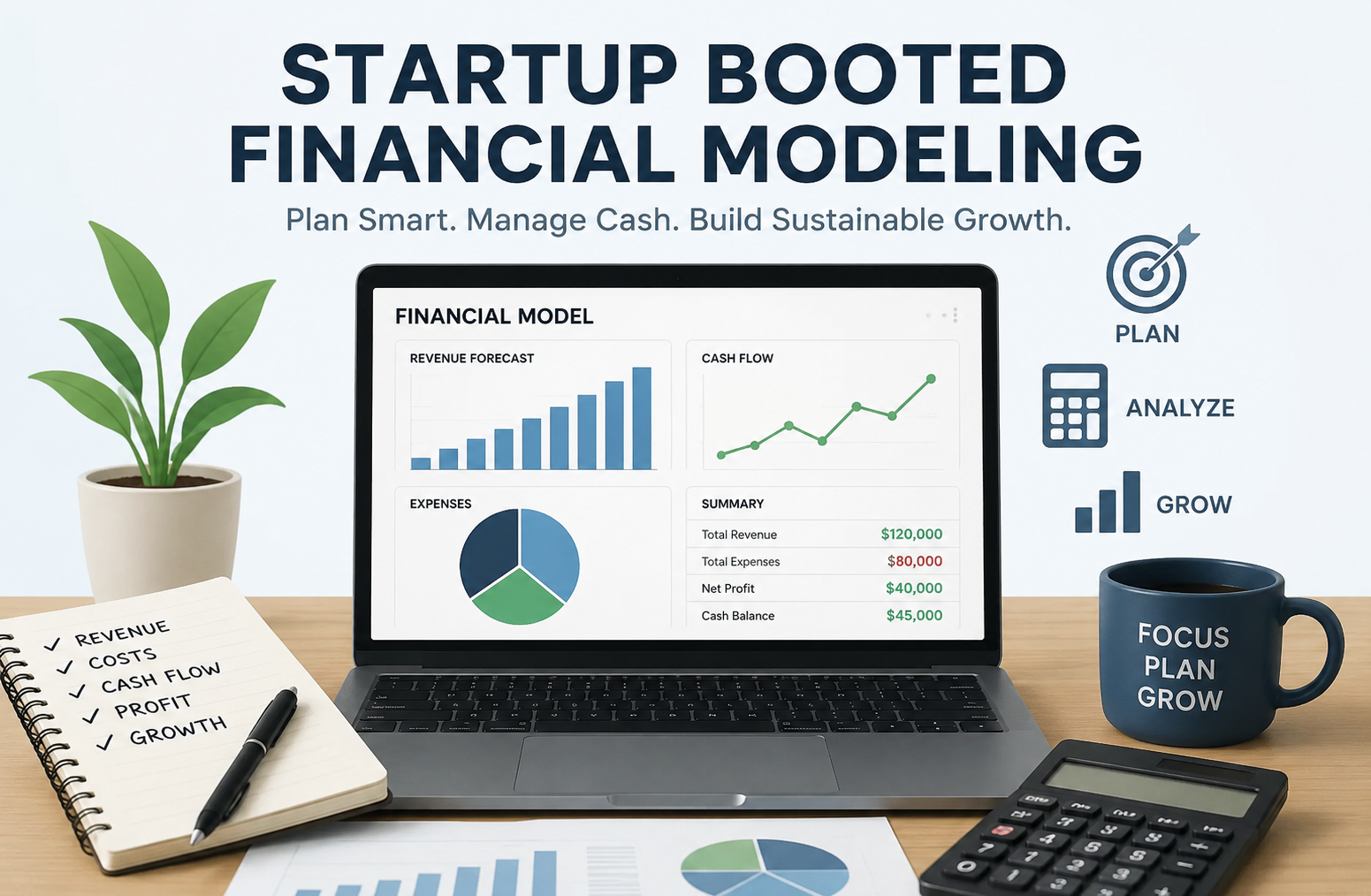
Startup Booted Financial Modeling: A Practical Guide
Building a company without outside funding requires a different kind of financial discipline. Startup booted financial modeling helps founders understand how much money the business needs, where that money will come from, how long it can survive, and what decisions are necessary to reach sustainable growth. For a bootstrapped startup, financial modeling is not simply an exercise for investors or accountants. It is a practical decision-making system that can determine whether the company remains independent or runs out of cash.
Unlike heavily funded startups, bootstrapped businesses cannot always rely on another investment round to fix poor financial planning. Every hiring decision, marketing expense, software subscription, inventory purchase, and pricing change can directly affect the company’s ability to continue operating.
That is why a strong financial model becomes one of the most valuable tools a founder can build.
This guide explains how financial modeling works for bootstrapped startups, how it differs from investor-focused forecasting, what founders should include in their models, which mistakes can create serious problems, and how to build a practical system that supports real business decisions.
What Is Startup Booted Financial Modeling?
Startup booted financial modeling is the process of forecasting and managing the financial future of a self-funded or bootstrapped startup.
The model usually brings together several important parts of the business:
- Revenue forecasts
- Operating expenses
- Cash flow projections
- Customer acquisition costs
- Pricing assumptions
- Profitability estimates
- Hiring plans
- Break-even analysis
- Cash runway
- Best-case and worst-case scenarios
The purpose is simple: to understand whether the business can fund its own operations and growth.
A traditional startup financial model may focus heavily on demonstrating rapid growth to potential investors. A bootstrapped model has a different priority. It focuses first on financial survival, efficient growth, and long-term sustainability.
That difference matters.
A venture-backed company may decide to spend aggressively to acquire customers because it expects future investment to support the strategy. A bootstrapped company usually needs to ask a more immediate question:
Can the cash generated by the business support this decision?
This creates a more disciplined approach to forecasting.
The goal is not to create an impressive spreadsheet filled with optimistic numbers. The goal is to build a realistic financial picture that helps the founder make better decisions.
Why Financial Modeling Is More Important for Bootstrapped Startups
Bootstrapped founders operate with limited financial flexibility.
When external funding is unavailable, the business usually depends on some combination of:
- Founder savings
- Early customer revenue
- Personal income
- Retained profits
- Small business financing
- Strategic partnerships
Because available capital is limited, mistakes can become expensive very quickly.
For example, imagine a founder who hires three employees based on projected sales growth. If those sales take six months longer than expected, payroll costs continue even though the expected revenue has not arrived.
A financial model can reveal that risk before the hiring decision is made.
This is one of the most important benefits of financial planning for independent startups.
It Forces Founders to Understand Their Numbers
Many founders know their product extremely well but have a weaker understanding of the economics behind the business.
They may know:
- How many customers they have
- How much revenue they generated last month
- Whether sales are increasing
But they may not know:
- How much cash the business actually consumes each month
- Which customers are the most profitable
- How much it costs to acquire a customer
- When recurring revenue becomes sufficient to cover fixed expenses
- How much revenue is required before hiring another employee
- What happens if sales decline by 20%
A financial model connects these questions.
Instead of making decisions based on optimism or intuition alone, the founder can see the likely financial consequences.
It Protects Cash
For a bootstrapped business, cash is often more important than reported profit.
A company can technically be profitable while still facing a cash problem.
Consider a business that invoices customers today but receives payment 60 days later. The company may record revenue, but it still needs enough cash to pay employees and suppliers before the customer payments arrive.
This is why cash flow forecasting should sit at the center of every serious startup model.
Revenue is important.
Profit is important.
But cash determines whether the company can continue operating.
The Core Philosophy Behind a Bootstrapped Financial Model
The strongest models are built around realistic assumptions rather than optimistic projections.
This philosophy can be summarized in five principles.
1. Survival Comes Before Scale
A bootstrapped company must first become financially stable.
Rapid growth is valuable only when the business can support it.
Growth that creates more expenses than cash can sometimes be dangerous. More customers may require:
- More support staff
- More infrastructure
- More inventory
- More software costs
- More working capital
If the economics are weak, growth can increase financial pressure instead of reducing it.
2. Cash Flow Matters More Than Vanity Metrics
Founders can easily become distracted by impressive numbers.
Website traffic may increase.
Social media followers may grow.
The number of registered users may rise.
But these numbers do not automatically create a sustainable company.
A bootstrapped financial model should focus on metrics that influence financial health.
Examples include:
- Monthly recurring revenue
- Gross margin
- Customer retention
- Operating expenses
- Cash balance
- Monthly cash burn
- Customer acquisition cost
- Average revenue per customer
3. Assumptions Should Be Easy to Test
Every important forecast should be based on an assumption that can be reviewed.
For example:
Bad assumption: Revenue will grow significantly next year.
Better assumption: The company expects to add 20 new customers per month, with an average monthly subscription value of $100.
The second assumption can be tested.
If the business adds only 10 customers per month, the forecast can immediately be adjusted.
Good models make assumptions visible.
4. Conservative Planning Creates Flexibility
Bootstrapped founders benefit from planning for slower growth and higher costs.
This does not mean founders should be pessimistic.
It means they should understand what happens when reality is less favorable than expected.
A useful model should include multiple scenarios:
- Expected scenario
- Strong growth scenario
- Slow growth scenario
- Downside scenario
The downside scenario is particularly valuable because it answers an important question:
How does the company survive when things do not go according to plan?
5. Financial Models Should Support Decisions
A model is useful only when it helps someone make a better decision.
If a spreadsheet contains hundreds of rows but does not answer practical questions, it has become unnecessarily complicated.
A founder should be able to use the model to answer questions such as:
- Can we afford this new hire?
- Should we increase marketing spending?
- When will we reach break-even?
- How long will our cash last?
- What happens if revenue growth slows?
- How much should we charge?
- Can the business fund expansion from its own cash flow?
These are the questions that matter.
Startup Booted Financial Modeling and the Three Financial Statements
A complete financial model usually connects three major financial statements.
Understanding them is important even for founders who are not accountants.
The Income Statement
The income statement shows financial performance over a period of time.
Its basic structure is:
Revenue
Minus:
Cost of goods sold
Equals:
Gross profit
Minus:
Operating expenses
Equals:
Operating profit or loss
This statement helps founders understand whether the underlying business model can become profitable.
For example, a software company may generate $50,000 in monthly revenue.
Its direct infrastructure and service costs might be $10,000.
That produces a gross profit of $40,000.
The company may then spend $35,000 on salaries, marketing, administration, and other operating expenses.
The operating result would be $5,000.
This helps the founder see where money is being generated and where it is being spent.
The Cash Flow Statement
The cash flow statement focuses on the movement of actual cash.
This is especially important for bootstrapped companies.
A company might show strong revenue but still have weak cash flow because customers pay late or expenses must be paid in advance.
A practical startup cash flow forecast should track:
- Starting cash balance
- Cash received from customers
- Operating payments
- Payroll
- Marketing expenses
- Taxes
- Equipment purchases
- Debt payments
- Ending cash balance
The ending cash balance from one month becomes the starting balance for the next.
This creates a clear picture of financial survival.
The Balance Sheet
The balance sheet provides a snapshot of what the business owns and owes.
It includes:
Assets
- Cash
- Accounts receivable
- Inventory
- Equipment
Liabilities
- Loans
- Accounts payable
- Taxes owed
Equity
The owner’s financial interest in the business.
Early-stage founders often spend more time on revenue and cash flow than on the balance sheet. That is understandable, but the balance sheet still provides useful insight into the financial position of the company.
Together, these three statements create a more complete picture than revenue forecasting alone.
The Essential Components of a Bootstrapped Startup Financial Model
A practical model does not need to begin with complexity.
The most effective approach is usually to build the model in layers.
Start with the numbers that matter most.
1. Revenue Forecast
The revenue forecast estimates how much money the company expects to generate.
The best method depends on the business model.
Subscription Businesses
For a subscription business, revenue may depend on:
- Starting customers
- New customers
- Customer churn
- Monthly pricing
- Expansion revenue
A simple structure could look like this:
Starting customers
Plus new customers
Minus customers who cancel
Equals ending customers
Then:
Ending customers × average monthly revenue per customer = monthly recurring revenue
This approach is often more reliable than simply assuming revenue will increase by a certain percentage every month.
Service Businesses
Service companies can forecast revenue based on:
- Number of clients
- Average project value
- Retainer revenue
- Employee capacity
- Utilization rate
Capacity is particularly important.
A consulting company cannot sell unlimited work if its team has limited hours.
The financial model should connect revenue growth to operational capacity.
Ecommerce Businesses
An ecommerce forecast may include:
- Website visitors
- Conversion rate
- Average order value
- Repeat purchases
- Product returns
For example:
Visitors × conversion rate = number of orders
Orders × average order value = gross sales
This creates a clear relationship between marketing performance and revenue.
2. Cost of Goods Sold
Cost of goods sold represents the direct cost of delivering the product or service.
Examples include:
- Manufacturing costs
- Product materials
- Shipping
- Payment processing
- Hosting infrastructure
- Direct fulfillment expenses
Understanding these costs helps calculate gross margin.
Gross margin is important because it shows how much money remains after direct delivery costs.
A company with strong revenue but weak gross margins may struggle to generate enough cash for growth.
3. Operating Expenses
Operating expenses include the costs required to run the company.
Common categories include:
- Salaries
- Freelancers
- Marketing
- Software
- Office costs
- Legal services
- Accounting
- Insurance
- Customer support
A useful approach is to divide expenses into two categories.
Fixed Expenses
These generally remain stable regardless of short-term sales.
Examples:
- Salaries
- Software subscriptions
- Rent
Variable Expenses
These change as business activity changes.
Examples:
- Payment processing
- Shipping
- Sales commissions
- Advertising tied to customer acquisition
This distinction helps founders understand operating leverage.
4. Payroll and Hiring Plan
Hiring is one of the most significant financial decisions a startup can make.
A founder should not simply ask:
Can we pay this person today?
A better question is:
Can the business support this cost for the next 12 months under realistic conditions?
The model should include:
- Salary
- Taxes and benefits
- Equipment
- Software
- Recruitment costs
It should also estimate the expected financial impact of the hire.
For example, a salesperson may cost the company $60,000 annually.
The founder should estimate:
- When the employee becomes productive
- Expected sales contribution
- Time required to recover the hiring cost
This creates a more disciplined hiring process.
5. Cash Runway
Cash runway estimates how long the business can continue operating with its available cash.
A simple formula is:
Available cash ÷ average monthly net cash burn = estimated runway
However, founders should not rely only on a simple average.
Expenses and revenue often change over time.
A month-by-month cash forecast is more useful because it can show periods where cash pressure becomes unusually high.
6. Break-Even Analysis
Break-even analysis estimates when revenue becomes sufficient to cover costs.
The basic question is:
How much revenue must the company generate before it stops losing money?
This helps founders make decisions about:
- Pricing
- Hiring
- Marketing budgets
- Growth targets
For a simple business:
Fixed costs ÷ contribution margin = break-even sales requirement
The exact calculation depends on the business model, but the underlying idea remains the same.
How to Build a Financial Model Step by Step
The following process works well for many early-stage companies.
Step 1: Start With Historical Data
If the business already operates, begin with actual numbers.
Collect information about:
- Monthly revenue
- Customer growth
- Expenses
- Cash balances
- Gross margins
- Customer retention
Historical performance provides a stronger foundation than assumptions alone.
The past does not perfectly predict the future, but it provides useful evidence.
Step 2: Define the Key Business Drivers
Every company has a small number of factors that drive financial performance.
For a SaaS company, those may include:
- Website traffic
- Conversion rate
- Customer acquisition
- Churn
- Average subscription price
For a service business:
- Number of leads
- Sales conversion rate
- Average project value
- Team capacity
For ecommerce:
- Traffic
- Conversion rate
- Average order value
- Repeat purchase rate
Identify these drivers before building complicated formulas.
Step 3: Build Revenue From Operational Assumptions
Instead of typing a revenue number directly into the spreadsheet, build it from underlying business activity.
For example:
1,000 qualified visitors
× 5% conversion rate
= 50 new customers
50 customers
× $100 monthly value
= $5,000 monthly recurring revenue
This method makes the forecast easier to understand and improve.
Step 4: Add Direct Costs
Calculate the cost required to deliver the product or service.
This allows the model to calculate gross profit.
Step 5: Add Operating Expenses
List expenses by realistic categories.
Avoid combining everything into one large number.
Separate categories help founders identify where spending can be reduced if necessary.
Step 6: Build the Cash Flow Forecast
Create monthly projections.
Track when money actually enters and leaves the business.
This is where many startup models become genuinely useful.
A company may discover that it is profitable on paper but faces a temporary cash shortage because of payment timing.
Step 7: Add Hiring Decisions
Place future hires in the months when they are expected to begin.
Do not assume all employees become productive immediately.
Include ramp-up periods where appropriate.
Step 8: Create Multiple Scenarios
At minimum, consider three scenarios.
Base Case
The most realistic expectation.
Upside Case
The company performs better than expected.
Downside Case
Growth is slower, costs are higher, or customer churn increases.
The downside scenario often produces the most valuable strategic insight.
The Most Important Metrics to Track
Financial models should connect to a small group of meaningful metrics.
Revenue Growth
Revenue growth shows whether the business is expanding.
However, growth should always be considered alongside profitability and cash flow.
Fast growth can be expensive.
Gross Margin
Gross margin measures the percentage of revenue remaining after direct costs.
A strong gross margin provides more flexibility to cover operating expenses and invest in growth.
Customer Acquisition Cost
Customer acquisition cost estimates how much the business spends to acquire a customer.
A founder should understand:
- Which channels acquire customers
- How much each channel costs
- Whether the acquired customers generate enough value
Customer Lifetime Value
Customer lifetime value estimates the economic value of a customer relationship.
The calculation depends on assumptions about:
- Average revenue
- Gross margin
- Retention
- Customer lifespan
Because future customer behavior is uncertain, founders should avoid treating lifetime value as a guaranteed number.
It is an estimate, not a promise.
Monthly Burn
Monthly burn measures how quickly the company consumes cash when expenses exceed incoming cash.
Tracking burn helps founders understand financial risk.
Runway
Runway shows how much time remains before the business needs to generate more cash, reduce expenses, or obtain financing.
Net Cash Flow
Net cash flow shows whether the company’s cash balance is increasing or decreasing.
This is one of the most practical indicators of financial health.
Common Challenges in Startup Booted Financial Modeling
Financial modeling is valuable, but it is not easy.
Several challenges appear repeatedly.
Challenge 1: Forecasting Without Enough Historical Data
New startups often have limited information.
The founder may not know:
- Future conversion rates
- Customer retention
- Acquisition costs
- Demand levels
The solution is not to invent precise numbers.
Instead, use ranges and scenarios.
For example, rather than assuming exactly 100 customers next quarter, consider several possibilities.
This approach is more honest and often more useful.
Challenge 2: Confusing Revenue With Cash
Revenue does not automatically mean available cash.
A company can record sales while still waiting for payment.
Founders should forecast payment timing.
Questions to consider include:
- When does the customer pay?
- Is payment made upfront?
- Are invoices paid in 30 or 60 days?
- Are refunds possible?
- Are there seasonal payment patterns?
Challenge 3: Underestimating Expenses
Founders often remember major costs and forget smaller recurring expenses.
These can include:
- Software tools
- Payment fees
- Professional services
- Taxes
- Equipment replacement
- Customer support
Small expenses become meaningful when they repeat every month.
Challenge 4: Overestimating Growth
Optimism is useful for entrepreneurship.
Optimism alone is not a financial strategy.
One of the strongest habits in startup booted financial modeling is separating ambition from forecasting.
You can have an ambitious business goal while still maintaining a conservative financial plan.
Challenge 5: Making the Model Too Complicated
A complicated model can create the illusion of sophistication.
But complexity does not guarantee accuracy.
If the founder cannot understand the spreadsheet, the model is not serving its purpose.
Start simple.
Add complexity only when it improves decision-making.
Real-World Applications of Financial Modeling for Bootstrapped Founders
A financial model becomes valuable when it is used before major decisions.
Deciding Whether to Hire
Before hiring, model:
- Total employment cost
- Expected productivity
- Revenue impact
- Cash runway after the hire
This can reveal whether the business should hire immediately or wait until revenue reaches a specific level.
Testing a New Pricing Strategy
A pricing change affects more than revenue.
It may influence:
- Conversion rates
- Customer retention
- Profit margins
- Customer expectations
The model can compare different pricing scenarios before implementation.
Planning Marketing Spending
Marketing should not be viewed simply as an expense.
It is an investment that must be evaluated.
A model can estimate:
- Marketing cost
- Expected leads
- Conversion rate
- Revenue generated
- Payback period
This helps founders decide whether a marketing channel is financially sustainable.
Preparing for a Slow Period
Many businesses experience seasonal or unexpected declines.
A downside scenario can answer:
- Which expenses can be reduced?
- How long can the company survive?
- What revenue level creates serious risk?
- When should action be taken?
Planning before a crisis is significantly easier than reacting during one.
Building a Sustainable Growth Strategy
The greatest strength of a bootstrapped business is often its ability to grow at its own pace.
The financial model helps identify a growth rate that the company can actually afford.
This may be slower than venture-backed competitors.
But sustainable growth can create significant advantages:
- Greater ownership
- Lower financial pressure
- Better capital efficiency
- More strategic independence
A Practical Example of a Monthly Financial Model
Consider a fictional software startup.
The company begins January with:
- 100 customers
- Average monthly revenue per customer of $50
- Monthly recurring revenue of $5,000
The company expects:
- 20 new customers each month
- 5% monthly churn
- Direct service costs equal to 15% of revenue
- Fixed operating expenses of $7,000
The model begins with customer activity.
Starting customers: 100
New customers: 20
Expected churn: 5 customers
Ending customers: 115
Estimated revenue:
115 × $50 = $5,750
Direct costs:
15% of $5,750 = $862.50
Gross profit:
$5,750 minus $862.50 = $4,887.50
Operating expenses:
$7,000
Estimated operating loss:
$2,112.50
The company may be growing, but it is still consuming cash.
The founder now has useful questions to explore.
Should the company:
- Increase prices?
- Reduce fixed expenses?
- Improve customer retention?
- Acquire customers more efficiently?
- Delay hiring?
This is the value of financial modeling.
The spreadsheet does not make the decision.
It makes the consequences of different decisions visible.
How Often Should Founders Update Their Financial Model?
A startup financial model should not be created once and forgotten.
Early-stage businesses change quickly.
A practical approach is:
Weekly
Monitor key operating metrics.
Examples:
- Sales
- New customers
- Cash balance
- Marketing performance
Monthly
Update actual financial results and compare them with forecasts.
Ask:
- Where were we correct?
- Where were we wrong?
- Which assumptions changed?
Quarterly
Review the larger strategy.
Update:
- Hiring plans
- Revenue forecasts
- Growth targets
- Major expenses
The model should become more accurate over time as the company collects better information.
How to Improve Forecast Accuracy
No financial model will perfectly predict the future.
The goal is not perfect prediction.
The goal is better preparation.
Several practices can improve accuracy.
Track Forecast Errors
Compare predicted results with actual results.
If sales forecasts are consistently too optimistic, adjust the assumptions.
If customer retention is better than expected, update the model.
This creates a learning system.
Use Ranges Instead of False Precision
A forecast saying revenue will be exactly $127,483 twelve months from now may create false confidence.
Future estimates are uncertain.
Ranges and scenarios often communicate uncertainty more honestly.
Separate Facts From Assumptions
A good model clearly distinguishes between:
Known facts
Such as current customers and current expenses.
And:
Assumptions
Such as future conversion rates and expected growth.
This makes the model easier to review.
Update Important Assumptions First
Not every number deserves equal attention.
Focus on assumptions with the greatest financial impact.
For many startups, these include:
- Pricing
- Customer acquisition
- Churn
- Gross margin
- Payroll
Improving these assumptions can dramatically improve the quality of the model.
Financial Modeling Mistakes That Can Hurt a Bootstrapped Startup
Some mistakes are especially dangerous.
Building for Investors Instead of the Business
A bootstrapped founder may copy a venture capital financial model designed to show massive future growth.
That model may not answer the most important operational questions.
The business needs a model designed around its actual financial reality.
Ignoring Taxes
Taxes can create major cash problems.
Founders should account for expected tax obligations rather than assuming all incoming cash is available for spending. If unexpected issues arise with tax authorities, businesses may also seek professional tax dispute resolution to understand their options and address the matter appropriately.
Forgetting Working Capital
Businesses that hold inventory or wait for customer payments need to understand working capital.
Growth can sometimes require more cash before it generates more cash.
Assuming Every Customer Pays and Stays
Customers may cancel.
Invoices may be delayed.
Payments may fail.
A realistic model includes these possibilities.
Treating the Model as a Guarantee
A forecast is not a prediction of destiny.
It is a structured estimate based on current knowledge.
The best founders regularly update their models when reality changes.
Building a Financial Culture Inside a Bootstrapped Company
Financial modeling should not exist only inside a spreadsheet.
The numbers should influence company culture.
Teams make better decisions when they understand relevant constraints.
For example, a marketing team may benefit from understanding acquisition economics.
A product team may benefit from understanding gross margins.
Managers may benefit from understanding the cost of additional hiring.
This does not mean every employee needs access to every financial detail.
It means financial awareness can improve decision-making across the company.
A bootstrapped business benefits when employees understand that resources are limited and every major investment should create meaningful value.
The Difference Between Planning and Predicting
One of the most useful ways to think about financial modeling is this:
Financial modeling is not about predicting the future perfectly. It is about preparing for multiple possible futures.
This distinction changes how founders use forecasts.
A weak model asks:
What will happen?
A stronger model asks:
What could happen, and what should we do if it does?
This is particularly important for independent startups.
The founder cannot control the economy, customer demand, competitors, or unexpected costs.
But the founder can prepare.
A Simple Financial Modeling Framework for Bootstrapped Startups
If you are starting from scratch, organize the model into these sections.
Section 1: Assumptions
Include:
- Pricing
- Customer growth
- Churn
- Conversion rates
- Hiring dates
Section 2: Revenue
Forecast income based on real business drivers.
Section 3: Direct Costs
Calculate the cost of delivering products or services.
Section 4: Operating Expenses
Track fixed and variable expenses.
Section 5: Hiring
Add future employees and total employment costs.
Section 6: Cash Flow
Track monthly cash movement.
Section 7: Scenarios
Create base, upside, and downside cases.
Section 8: Dashboard
Summarize the most important numbers.
A founder’s dashboard might include:
- Monthly revenue
- Gross margin
- Operating expenses
- Net cash flow
- Cash balance
- Runway
- Break-even date
This structure is usually enough to create a powerful starting point.
Frequently Asked Questions
What is startup booted financial modeling?
Startup booted financial modeling is the process of forecasting revenue, expenses, cash flow, profitability, and financial runway for a self-funded or bootstrapped startup.
Why is financial modeling important for bootstrapped startups?
It helps founders protect cash, plan growth, evaluate hiring decisions, understand profitability, and prepare for slower-than-expected revenue.
How far ahead should a startup forecast?
Many early-stage startups benefit from a detailed monthly forecast for at least 12 months, with broader projections beyond that period when useful for strategic planning.
What is the most important financial metric for a bootstrapped startup?
There is no single metric for every business, but cash flow and cash runway are often among the most important because they show whether the company can continue operating.
Should a financial model include multiple scenarios?
Yes. A base case, upside case, and downside case help founders prepare for uncertainty and understand the financial consequences of different outcomes.
How often should a startup update its financial model?
Key financial results should generally be reviewed monthly, while major assumptions and strategic forecasts should be updated whenever significant business conditions change.
Conclusion
A bootstrapped startup does not need an enormous finance department to make smart financial decisions. It needs a clear understanding of how money enters the business, how money leaves it, and what conditions are required for sustainable growth.
The strongest financial models are realistic, flexible, and connected to real business activity. They do not exist to impress investors or create attractive projections. They exist to help founders make better decisions.
Startup booted financial modeling works best when it becomes part of the operating rhythm of the company. Revenue assumptions are tested against actual results. Expenses are reviewed carefully. Hiring decisions are connected to cash capacity. Growth plans are evaluated through both opportunity and risk.
Most importantly, a useful model gives founders visibility before problems become emergencies.
A founder who understands cash flow can react earlier.
A founder who understands unit economics can invest more intelligently.
A founder who understands runway can make difficult decisions with greater confidence.
For a self-funded company, that financial clarity can become a genuine competitive advantage.