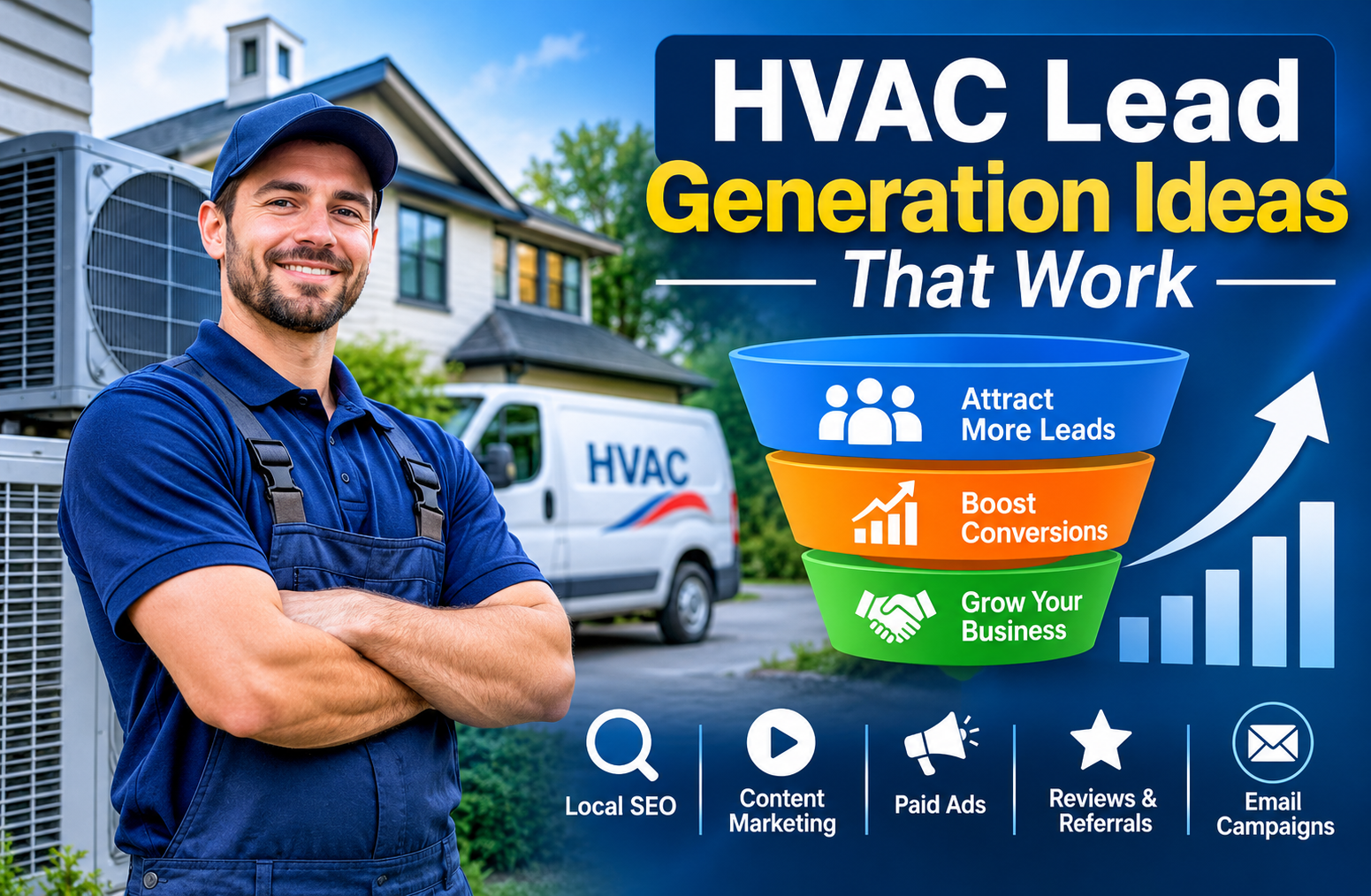
Detailed Guide to HVAC Lead Generation Ideas That Work
Core Channels for Proven HVAC Lead Generation
To build a resilient business, you must stop viewing marketing as a series of isolated experiments and start seeing it as a cohesive ecosystem. Lead qualification is the heartbeat of this system; it ensures that your team spends their time on homeowners who are ready to buy, rather than tire-kickers. By focusing on high-intent inbound channels, you align your business with the way modern consumers search for services.
Whether you are optimizing your service area to capture local traffic or leveraging proven HVAC lead generation techniques to increase your visibility, the goal remains the same: to be the first company a homeowner thinks of when their system fails.
Local SEO and Maps Optimization for Proven HVAC Lead Generation
For most HVAC contractors, the “Map Pack”—the three local businesses displayed at the top of Google Maps results—is the most valuable real estate on the internet. Three-quarters of consumers turn to Google when they need a local service, and they rarely look past the first few results.
To dominate this space, your Google Business Profile must be more than just a placeholder. Ensure your Name, Address, and Phone number (NAP) are perfectly consistent across every directory, including Yelp, Angi, and local chamber of commerce sites. If your business is listed as “Street” on your website but “St.” on a directory, Google’s algorithm may penalize your ranking.
Furthermore, consider creating geo-targeted landing pages for every city or neighborhood you serve. Instead of sending all traffic to a generic homepage, a page titled “AC Repair in [Neighborhood Name]” allows you to include specific local landmarks, neighborhood-specific keywords, and unique testimonials. This hyper-local approach signals to search engines that you are the authority in that specific area, which is essential for capturing “near me” search intent.
High-Converting HVAC Content and Video Marketing
Content marketing is often misunderstood as “writing for the sake of writing.” In reality, it is about answering the specific questions your customers are asking at 2:00 AM when their furnace stops working. Educational blog posts—such as “Why is my AC blowing warm air?” or “How to tell if your furnace needs a repair or a replacement”—establish your authority and build trust before you ever speak to the customer.
Video marketing has become the ultimate trust-builder. When a homeowner sees a video of one of your technicians explaining a ductless mini-split installation or demonstrating how to change a filter, they feel like they already know your team. This familiarity significantly lowers the barrier to entry. Short-form videos, such as “before-and-after” installation walkthroughs, provide tangible proof of your expertise. These clips don’t need to be high-budget productions; in fact, authentic, slightly unpolished video often performs better because it feels more genuine to the viewer.
Paid Advertising, Lead Sourcing, and Acquisition Costs
While organic growth is the foundation, paid advertising provides the “gasoline” to scale your lead volume quickly. However, without a clear understanding of your cost-per-lead (CPL) and cost-per-booked-job, it is easy to burn through your budget without seeing a return.
Exclusive Leads vs. Shared Leads Comparison
One of the most common debates in the industry is whether to buy exclusive or shared leads. Shared leads are cheaper upfront, but they are sold to multiple contractors simultaneously. This forces you into a “race to the bottom” where the first person to call usually wins, often leading to lower conversion rates and frustrated customers.
Exclusive leads, by contrast, are routed only to you. While the initial cost per lead is higher, the ROI is usually superior because your team isn’t competing with three other companies for the same homeowner’s attention.
Lead Type Average Cost Conversion Rate Customer Lifetime Value Exclusive Leads Higher High High Shared Leads Low Low Low Organic Inbound Cost of SEO Very High Very High Balancing Short-Term Paid Ads with Long-Term Proven HVAC Lead Generation
The most successful companies balance the immediate gratification of Google Ads with the long-term equity of SEO. Paid ads are excellent for capturing emergency demand during a heatwave, but you shouldn’t rely on them exclusively. Use paid search to fill gaps in your schedule while your organic SEO efforts build a steady, “free” pipeline of leads that compounds over time. Always use negative keyword lists in your ad campaigns to ensure you aren’t paying for clicks from people searching for “HVAC jobs” or “free DIY repair manuals.”
Customer Retention, Referrals, and Community Trust Building
Acquiring a new customer is significantly more expensive than retaining an existing one. Your database of past clients is a goldmine that is often left untapped.
Automated Review Generation and Online Reputation Management
Ninety-nine percent of consumers consult reviews before hiring a contractor. If your profile is stagnant, you are losing potential jobs. Implement an automated system that sends an SMS request for a review immediately after a service visit. By tying these requests to your CRM, you ensure the timing is perfect. Furthermore, train your technicians to solicit reviews as part of their standard wrap-up process. When a customer sees a technician go above and beyond, they are usually more than happy to provide a five-star rating if asked at the right moment.
Structured Referral Programs and B2B Strategic Partnerships
Word-of-mouth is the original lead generation tool, but you can make it more predictable by structuring it. Create a formal referral program where you reward both the referrer and the new client. Additionally, build strategic partnerships with non-competing businesses. Plumbers, electricians, real estate agents, and home inspectors are often the first to know when a homeowner is having issues with their HVAC system. A simple referral agreement, such as a reciprocal lead-swap or a service discount for their clients, can provide a consistent stream of high-quality leads that never enter the public marketplace.
Targeted Email and Direct Mail Reactivation Sequences
Do not let your customer database go cold. Use email marketing to send seasonal reminders for maintenance tune-ups. If a customer hasn’t had a service visit in 18 months, send them a “We Miss You” offer. For geographic farming, use Every Door Direct Mail (EDDM) to saturate specific neighborhoods with postcards before the heating or cooling season begins. This keeps your brand top-of-mind so that when an emergency arises, your company is the only one they remember.
Operational Automation, CRM Integration, and Lead Tracking
Marketing is useless if your operations team can’t handle the influx of leads. Speed-to-lead is a critical metric; research shows that responding to a lead within the first minute can increase conversion rates by nearly 400%.
Speed-to-Lead Response Workflows and AI Communication Tools
If you are currently relying on a human to manually call every lead, you are likely losing business. Implement 24/7 AI-driven web chat or automated SMS dispatching to acknowledge inquiries instantly. Even if a live person can’t pick up the phone at 3:00 AM, an automated message that says, “We received your request and a technician will call you at 8:00 AM,” keeps the lead from jumping to the next competitor.
Attribution Tracking, Key Performance Indicators, and Avoiding Common Pitfalls
If you don’t track it, you can’t improve it. Use dynamic call tracking numbers for every marketing channel—one for your website, one for your Google Ads, and one for your direct mailers. This allows you to see exactly which campaigns are driving revenue and which are just costing you money. Avoid the common trap of signing long-term contracts with lead-gen agencies that don’t provide transparent reporting. You should always know your cost-per-acquisition and the lifetime value of the customers each channel brings in.
Frequently Asked Questions About HVAC Lead Generation
How much does an average HVAC lead cost in 2026?
Costs vary by market and lead quality. In 2026, you can expect to pay anywhere from $60 to over $300 for an exclusive, high-intent lead. Markets with high competition, such as major metropolitan areas, will naturally be on the higher end of that spectrum.
What is the most reliable way to generate emergency HVAC calls during peak seasons?
Google Local Services Ads (LSAs) are currently the most effective tool for emergency calls. Because they appear at the very top of search results and are backed by the “Google Guaranteed” badge, they build immediate trust and capture homeowners who need help right now. Ensure your profile is set to “24/7 availability” and that your response time is as fast as possible to maintain your ranking.
How long does it take to see positive ROI from HVAC marketing investments?
Paid advertising, such as Google Ads, can generate leads within 24 to 48 hours, providing an immediate return if your landing pages are optimized. SEO, however, is a long-term asset. It typically takes three to six months to see a significant shift in organic rankings, but the leads you generate through SEO are often the most cost-effective and highest-quality in the long run.
Conclusion
HVAC lead generation is not a “set it and forget it” task; it is a continuous process of refinement. By integrating your paid advertising with a strong organic presence, automating your follow-ups, and treating your past customers as your most valuable asset, you can escape the feast-or-famine cycle. Consistency is the difference between a business that struggles to survive and one that dominates its local market year after year. Start by auditing your current lead sources, implementing a tracking system, and focusing on the channels that provide the highest quality of service calls. Your future growth depends on the system you build today.