New York Yankees vs White Sox Match Player Stats
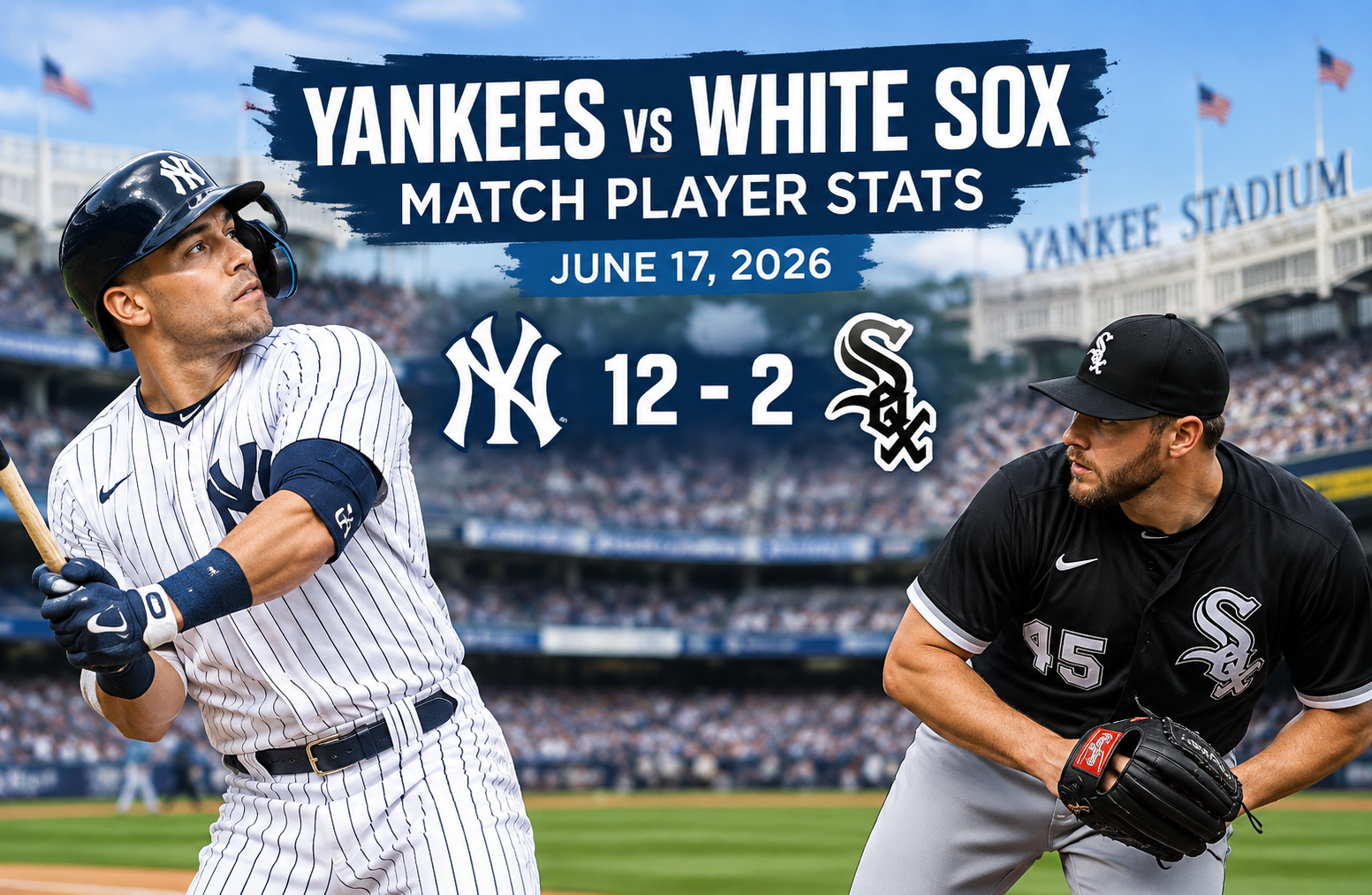
New York Yankees vs White Sox match player stats from June 17, 2026, tell the story of a game that quickly moved away from Chicago and turned into a dominant 12-2 Yankees victory at Yankee Stadium. New York produced 16 hits, four home runs, 12 runs and 11 RBIs, while Chicago managed only four hits and two runs. Gerrit Cole delivered six strong innings for New York, and the Yankees completed the game without committing an error.
The result also gave New York a 2-1 series victory. The Yankees entered the contest with a 44-27 record and a 20-12 home mark, while the White Sox were 38-33 overall and 14-21 on the road.
For readers looking beyond the final score, this game offers several useful points to study. The Yankees did not win simply because of one big swing. Their offense created pressure across several innings, their pitching limited Chicago’s opportunities, and their defense avoided the mistakes that can extend innings.
New York Yankees vs White Sox Match Player Stats
The most important numbers from the June 17 matchup are summarized below.
| Category | White Sox | Yankees |
| Final score | 2 | 12 |
| Runs | 2 | 12 |
| Hits | 4 | 16 |
| Errors | 1 | 0 |
| Team at-bats | 31 | 39 |
| RBIs | 2 | 11 |
| Home runs | 1 | 4 |
| Walks | 2 | 6 |
| Strikeouts | 9 | 10 |
| Left on base | 4 | 10 |
| RISP | 1-for-3 | 3-for-12 |
| Team innings pitched | 8.0 | 9.0 |
| Team earned runs allowed | 11 | 2 |
| Team home runs allowed | 4 | 1 |
The numbers show how wide the gap became.
Chicago actually converted one of its three opportunities with runners in scoring position, while New York went 3-for-12. That means the Yankees did not rely on an unusually high RISP conversion rate to create the final margin. Instead, their advantage came largely from volume, extra-base power and sustained offensive pressure.
New York also collected four times as many hits as Chicago. Sixteen hits in nine innings gave the Yankees repeated opportunities to move runners and build innings.
Game Overview
The game was played on June 17, 2026, at Yankee Stadium in the Bronx.
The Yankees won 12-2, with the game lasting 2 hours and 46 minutes. Attendance was listed at 36,723.
The victory gave New York the series 2-1.
Chicago struck first. Andrew Benintendi homered in the opening inning to give the White Sox an early 1-0 lead. The advantage did not last long.
Spencer Jones answered with a home run in the second inning, tying the game at 1-1.
The third inning was where New York began to establish control. Cody Bellinger delivered a two-run single, Jones drew an RBI walk, and José Caballero added a sacrifice fly. By the end of the inning, the Yankees had moved ahead 5-1.
The fourth inning effectively broke the game open.
Ben Rice hit a two-run home run, Paul Goldschmidt followed with another two-run homer, and Ryan McMahon added an RBI single. The Yankees also benefited from a defensive error as the inning developed.
New York entered the bottom of the fourth leading 11-1.
Chicago scored once more in the sixth when Luis Acuña delivered an RBI single. That reduced the margin to 11-2, but there was no sustained comeback.
Caballero hit a solo home run in the eighth inning to complete the scoring.
The final result was Yankees 12, White Sox 2.
Yankees Offensive Performance
The Yankees’ offensive performance was built around both contact and power.
New York recorded 16 hits and four home runs. That combination matters because it prevented the White Sox pitching staff from settling into a comfortable rhythm.
Four different Yankees were credited with home runs:
- Paul Goldschmidt
- José Caballero
- Spencer Jones
- Ben Rice
Goldschmidt, Caballero, Jones and Rice each produced two RBIs according to the supplied game data.
Cody Bellinger and Anthony Volpe led the Yankees with three hits apiece.
That combination is particularly important when evaluating the game. The Yankees were not dependent on one player generating the entire offense. Multiple hitters contributed, and the lineup continued to create opportunities after individual at-bats ended.
Cody Bellinger’s Three-Hit Contribution
Cody Bellinger finished with three hits and played a significant role in the Yankees’ third-inning surge.
His two-run single helped turn a tied game into a four-run advantage. That hit was more important than simply adding two runs to the box score because it came during the first major offensive rally of the game.
Bellinger’s contribution illustrates why RBI situations need to be considered alongside raw hit totals. A three-hit performance can be valuable in any game, but producing a key hit during a developing rally can change the shape of an inning.
Anthony Volpe’s Three Hits
Anthony Volpe also collected three hits.
Although the supplied data does not provide his complete individual line, his three-hit performance places him among the most productive Yankees hitters in the game.
When a lineup produces 16 total hits, having multiple players reach three-hit territory is a major reason the offense can maintain pressure from inning to inning.
Paul Goldschmidt’s Home Run
Paul Goldschmidt was one of the Yankees’ four home-run hitters.
His two-run home run came during the fourth inning, when New York was already attacking a White Sox pitching staff that had begun to lose control of the game.
Goldschmidt’s homer was part of a four-run fourth inning that increased the Yankees’ lead from 5-1 to 11-1.
The supplied player data also credits Goldschmidt with two RBIs.
José Caballero’s Power
José Caballero produced two RBIs and hit a home run.
His sacrifice fly in the third inning helped New York extend its lead, and his solo home run in the eighth supplied the game’s final run.
That gives Caballero two different types of offensive contribution in the same game. His earlier RBI came as part of a situational offensive sequence, while his later homer added another run after the outcome was already largely decided.
Spencer Jones
Spencer Jones hit the Yankees’ second-inning home run.
That home run was important because it immediately erased Chicago’s early advantage. Instead of allowing the White Sox to build confidence after Benintendi’s first-inning homer, New York answered in the next half-inning.
Jones also received an RBI walk during the third-inning rally, according to the supplied game information.
Ben Rice
Ben Rice hit a two-run home run in the fourth inning.
The homer was one of the biggest offensive blows of the game because it contributed to an inning that produced four runs and pushed the Yankees’ lead to 11-1.
Rice was therefore one of the central contributors to the game’s decisive offensive explosion.
White Sox Offensive Performance
Chicago’s offense had a difficult night against Yankees pitching.
The White Sox finished with only four hits and two runs across 31 at-bats. Their team line included one home run, two walks and nine strikeouts.
Andrew Benintendi provided the first major offensive moment of the contest with a first-inning home run.
That gave Chicago a 1-0 lead, but the White Sox were unable to add enough traffic afterward.
Benintendi was also credited with one RBI, while Luis Acuña produced the other White Sox RBI with a sixth-inning single.
Andrew Benintendi’s Home Run
Benintendi’s first-inning home run gave Chicago the ideal start.
It was the only White Sox home run in the game and accounted for the team’s first run.
However, the early lead did not translate into sustained offensive production. New York’s pitching limited Chicago to three additional hits for the rest of the contest.
Luis Acuña’s RBI
Acuña produced the White Sox’s second RBI with a sixth-inning single.
By that point, Chicago was already trailing 11-1.
The hit reduced the deficit to nine runs, but the Yankees’ offense had created too large a cushion for the White Sox to overcome.
Gerrit Cole’s Pitching Performance
Gerrit Cole was the winning pitcher for New York, improving to 2-1 according to the supplied game data.
His line was:
- 6.0 innings
- 3 hits allowed
- 2 earned runs
- 2 walks
- 6 strikeouts
- 1 home run allowed
Cole’s performance was especially important because Chicago scored in the first inning.
Rather than allowing the early home run to create a larger problem, Cole settled into the game and limited the White Sox to two runs over six innings.
His six strikeouts also helped keep Chicago from consistently putting balls in play.
The supplied game score was 62 for Cole, compared with 9 for Chicago starter D. Martin.
That gap reflects the difference between the two starting pitching performances.
D. Martin’s Difficult Outing
- Martin was charged with the loss for Chicago and moved to 9-3 according to the supplied data.
His pitching line was:
- 3.1 innings
- 8 hits allowed
- 9 earned runs
- 3 walks
- 4 strikeouts
- 3 home runs allowed
The most damaging part of Martin’s outing was the combination of hits and home runs.
He allowed three home runs, and New York scored nine earned runs against him in only 3.1 innings.
The Yankees’ fourth-inning explosion was the decisive point. By the time Martin’s outing ended, New York had already built an 11-1 advantage.
This is one of the clearest differences between the starting pitchers in the game. Cole allowed one home run and two earned runs across six innings, while Martin surrendered three home runs and nine earned runs in 3.1 innings.
Ryan Yarbrough Finishes the Game
Ryan Yarbrough handled the final three innings for New York.
His line was:
- 3.0 innings
- 1 hit allowed
- 0 earned runs
- 0 walks
- 3 strikeouts
Yarbrough did not allow Chicago to create a late rally.
His three scoreless innings also meant the Yankees did not need to use additional pitchers to close out the nine-inning victory.
The supplied data lists Yarbrough with his second save.
Yankees Pitching vs White Sox Pitching
The team pitching numbers show the difference even more clearly than the individual lines.
New York’s pitching staff allowed:
- 4 hits
- 2 runs
- 2 earned runs
- 2 walks
- 9 strikeouts
- 1 home run
Chicago’s pitching staff allowed:
- 16 hits
- 12 runs
- 11 earned runs
- 6 walks
- 10 strikeouts
- 4 home runs
The most striking difference is the number of hits allowed.
Chicago surrendered 16 hits, while New York gave up only four.
That 12-hit difference created a huge advantage in opportunities. Even though both teams recorded double-digit strikeouts as a pitching staff, the Yankees consistently put more balls into play successfully.
How the Yankees Built the 12-Run Total
The scoring sequence provides a useful way to understand the game.
First Inning
Andrew Benintendi homered for Chicago.
White Sox 1, Yankees 0.
Second Inning
Spencer Jones homered for New York.
White Sox 1, Yankees 1.
Third Inning
The Yankees took control with several productive plate appearances.
Bellinger delivered a two-run single. Jones drew an RBI walk, and Caballero added a sacrifice fly.
Yankees 5, White Sox 1.
Fourth Inning
The game changed dramatically.
Rice hit a two-run home run. Goldschmidt followed with a two-run homer. McMahon added an RBI single, and a defensive error also helped extend the inning.
Yankees 11, White Sox 1.
Sixth Inning
Luis Acuña produced an RBI single for Chicago.
Yankees 11, White Sox 2.
Eighth Inning
Caballero hit a solo home run.
Yankees 12, White Sox 2.
The sequence shows that New York’s offensive advantage was established before the final two innings. The eighth-inning homer was important for the final score, but the decisive damage had already been done.
Why the Fourth Inning Mattered Most
The fourth inning deserves special attention when reviewing the game.
New York entered the inning with a 5-1 lead. Four runs would already have represented a strong offensive inning, but the Yankees scored six.
Rice’s two-run homer and Goldschmidt’s two-run homer provided the power. McMahon’s RBI single added another run, while the defensive error created additional pressure.
The result was an 11-1 advantage.
This inning also demonstrates why baseball games can change rapidly. Chicago had entered the contest with a 1-0 lead and remained within striking distance after three innings. One sustained inning completely changed the competitive context.
The Importance of Power Hitting
The Yankees hit four home runs.
Chicago hit one.
That difference alone does not explain every part of the game, but it clearly contributed to the final margin.
New York’s home runs came from four different players. That distribution matters because it shows the lineup was producing power from multiple spots rather than relying on one hitter.
The four Yankees homers accounted for a substantial portion of their 11 RBIs.
Chicago’s only home run came from Benintendi and produced one RBI.
Contact Hitting Was Just as Important
Power was only half of the story.
New York recorded 16 hits overall. Four of those hits left the park, meaning the Yankees also generated 12 non-home-run hits.
Bellinger and Volpe each recorded three hits.
That type of contact production creates the conditions for home runs to become even more damaging. When a lineup regularly reaches base through hits, walks and other productive plate appearances, pitchers have fewer comfortable situations.
New York also drew six walks compared with two for Chicago.
The Yankees therefore had advantages in both hits and walks.
RISP Numbers Need Context
New York went 3-for-12 with runners in scoring position.
Chicago went 1-for-3.
At first glance, Chicago’s 33.3 percent success rate in those situations was higher than New York’s 25 percent rate.
However, using RISP alone to explain this game would miss the larger picture.
New York had 12 RISP opportunities, four times as many as Chicago. The Yankees created many more opportunities because they reached base and produced hits more consistently.
This is a useful reminder that a team can win comfortably without posting an exceptional RISP percentage.
The number of opportunities matters just as much as the conversion rate.
Defensive Difference
The Yankees committed no errors.
Chicago committed one.
A single error may appear small in a box score, but the timing of an error can matter. The White Sox error occurred during the fourth-inning sequence in which New York expanded a 5-1 lead into an 11-1 advantage.
Chicago also turned one double play.
New York’s clean defensive game helped prevent additional opportunities from being created for the White Sox.
What the Box Score Says About the Game
The overall numbers point toward several clear conclusions.
First, the Yankees won the hit battle decisively.
Sixteen hits against four is the most obvious statistical difference in the game.
Second, New York’s lineup produced considerably more power.
Four Yankees homered, compared with one White Sox homer.
Third, the Yankees received a stronger starting pitching performance.
Cole completed six innings and allowed two earned runs. Martin lasted only 3.1 innings while allowing nine earned runs.
Fourth, New York avoided defensive mistakes.
The Yankees had zero errors, while Chicago had one.
Finally, New York maintained its advantage after building a large lead. Yarbrough completed three scoreless innings to prevent a late change in momentum.
New York Yankees vs White Sox Match Player Stats: Key Takeaways
For readers searching specifically for the most important player-level information, the supplied data highlights these contributors:
| Player | Team | Key contribution |
| Gerrit Cole | Yankees | 6.0 IP, 3 H, 2 ER, 2 BB, 6 K, 1 HR |
| Ryan Yarbrough | Yankees | 3.0 IP, 1 H, 0 ER, 0 BB, 3 K |
| Cody Bellinger | Yankees | 3 hits, 2 RBIs |
| Anthony Volpe | Yankees | 3 hits |
| Paul Goldschmidt | Yankees | 2-run home run, 2 RBIs |
| José Caballero | Yankees | Home run, 2 RBIs |
| Spencer Jones | Yankees | Home run, 2 RBIs |
| Ben Rice | Yankees | 2-run home run, 2 RBIs |
| Andrew Benintendi | White Sox | Home run, 1 RBI |
| Luis Acuña | White Sox | 1 RBI |
The table intentionally focuses only on statistics contained in the supplied game data. It does not fill in missing individual at-bat, run, walk or strikeout totals with estimates.
A Practical Way to Read This Box Score
When evaluating a baseball matchup, it is tempting to focus on the final score and the player who hit the most memorable home run.
A better approach is to examine the game in layers.
Start with the overall run differential. Then compare hits and walks. After that, look at home runs and extra-base production. Next, review the starting pitching. Finally, consider defensive mistakes and situational hitting.
For this game, every major layer points in the same direction.
The Yankees:
- Scored 12 runs
- Recorded 16 hits
- Hit four home runs
- Drew six walks
- Allowed only four hits
- Allowed two runs
- Committed zero errors
- Received six innings from Cole
- Received three scoreless innings from Yarbrough
The White Sox:
- Scored two runs
- Recorded four hits
- Hit one home run
- Drew two walks
- Struck out nine times
- Allowed 12 runs
- Allowed 16 hits
- Allowed four home runs
- Committed one error
That is why the 10-run final margin is consistent with the underlying box score rather than being the product of one unusual event.
Game Context and Series Result
The Yankees entered the game at 44-27 overall and 20-12 at home.
The White Sox entered at 38-33 overall and 14-21 away.
After the game, the Yankees had completed a 2-1 series victory.
The home setting was therefore part of a broader series context rather than an isolated contest.
The attendance was 36,723, and the game lasted 2:46.
For official MLB information and broader game records, readers can consult MLB.com.
What These Statistics Mean for Future Game Analysis
A single game should not be treated as proof of a player’s entire-season performance.
That is especially important when using a box score for fantasy analysis, betting research, historical comparison or player evaluation.
The June 17 game does provide useful evidence about what happened on that specific day.
The Yankees generated substantial offensive volume, and several players contributed. Cole provided a strong start. Yarbrough protected the lead. Chicago’s offense struggled to generate sustained traffic.
Those are game-specific findings.
For longer-term evaluation, readers should compare this game with larger samples that include recent performance, season totals, opponent quality, home and road splits, pitching matchups and workload.
This distinction is important because baseball contains significant game-to-game variation.
Visual and Media Recommendations
A direct-to-publish version of this article can work without additional visuals, but an original visual can make the statistical story easier to understand.
A useful chart would compare the two teams across:
- Runs
- Hits
- Home runs
- Walks
- Strikeouts
- Errors
Another useful graphic would show the scoring progression by inning, with the Yankees’ third and fourth innings highlighted.
For a more advanced baseball audience, a pitching comparison graphic could place Cole’s six-inning performance beside Martin’s 3.1-inning outing.
These visuals should be created from the supplied box-score data rather than copied from another publisher.
Frequently Asked Questions
What was the Yankees vs White Sox score on June 17, 2026?
The New York Yankees defeated the Chicago White Sox 12-2 at Yankee Stadium.
Who was the winning pitcher?
Gerrit Cole was the winning pitcher for New York. He pitched six innings, allowed three hits and two earned runs, walked two and struck out six.
Who hit home runs for the Yankees?
Paul Goldschmidt, José Caballero, Spencer Jones and Ben Rice each hit a home run for New York.
Who hit the White Sox home run?
Andrew Benintendi hit Chicago’s only home run. It came in the first inning and gave the White Sox an early 1-0 lead.
Which Yankees hitters had three hits?
Cody Bellinger and Anthony Volpe each recorded three hits according to the supplied game data.
How many hits did each team have?
The Yankees recorded 16 hits, while the White Sox recorded four.
Conclusion
The June 17, 2026 matchup between the Yankees and White Sox was defined by a sharp contrast in offensive production and pitching effectiveness.
New York finished with 16 hits, four home runs and 12 runs. Cody Bellinger and Anthony Volpe each recorded three hits, while Goldschmidt, Caballero, Jones and Rice supplied the Yankees’ home runs.
On the mound, Gerrit Cole delivered six innings with two earned runs allowed and six strikeouts. Ryan Yarbrough then added three scoreless innings to close out the 12-2 victory.
Chicago’s offense produced only four hits. Benintendi supplied the early home run, and Acuña added an RBI single, but the White Sox could not maintain offensive pressure after taking the initial 1-0 lead.
The fourth inning was the decisive stretch. New York turned a 5-1 advantage into an 11-1 lead through a combination of home-run power, contact hitting and continued pressure.
The Yankees also played error-free defense, while Chicago committed one error.
Taken together, the statistics provide a clear picture of why New York won the game and the series 2-1. The result was not based on one isolated performance. It came from a combination of 16 hits, four home runs, strong starting pitching, effective relief work and clean defense.