The Clerk’s Mistake: A Word Born on the Tweed, and the Tartan That Came from It
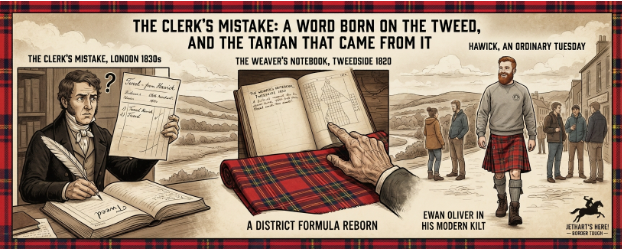
The story of the Oliver tartan begins in the Scottish Borders, where the river, its weaving traditions and the families who lived along its banks became closely intertwined. Some time in the 1830s, a London cloth merchant received a consignment from a firm in Hawick, in the Scottish Borders, with an invoice attached. The cloth was a rough woollen twill of the kind the Border mills had woven for generations. The invoice, written in a Scottish hand, described it by the Scots word for twill, which is tweel.
The clerk who handled it could not read the handwriting, or did not know the word. He knew, however, that the goods had come from the valley of the River Tweed. So he wrote down what he thought it said, and sold the cloth under that name, and the name stuck.
That, at any rate, is the story the Borders have told for a hundred and fifty years, and nobody has been able to disprove it. Whether or not a single clerk was responsible, the word tweed was unknown before the 1830s and universal within a generation. It turned a country cloth into a world industry. And the same river valley, a little earlier, had quietly given a Border family the beginnings of a tartan.
The weaver’s notebook
Before the mills, weaving in the Borders was cottage work. Every village had its weavers, working handlooms in their own houses on wool spun by their neighbours, and every weaver kept a book of patterns: the sequences of coloured threads that made up the checks and stripes his customers asked for. Most of those books are lost. A few survive, and a few of their patterns were copied into the records of the great tartan firm of William Wilson & Sons of Bannockburn, which collected setts from all over Scotland.
One of them was labelled Tweedside. The tartan archives date it to about 1820. It was a district pattern, the kind of thing a farmer or a shepherd along the river might have had made up into a plaid, and it belonged to nobody in particular.
The Olivers were not, in the days of the cottage weavers, wearing any of it. Border families did not wear tartan. They wore the shepherd’s check, the small black and white pattern of the hill plaids, and later the tweeds their own mills made. The idea that a Border name should have a tartan of its own came with the general Scottish enthusiasm of the nineteenth century, and most of the riding families took theirs from the Vestiarium Scoticum of 1842, which invented one for everybody. The Olivers, being small and not in that book, had to wait longer and did it better.
The Tweedside pattern stayed in the books, unused, for a hundred and fifty years. Then in 1973 the Oliver Society, an association of people of that surname, wanted a tartan of their own. Instead of inventing one from nothing, they went back to the river. The register records that the Oliver tartan was designed for the Society in 1973 and based on a cottage weaver’s formula named Tweedside, dating from around 1820. The mills at Lochcarron wove it. There is a hunting version in green with black, yellow and blue, and a dress version on red.
Jethart’s here
The Olivers belong to Jedburgh and the valley of the Jed, in the middle of the old Scottish Border. They were one of the riding families of Jedforest, the wild country south of the town, and their name turns up in the records of the sixteenth century in the company of the Rutherfords, the Turnbulls and the Kerrs, which is to say among the reivers. Jedburgh had a reputation for rough justice, and the phrase Jethart justice, meaning hang first and try afterwards, is still in the language.
The town’s war cry was Jethart’s here! It was shouted at Flodden, where the men of Jedburgh went in with their long axes, and it is shouted still. Every July the town holds the Jethart Callant’s Festival, one of the Border Common Ridings, when several hundred riders on horseback follow the Callant, a young man chosen for the year, out to the old boundaries and back, to mark the marches and remember the dead. The Border towns take these festivals very seriously. A man who has ridden in twenty of them is a person of standing.
Hawick, the tweed town, has the oldest and fiercest of them, and its story explains why. In 1514, the year after Flodden had killed most of the grown men of the district, a party of English raiders camped at Hornshole, on the Teviot two miles from the town. The boys of Hawick, the callants, too young to have gone to the war, rode out at night, fell on the camp and came home with the raiders’ flag. The town has ridden out to remember them every June since, behind a replica of that flag, and the word callant, a lad, has stuck to every Border festival that followed. It is not a place that forgets.
The Oliver tartan is therefore a Border tartan through and through: a district pattern from the river, adopted by a Jedburgh name. Its Modern version is a warm, close design of red and green with black, blue and a little yellow, the colours of a Tweedside autumn, and it has a homely quality that the grand Highland setts lack. Retailers offer Oliver tartan made to order as kilts, skirts, waistcoats and scarves, or by the yard, with the hunting and dress versions alongside.
There is a certain justice in what it is now most often made into.
Hawick, an ordinary Tuesday
Ewan Oliver is twenty-six and works in the dye house of a cashmere mill in Hawick, eleven miles from Jedburgh, in the town where the invoice was written. He rides in the Callant’s Festival every July, in jodhpurs and a tweed jacket like everyone else. The rest of the year he wears a kilt about three days a week, and it is not the kind his grandfather owned.
His grandfather’s kilt is in the wardrobe at his mother’s house: eight yards of heavy worsted, pleated by hand, a magnificent object that comes out for weddings and weighs as much as a small dog. Ewan loves it and has no intention of wearing it to the pub.
What he wears instead is what the trade has started calling a contemporary kilt. He bought his from Scottish Kilt, whose range of modern kilts is described, accurately, as having lighter construction, shallower pleating and modern hardware, in real tartan setts, in a cut you can wear on an ordinary Tuesday. It is cut to his own waist, hips and length like any of their kilts, and it is unmistakably a kilt, with a flat front apron and pleats behind. But it uses about five yards of cloth instead of eight, the pleats are shallower and swing less, it sits a little lower on the hip, and it fastens with snaps and a strap rather than three buckles. There are pockets. It is machine washable, which in a dye house is not a small thing.
It is also, he has found, the kilt that gets him talked to. A full traditional kilt at a wedding is expected and nobody comments. A light one in the Oliver check, worn with a sweatshirt into the Co-op on a Tuesday evening, gets a question at the till from someone who has lived in Hawick all her life and thought kilts were for Highlanders.
His is the Oliver, the red and green of the river. He wears it with a plain black T-shirt or a grey sweatshirt, thick socks pushed down, and boots, and on a Tuesday evening in Hawick that reads not as costume but as clothes. Older men in the Borders, who never wore a kilt in their lives because the kilt was a Highland thing, have stopped him in the street to ask about it.
“Oliver,” he tells them. “It’s a Tweedside pattern. Some weaver up the river had it in his book two hundred years ago, and the society took it up in the seventies.”
“Tweedside. That’s a Border tartan, then.”
“Born here. Same as the word.”
He has explained the clerk and the invoice so many times that he has it down to four sentences. He is not sure he believes it. He tells it anyway, because it is the best thing anyone in the Borders ever got out of a spelling mistake.
What the river gave
The Tweed valley gave the world a word, by accident, and then gave a Border family a tartan, on purpose, from a pattern that had waited a century and a half in a weaver’s book. Neither the clerk nor the cottage weaver could have imagined the uses their work would be put to, and both would probably be pleased.
The cloth of the Borders was always working cloth: tweel for coats, checks for plaids, something to wear on a horse or a hill. A lighter kilt, in the river’s own colours, with pockets and snaps, worn to work in a dye house in Hawick, is exactly the kind of thing they wove it for.