Pyjamaspapper: Meaning, History, Uses, and Its Connection to Traditional Computer Paper
The word Pyjamaspapper may look unusual at first, but its meaning becomes more interesting when examined through language, printing history, and everyday technology. It is a niche term associated with an older style of continuous computer paper, particularly the long sheets with distinctive stripes and perforated edges that were commonly used with traditional printing systems. Although the word is now appearing in online searches and lifestyle discussions, its historical connection to paper and printing deserves particular attention.
Unlike familiar terms such as printer paper, notebook paper, or wrapping paper, Pyjamaspapper does not have one widely documented definition across modern English-language dictionaries. Some online publications describe it as a creative lifestyle concept, while others connect it with decorative designs, pajama-inspired patterns, or comfortable clothing. These different explanations can make it difficult to understand what the word actually represents.
The most useful way to understand the term is to separate its established-looking historical association from newer online interpretations. In particular, its connection with continuous-feed computer paper provides a practical explanation of the unusual name. This article explores its possible meaning, historical background, appearance, applications, modern relevance, and the important differences between documented information and creative interpretations.
What Is Pyjamaspapper?
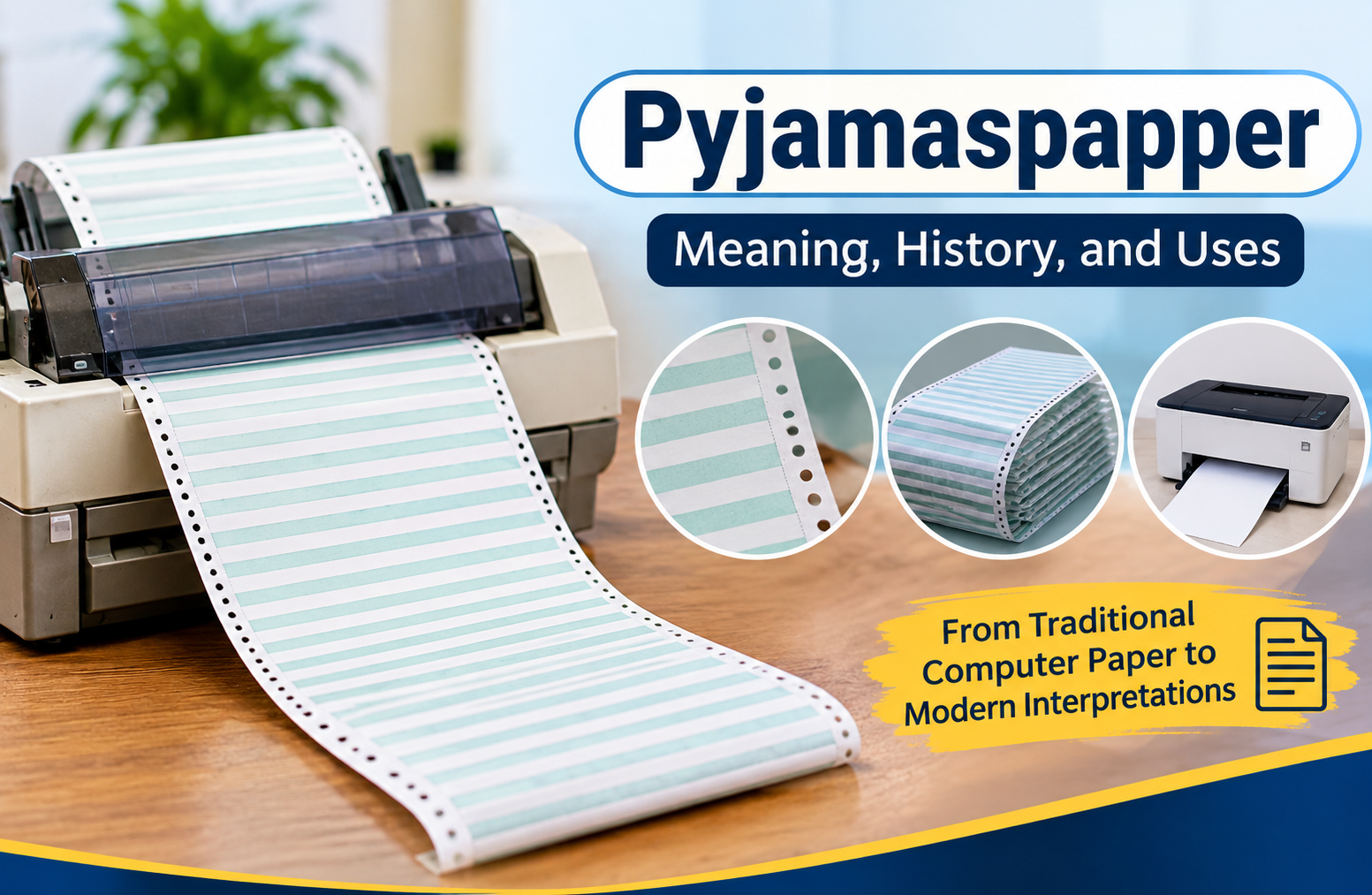
Pyjamaspapper is an uncommon term associated with striped continuous computer paper, especially the long connected sheets used by older computer printing systems.
This type of paper was designed to move through compatible printers without requiring individual sheets to be loaded manually. It commonly featured perforated edges, allowing mechanical feeding systems to pull the paper through the printer accurately.
The paper could also feature alternating light and darker horizontal stripes. These stripes made long printed reports easier to read because they helped users follow information across the page.
The association with pajamas comes from the paper’s distinctive striped appearance. The visual similarity between striped sleepwear and the paper’s alternating bands offers a straightforward explanation for the unusual name.
However, an important distinction is necessary: although this historical interpretation appears in online discussions, a definitive historical etymology has not been established here through an authoritative Swedish dictionary or archival source.
Understanding the Name
The word appears to combine two recognizable linguistic elements:
- Pyjama: A word associated with traditional sleepwear and clothing.
- Papper: A Swedish word meaning paper.
Together, these elements suggest a connection between pajamas and paper, particularly paper with a striped appearance.
The spelling is especially interesting because it reflects a Scandinavian-language construction rather than a standard English expression.
It is therefore important not to assume that every website using the word is describing an actual paper product. Context determines whether the writer is discussing printing materials, decorative design, fashion, or a newly invented lifestyle concept.
The Historical Connection Between Pyjamaspapper and Continuous Computer Paper
To understand why this paper matters, it helps to look at how businesses handled printed information before modern digital workflows became common.
Older computer systems frequently produced large amounts of information. Businesses, government offices, warehouses, financial departments, and other organisations needed reliable ways to print records, invoices, lists, and reports.
Ordinary individual sheets were not always the most practical solution.
Continuous-feed paper provided an alternative. Instead of loading one sheet at a time, users could place a connected stack of paper into a compatible printer.
The machine pulled the paper through as printing continued.
How Continuous-Feed Paper Worked
Traditional continuous computer paper usually included several practical features:
- Connected sheets: Individual pages remained attached through perforated folding lines.
- Perforated edges: Holes along the sides helped compatible printers move the paper.
- Folding sections: The paper could be folded into a compact stack for storage.
- Consistent dimensions: Standardised formats helped businesses organise printed output.
- Striped backgrounds: Some varieties used alternating colours to improve readability.
These features made continuous paper especially useful when printing lengthy documents.
Rather than collecting hundreds of separate sheets, workers could handle a connected paper stream and separate individual pages when necessary.
Why Older Businesses Relied on This Format
Before modern cloud storage and digital document management became widespread, printed records played a central role in business operations.
For example, a warehouse might need a long inventory report showing product numbers, quantities, and storage locations.
A financial department might print transaction records or accounting summaries.
A transport company could produce delivery information, shipment lists, and operational records.
Continuous-feed paper supported these activities by making long printing jobs easier to manage.
It was not simply a different-looking paper format. It was part of the practical infrastructure that helped organisations operate their computer systems.
What Did Traditional Striped Computer Paper Look Like?
One of the easiest ways to recognise this type of paper is its distinctive physical appearance.
Traditional continuous-feed paper was usually supplied in a folded stack. When opened, it formed a long connected strip that could travel through a printer.
Depending on its intended use, it could include different colours, printed lines, pre-designed sections, and perforations.
1. Alternating Horizontal Stripes
Some varieties featured alternating green and white or blue and white horizontal bands.
These patterns were useful when reading long lists because they helped separate one line of information from another.
Imagine looking at a printed report containing hundreds of rows of numbers. Without visual separation, it would be easy to lose track of the correct row.
Alternating stripes made the information easier to follow.
2. Perforated Side Edges
Many traditional forms included small holes along both sides.
These holes were not decorative. They served an important mechanical purpose.
The printer’s tractor mechanism used rotating pins to engage with the holes and move the paper forward.
This arrangement helped maintain alignment during printing.
3. Folding Perforations
Another common feature was the horizontal perforation between individual pages.
These perforations allowed the connected paper to fold backward and forward into a compact stack.
After printing, users could separate individual sheets by tearing along the perforated lines.
4. Different Paper Widths
Continuous forms were available in different widths and lengths.
The correct format depended on the printer, the document layout, and the number of characters required per line.
Some businesses also ordered specially printed forms with headings, columns, and spaces for particular information.
Why Was Striped Paper Useful?
The striped appearance was more than a visual design choice.
It addressed a practical problem associated with reading large amounts of printed information.
When documents contain many rows of similar-looking numbers, the reader needs a reliable way to distinguish one line from another.
This is particularly important in financial reports, inventory lists, payroll records, and other structured documents.
Improved Line Tracking
Alternating background colours made it easier to follow information horizontally.
For example, someone checking a financial report could identify a particular row without accidentally moving to the line above or below it.
This was especially useful when working with wide printouts.
Easier Reading of Large Reports
Computer-generated reports were sometimes lengthy and contained hundreds or thousands of entries.
A striped background provided a simple visual reference.
Employees could scan information more efficiently without relying entirely on manual line counting.
Better Organisation
Printed records were often shared between different departments.
Clear visual formatting made documents easier to inspect, sort, and review.
For organisations that depended on paper-based records, this was a meaningful advantage.
Practical Printing and Handling
Continuous paper reduced the need to feed individual sheets into compatible printers.
Its connected format also made it easier to manage large printing jobs.
These benefits explain why continuous forms remained useful in business environments for many years.
How Was Pyjamaspapper Used in Traditional Workplaces?
The historical relevance of this paper becomes clearer when looking at the types of documents businesses produced.
Although specific applications varied, continuous-feed paper was particularly suitable for structured information that needed to be printed in large quantities.
Accounting and Financial Reports
Financial departments regularly handled information such as:
- Transaction records
- Payment summaries
- Account statements
- Daily financial reports
- Tax-related records
- Internal accounting lists
A continuous printer could produce long reports without requiring someone to load individual pages repeatedly.
Striped paper could also make rows of financial figures easier to examine.
Warehouse and Inventory Management
Warehouses often needed printed lists showing stock information.
These documents could include product identifiers, quantities, locations, and stock movement records.
A continuous paper format made it convenient to print lengthy inventories.
Workers could then review the output, mark changes, and retain physical copies where required.
Payroll Processing
Payroll systems generated structured information for employees and accounting departments.
Depending on the system, printed output could include employee identifiers, payment amounts, deductions, and other records.
Continuous forms were useful for producing multiple pages of organised information.
Some specialised forms also supported multiple copies, allowing different departments to receive the necessary documentation.
Transport and Logistics
Transport businesses handled large amounts of operational information.
Examples included shipment records, delivery schedules, consignment details, and dispatch lists.
Continuous-feed printing offered a practical method for generating these documents.
Government and Administrative Offices
Government departments and administrative organisations also relied on computer-generated reports.
Long lists, registration records, transaction summaries, and other structured documents could be printed using continuous forms.
The important point is that the paper supported a broad range of administrative activities rather than serving only one specialised industry.
The Relationship Between Pyjamaspapper and Older Printer Technology
The history of continuous-feed paper is closely connected to the development of computer printing.
Early computer systems needed physical methods of displaying and preserving information.
A monitor could show information temporarily, but printed records provided a physical document that could be stored, distributed, reviewed, and signed.
This made printing technology an important part of business computing.
Dot-Matrix Printers
9-1/2 x 11″ Dot Matrix Pinfeed Continuous Tractor Feed Computer Paper 1 Part – Walmart.com
Dot-matrix printers became closely associated with continuous computer paper.
They used a print head containing small pins that struck an ink ribbon against the paper.
The pins formed characters and images through a series of dots.
These printers were particularly useful for applications where businesses needed:
- Large quantities of printed information
- Relatively inexpensive printing
- Multi-part forms
- Continuous document output
- Durable administrative records
The tractor-feed mechanism helped move the paper through the machine.
Line Printers
Accounting machines, the IBM 1403, and why printers standardized on 132 columns
Line printers were designed to produce large amounts of computer output.
Rather than printing individual characters in the same manner as a typical desktop printer, many systems printed complete lines at high speed.
They were commonly associated with mainframe computing and large organisational workloads.
Continuous paper was well suited to this environment because the machines could produce lengthy reports.
Tractor-Feed Mechanisms
Continuous paper for dot matrix printers. Copy printing.
The tractor-feed mechanism was an important part of continuous-paper printing.
It used rotating components to engage with the perforated edges of the paper.
This helped the machine move the paper forward at a controlled rate.
The mechanism also reduced the risk of paper shifting sideways during printing.
The relationship between the paper and the printer was therefore mechanical as well as practical.
For additional technical background, the National Institute of Standards and Technology’s historical computer-printer material explains different paper-feeding systems, including pin-feed and tractor-feed mechanisms.
Pyjamaspapper Compared With Modern Printer Paper
Printing technology has changed significantly, but understanding older formats helps explain why modern printing products look different.
Continuous forms and ordinary office paper serve related purposes, but their construction and feeding methods are not the same.
| Feature | Traditional continuous paper | Modern individual printer paper |
| Paper format | Connected sheets | Separate sheets |
| Feeding method | Tractor or compatible feed | Roller or sheet feeder |
| Side edges | Often perforated | Usually smooth |
| Storage | Folded continuous stack | Separate reams or sheets |
| Common printers | Dot-matrix and line printers | Inkjet and laser printers |
| Typical use | Long reports and forms | Letters, documents, and graphics |
| Separation | Perforated sections | Already separate |
Continuous Paper Versus A4 Paper
A4 paper is widely used in modern offices.
It has a standard rectangular format and is generally supplied as individual sheets.
Continuous paper, by contrast, is designed to move through a printer as one connected length.
The two formats are not interchangeable unless the printer specifically supports the relevant paper type.
Continuous Paper Versus Thermal Paper
Thermal paper is another specialised printing material.
It reacts to heat from a thermal print head, producing text or images without requiring a conventional ink ribbon.
It is commonly used for receipts, tickets, and labels.
Although thermal paper and continuous forms may both be supplied in rolls, they are different concepts.
One describes a printing material that reacts to heat, while the other describes a continuous paper format.
Continuous Paper Versus Carbonless Forms
Carbonless paper is designed to produce multiple copies of a document.
It is often used for invoices, delivery notes, and other forms where several parties need a copy.
Some continuous forms were also manufactured as multi-part documents.
However, carbonless paper and continuous-feed paper describe different properties. One relates to copying, while the other relates to paper feeding and format.
Benefits of Traditional Continuous Paper
Although many organisations now rely on digital records, the older paper format had several practical advantages.
1. Convenient Large-Scale Printing
The connected format made long printing jobs easier to manage.
Users did not have to load a new sheet after every page.
This was especially useful when a business needed to print extensive reports.
2. Consistent Paper Feeding
Perforated edges allowed compatible printers to move the paper through a tractor mechanism.
This provided a controlled feeding method.
3. Easy Document Separation
Horizontal perforations allowed printed pages to be separated when necessary.
The remaining paper could still be handled as a continuous strip.
4. Support for Multi-Part Documents
Certain continuous forms were manufactured in multiple layers.
These formats allowed compatible impact printers to produce several copies during one printing process.
5. Useful Visual Formatting
Striped varieties helped readers follow information across lengthy reports.
This was particularly valuable when documents contained numerous rows and columns.
6. Suitable for Specialised Workflows
Continuous forms could be manufactured with preprinted information and layouts.
For example, a business could order paper with specific fields for invoices, customer records, or internal reports.
This reduced the need to create every document layout from scratch.
Challenges and Limitations of Continuous Computer Paper
Despite its advantages, this paper format also had limitations.
Understanding these drawbacks explains why many workplaces eventually adopted different printing and record-management systems.
Printer Compatibility
Continuous paper requires compatible feeding equipment.
An ordinary modern inkjet or laser printer generally cannot use traditional tractor-feed paper in the same way as an older dot-matrix printer.
Using the wrong paper format can lead to feeding problems or unsuccessful printing.
Physical Storage Requirements
Large quantities of printed paper require storage space.
Long reports can become difficult to organise, particularly when an organisation produces new records every day.
Digital document management has made storing and retrieving large volumes of information more convenient.
Paper Damage
Continuous forms can tear around their perforated edges.
The tractor holes may also become damaged if the paper is loaded incorrectly or experiences excessive tension.
A damaged section can interfere with paper movement.
Printing Quality
Older impact printers were not designed to produce the same level of image quality as many modern laser and inkjet printers.
Their text output was suitable for many administrative tasks, but high-quality photographs and complex graphics were not their main strengths.
Manual Document Handling
After printing, workers often needed to separate, organise, file, or distribute the documents.
This required additional time and physical handling.
Modern digital systems can automate many of these activities.
Why Did Continuous Paper Become Less Common?
The decline of traditional continuous-feed paper was not caused by one single invention.
Instead, several technological developments gradually changed how organisations created, stored, and shared information.
The Growth of Laser Printers
Laser printers offered faster and cleaner printing for many everyday office tasks.
They also supported individual sheets, making them convenient for letters, reports, presentations, and general business documents.
As these printers became more accessible, organisations had fewer reasons to use continuous forms for ordinary printing.
The Expansion of Digital Records
Computers gradually became more capable of storing information electronically.
Businesses could save documents, search databases, send reports through email, and retrieve historical information without keeping every printed page.
This reduced the need for physical printouts.
The Development of Office Software
Word processors, spreadsheets, and database applications made document creation more flexible.
Users could produce professional reports using standard office printers.
They no longer needed specialised continuous forms for many administrative tasks.
The Growth of Network Printing
Network-connected printers allowed multiple employees to share printing equipment.
This made individual-sheet printing more convenient across departments.
The Shift Towards Paperless Workflows
Digital signatures, electronic invoices, online accounting platforms, and document-management systems reduced the need for traditional paper records.
However, paper printing did not disappear completely.
Some industries continue to use specialised forms because their equipment, operational requirements, or documentation procedures depend on physical output.
Is Pyjamaspapper Still Relevant Today?
The traditional continuous-feed paper format is less common in everyday offices, but its underlying applications have not completely disappeared.
Some businesses continue to rely on specialised printing systems.
The important difference is that modern printing environments are more diverse.
Industrial Printing
Some industrial environments use specialised continuous-feed printing equipment.
These systems can be appropriate when organisations need to produce large volumes of documents or labels.
The technology may differ from older dot-matrix systems, but the broader idea of feeding a continuous medium through a printer remains relevant.
Warehousing and Logistics
Warehouses need accurate labels, shipment information, and inventory records.
Specialised printers can produce continuous labels and other materials designed for operational requirements.
However, modern label printing should not automatically be confused with traditional striped computer paper.
Retail and Transaction Processing
Retail businesses continue to use printers for receipts, transaction records, and other customer-facing documents.
Many modern systems use thermal printing rather than traditional continuous computer paper.
Archival and Historical Research
Older printed records can be valuable to historians, researchers, and organisations studying the development of computing.
They provide physical evidence of how information was produced and managed before digital systems became dominant.
How to Identify Traditional Continuous Computer Paper
If you encounter an old box of printed paper or an unfamiliar continuous form, several characteristics can help you identify it.
Step 1: Examine the Side Edges
Look for evenly spaced holes along both sides.
These holes are a strong indication that the paper was designed for a pin-feed or tractor-feed printing mechanism.
Step 2: Check the Horizontal Perforations
Traditional fan-fold paper usually has perforated lines separating individual sections.
These lines allow the paper to fold and separate into pages.
Step 3: Look for Alternating Colours
Some varieties have alternating green and white or blue and white horizontal bands.
This feature is commonly associated with traditional computer printouts.
Step 4: Inspect the Folding Pattern
Check whether the paper has been folded into an alternating zigzag arrangement.
This is known as fan-folding.
It allows long continuous sheets to be stored in a compact stack.
Step 5: Look for Printed Information
Older computer forms may include:
- Transaction numbers
- Account identifiers
- Inventory details
- Column headings
- Financial figures
- Machine-generated text
- Preprinted document fields
These details can help establish the paper’s original purpose.
Step 6: Examine the Paper Condition
Older paper may have faded, become yellow, or developed brittle edges.
If the material appears historically significant, avoid pulling it apart or using unsuitable cleaning products.
Preserving original documents can be important for archival research.
How to Choose Continuous Paper for an Older Printer
Finding suitable paper for an older printer requires more attention than purchasing ordinary office paper.
Compatibility is essential.
The printer’s specifications should determine the paper selection.
1. Confirm the Printer Model
Start by identifying the exact printer model.
Different machines support different paper widths, thicknesses, and feeding arrangements.
Do not assume that every continuous-paper printer accepts the same format.
2. Check Paper Width
Measure the paper carefully.
The width must match the printer’s supported feeding range.
Paper that is too narrow or too wide may not align properly.
3. Examine Tractor Holes
If the printer uses a tractor-feed mechanism, the hole spacing must be compatible with its feeding components.
Incorrect spacing can lead to paper movement problems.
4. Choose the Appropriate Paper Thickness
Single-ply and multi-part forms have different thickness characteristics.
The printer must be able to handle the selected material.
5. Consider the Document Layout
Think about what you intend to print.
A simple report may require ordinary continuous paper, while a business form may need preprinted fields or multiple layers.
6. Check Folding and Perforation Quality
Good-quality perforations make folding and separation easier.
Poorly manufactured perforations can cause unwanted tearing.
7. Test Before Buying in Bulk
If possible, test a small quantity first.
Check whether the paper feeds smoothly, remains aligned, and separates cleanly.
This is particularly important when working with older printing equipment.
How to Preserve Old Continuous Computer Paper
Historical computer printouts can contain valuable information.
They may document business activity, technological processes, or personal records from earlier periods.
Preservation therefore requires some care.
Keep Paper Away From Excessive Moisture
Humidity can weaken paper and encourage mould growth.
Store old forms in a dry environment with reasonably stable conditions.
Avoid Direct Sunlight
Prolonged exposure to sunlight can cause fading and deterioration.
Keep important records away from windows and other sources of intense light.
Use Appropriate Storage Materials
Archival-quality folders and storage materials can help protect valuable documents.
Avoid storing important paper records in unsuitable plastic materials or containers that trap moisture.
Handle Fragile Paper Carefully
Old perforations and edges can tear easily.
Support the paper when moving it, and avoid pulling it from one corner.
Digitise Important Records
Scanning valuable documents creates an additional copy for reference.
A digital archive can also make searching and organising old information easier.
However, digital copies should not replace careful storage of original documents when the originals have historical, legal, or personal importance.
Pyjamaspapper in Modern Online Discussions
Although its historical association is connected with paper, the word now appears in several different online contexts.
This creates an important challenge for anyone researching it.
A search engine may display pages that describe the term as clothing, a lifestyle idea, a creative aesthetic, or a digital keyword.
These interpretations are not necessarily descriptions of the same thing.
Pyjamaspapper as a Creative Design Expression
Some lifestyle and design discussions use the word to suggest patterns inspired by traditional striped pajamas.
In this context, the emphasis is on appearance rather than printing technology.
For example, a designer might use soft stripes, familiar colours, or fabric-inspired patterns in a paper-based project.
This is a creative interpretation, not evidence that the word represents an established paper category.
Pyjamaspapper as a Lifestyle Concept
Other online writers connect the term with relaxation, comfort, and creativity.
They may use it to describe activities such as journaling, crafting, or spending quiet time at home.
This interpretation appears to be an informal use of the keyword.
It should not be confused with a formally recognised wellness method or a scientifically established lifestyle practice.
Pyjamaspapper as a Digital Keyword
The unusual spelling also makes it suitable for discussion as an internet search term.
People may encounter it in articles, search suggestions, social media posts, or unfamiliar websites.
When they cannot immediately understand its meaning, they may search for an explanation.
This creates an opportunity for accurate informational content.
However, search interest alone does not prove that a word represents a new product, established company, or widely adopted cultural trend.
Why Do Different Websites Give Pyjamaspapper Different Meanings?
The inconsistent explanations are one of the most important aspects of researching this term.
There are several reasons why different websites may describe it differently.
Lack of a Widely Accepted Definition
Some words have clear definitions supported by dictionaries and established technical publications.
Uncommon expressions do not always have the same level of documentation.
When a term lacks a widely accepted definition, writers may interpret it according to its spelling or the subject of their website.
Creative Interpretation
A fashion writer may focus on the word’s connection with pajamas.
A stationery writer may concentrate on paper and decorative patterns.
A technology writer may discuss continuous computer printing.
Each interpretation creates a different article, even though the keyword remains unchanged.
Repeated Online Explanations
Another problem occurs when websites repeat explanations without independently checking them.
Several articles discussing the same idea do not automatically establish that the idea is historically accurate.
For that reason, readers should distinguish between original evidence and repeated online claims.
Search Engine Context
Search engines use the surrounding content to understand what a page discusses.
If websites associate an unusual keyword with different subjects, search results may display a mixture of interpretations.
The best way to resolve this confusion is to identify the context in which the word appears.
How to Research Pyjamaspapper Without Confusing Its Meaning
Researching an uncommon term requires a slightly different approach from researching a familiar product.
Instead of accepting the first available explanation, examine the evidence behind each interpretation.
Here is a practical method.
- Start with the original context: Identify where you encountered the word. Was it on a paper product, fashion website, historical document, or lifestyle blog?
- Separate facts from interpretations: A documented printer mechanism is different from a creative explanation of a word.
- Check technical references: Look for printer manuals, historical documents, and established publications when researching continuous paper.
- Compare independent sources: Do not rely on several articles that appear to repeat the same unsupported claim.
- Look for product evidence: If someone describes it as a commercial product, check whether there is a manufacturer, product specification, or verifiable listing.
- Avoid assuming brand ownership: A website using the keyword does not automatically represent an official company associated with it.
- Update your understanding when evidence changes: New information may clarify how a niche term is being used.
This approach is useful for unusual search terms because it prevents assumptions from becoming presented as established facts.
Is Pyjamaspapper a Brand, Product, or Traditional Material?
This is a reasonable question because many online articles discuss the word as though it represents a specific product.
However, these categories need to be considered separately.
| Category | What can reasonably be established |
| Traditional paper association | Connected with striped continuous computer paper in some historical interpretations |
| Fashion product | Used in some online interpretations involving pajamas and sleepwear |
| Decorative paper | Used creatively in discussions about patterns and crafts |
| Lifestyle concept | Sometimes associated with relaxation and creativity |
| Established global brand | No single internationally recognised brand has been verified here |
| Standard technical category | Not established as a universally recognised paper classification |
A useful distinction is that a word can be used creatively without representing an officially recognised product.
If a seller offers something under this name, buyers should inspect the actual product description, material, specifications, and seller information.
Do not purchase an item based solely on an unfamiliar name.
The Future of Pyjamaspapper and Its Historical Significance
The future relevance of this term depends largely on how people continue to use it.
Its connection with older computer paper gives it a place in discussions about printing history and traditional office technology. Meanwhile, its newer creative interpretations show how unusual expressions can develop different meanings through online communication.
Preserving Traditional Printing Knowledge
Older printing systems are an important part of computing history.
Understanding continuous forms helps explain how organisations generated, processed, and stored information before modern digital document systems became widespread.
Preserving examples of traditional paper can also help researchers understand the materials used in earlier computer environments.
Interest From Collectors
Vintage computer equipment attracts interest from technology collectors and enthusiasts.
Original continuous forms, old printer manuals, and historical computer documents can provide useful context for restoring older machines.
However, not every old paper product has significant monetary or historical value. Its condition, rarity, origin, and documentation all matter.
Continued Use of Specialised Printing
Although traditional striped computer paper is less common, continuous-feed printing remains relevant in certain specialised environments.
Modern printing technology still supports different forms of continuous media.
This demonstrates that the underlying concept of feeding a continuous material through a printer has not disappeared entirely.
Evolution of the Keyword
The online meaning of Pyjamaspapper may continue to change.
It could remain a niche historical expression, become more closely associated with a particular creative community, or gain a clearer meaning through consistent usage.
Until stronger documentation becomes available, it is best to avoid making definite claims about a single modern meaning or origin.
Frequently Asked Questions About Pyjamaspapper
1. What is Pyjamaspapper?
Pyjamaspapper is an uncommon term associated with striped continuous computer paper used in older printing systems. The paper typically featured connected sheets, perforated edges, and sometimes alternating horizontal colours. Some modern websites also use the term in creative fashion and lifestyle contexts.
2. What does Pyjamaspapper mean in Swedish?
The word appears to combine elements associated with pajamas and the Swedish word papper, meaning paper. Its historical interpretation is associated with striped paper. However, a definitive historical explanation of the complete compound has not been established through an authoritative linguistic reference.
3. Why was traditional Pyjamaspapper striped?
Alternating colours helped readers distinguish individual lines in lengthy printed reports. This was particularly useful for financial records, inventory lists, and computer-generated tables containing large amounts of information.
4. Was Pyjamaspapper used with dot-matrix printers?
The traditional continuous-paper format was compatible with many dot-matrix printers designed for tractor-feed paper. Perforated side edges allowed the printer mechanism to move the paper through the machine while maintaining alignment.
5. Is Pyjamaspapper still used today?
Traditional striped computer paper is less common in modern offices. However, continuous-feed printing remains relevant in some specialised environments, including certain industrial and commercial printing applications.
6. Is Pyjamaspapper a recognised fashion brand?
There is insufficient verified information to identify it as a single established international fashion brand. Some websites use the term in sleepwear and lifestyle discussions, but these interpretations should not be treated as proof of brand ownership or commercial recognition.
7. Can Pyjamaspapper be used for creative projects?
If the term is being used creatively to describe striped or pajama-inspired paper designs, those patterns could be applied to stationery, scrapbooking, gift wrapping, and other decorative projects. However, this is a creative interpretation rather than a verified standard product category.
8. What is the difference between Pyjamaspapper and ordinary printer paper?
Traditional continuous computer paper is supplied as connected sheets with feeding and folding perforations. Ordinary printer paper is generally supplied as individual sheets. The two formats are designed for different paper-handling systems.
9. Why are people searching for Pyjamaspapper?
People may encounter the unusual term in online articles, historical discussions, or creative content and search for its meaning. Its different online interpretations also create curiosity about whether it refers to paper, fashion, technology, or a lifestyle concept.
10. How can I identify traditional continuous computer paper?
Look for long connected sheets, perforated side edges, horizontal folding lines, and possibly alternating coloured stripes. These characteristics help distinguish traditional continuous forms from ordinary office paper.
Conclusion
Pyjamaspapper is an unusual term that offers an interesting connection between language, traditional printing materials, and modern internet culture. Its historical association with striped continuous computer paper provides a practical way to understand the word, particularly when examining older printing systems and the development of business technology.
Traditional continuous forms played an important role in offices that needed to produce lengthy financial reports, inventory records, payroll information, and administrative documents. Their connected structure, tractor-feed holes, folding perforations, and optional alternating stripes made them useful for large-scale printing and organised recordkeeping.
Although modern printers and digital document systems have replaced many of their everyday applications, continuous-feed printing remains relevant in specialised environments. The older paper format also provides an interesting reminder of how businesses managed information before digital workflows became widespread.
At the same time, modern online discussions have introduced other interpretations involving sleepwear, decorative patterns, creative activities, and lifestyle ideas. These uses should be understood as developing interpretations rather than established historical definitions.
Ultimately, the most reliable way to understand the term is to consider its context, examine the available evidence, and distinguish documented printing technology from newer creative meanings. This balanced approach provides a clearer understanding of both its historical relevance and its evolving place in online discussions.