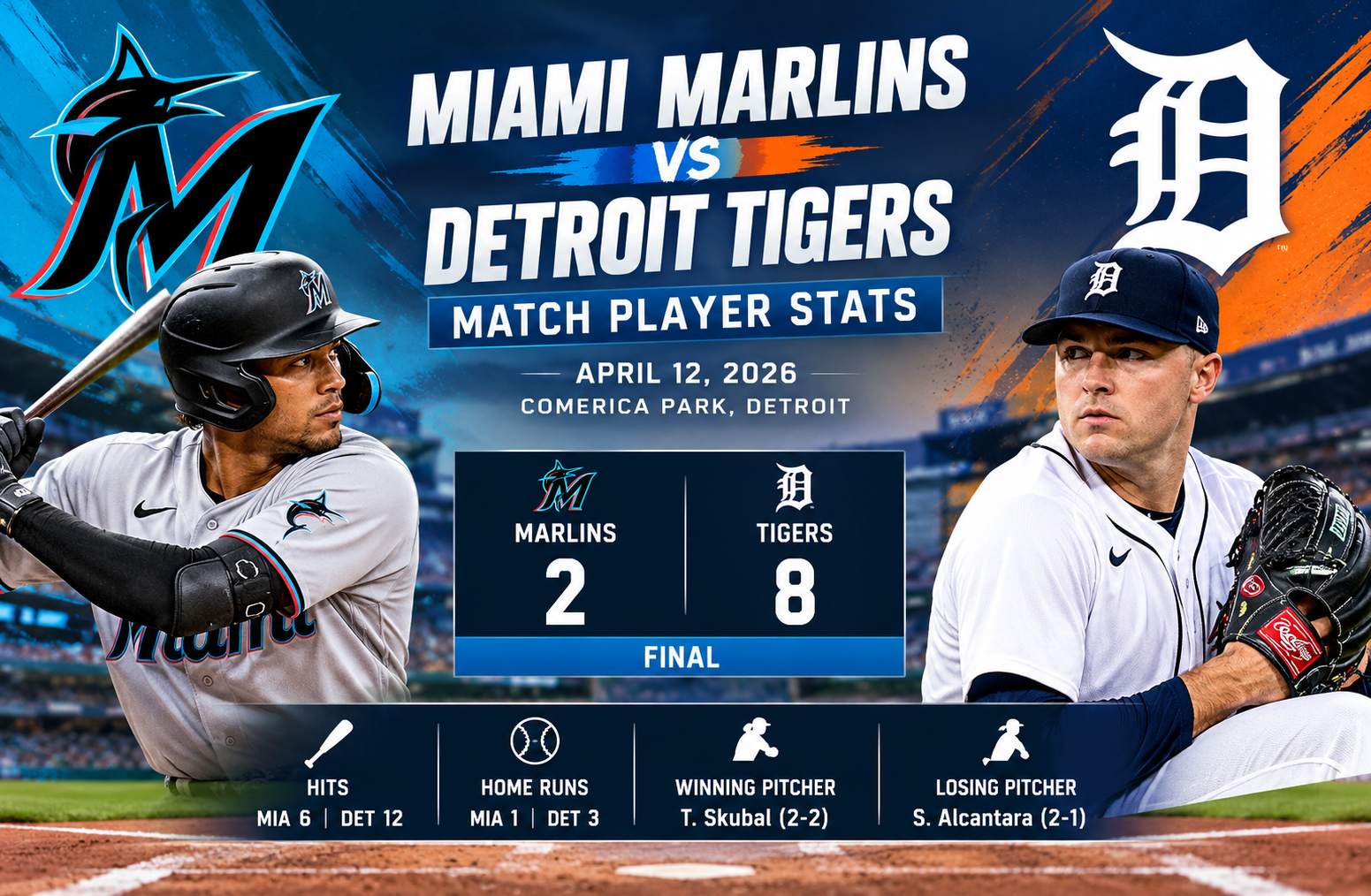
Miami Marlins vs Detroit Tigers Match Player Stats
Miami Marlins vs Detroit Tigers match player stats from April 12, 2026, tell the story of a game that looked like a potential pitching duel but quickly turned into a decisive Detroit victory. The Tigers defeated the Marlins 8-2 at Comerica Park, completing a three-game sweep and finishing the series with a 16-3 scoring advantage. Detroit’s offense produced 12 hits and three home runs, while Tarik Skubal delivered 6.2 strong innings and limited Miami to two hits before the Marlins finally broke through late.
The game had several layers beyond the final score. Dillon Dingler opened the scoring with a three-run homer in the first inning, Kevin McGonigle hit his first Major League home run in the fifth, and Kerry Carpenter added a two-run shot in the sixth. Otto Lopez provided Miami’s biggest offensive moments with a sacrifice fly and a ninth-inning home run, but the Marlins could not create enough sustained traffic against Skubal and the Detroit bullpen.
For readers looking beyond a basic box score, this game is especially useful because the numbers explain how Detroit controlled the contest. The Tigers combined early power, pressure on Sandy Alcantara, timely hitting and strong starting pitching. Miami, meanwhile, struggled to convert its limited opportunities and finished 0-for-2 with runners in scoring position.
Miami Marlins vs Detroit Tigers Match Player Stats: Game Overview
The matchup took place on April 12, 2026, at Comerica Park in Detroit, Michigan. Detroit entered the finale looking to complete the sweep, while Miami needed a win to avoid leaving Detroit without a victory in the series.
The Tigers accomplished the sweep with an 8-2 win.
| Game Detail | Miami Marlins | Detroit Tigers |
| Final Score | 2 | 8 |
| Runs | 2 | 8 |
| Hits | 6 | 12 |
| Errors | 0 | 0 |
| Home Runs | 1 | 3 |
| Runs Batted In | 2 | 7 |
| Walks | 2 | 3 |
| Strikeouts | 8 | 6 |
| RISP | 0-for-2 | 2-for-6 |
| Series Result | Lost 0-3 | Won 3-0 |
| Attendance | 26,768 | 26,768 |
| Game Time | 2:22 | 2:22 |
The official MLB game record confirms the 8-2 score, the 12-6 hit advantage and the pitching lines for Tarik Skubal and Sandy Alcantara. (MLB.com)
The most important number may not be the eight runs. It is the combination of 12 hits and three home runs. Detroit did not rely on one isolated offensive sequence. The Tigers repeatedly created productive contact and kept adding to their lead.
Miami’s six hits were not enough because most of the offense came after Detroit had already established control.
How the Game Unfolded
Detroit immediately put pressure on Sandy Alcantara in the first inning.
Dillon Dingler launched a three-run home run, giving the Tigers a 3-0 lead before Miami had an opportunity to establish its offense. That early homer shaped the rest of the game because Detroit could play from ahead while Skubal attacked Miami’s hitters with less pressure.
The score remained 3-0 until the fifth inning.
Kevin McGonigle then hit his first career Major League home run, extending Detroit’s advantage to 4-0. MLB’s postgame coverage highlighted the significance of the homer because McGonigle hit it against Alcantara, a former National League Cy Young Award winner. (MLB.com)
Detroit broke the game open in the sixth.
Kerry Carpenter hit a two-run homer to make it 6-0. Javier Báez followed with an RBI single, giving the Tigers a seven-run advantage.
Miami finally scored in the seventh when Otto Lopez produced a sacrifice fly. The Marlins added another run in the ninth on Lopez’s solo home run, but the late offense arrived after Detroit had already built an insurmountable lead.
The final scoring sequence was:
- First inning: Detroit scored 3 runs
- Fifth inning: Detroit scored 1 run
- Sixth inning: Detroit scored 3 runs
- Seventh inning: Miami scored 1 run
- Eighth inning: Detroit scored 1 run
- Ninth inning: Miami scored 1 run
The official MLB game story records the same progression and identifies Dingler, McGonigle, Carpenter, Báez and Lopez among the key scoring contributors. (MLB.com)
Detroit Tigers Offensive Breakdown
Detroit’s offense was the defining difference.
The Tigers collected 12 hits in 36 at-bats and scored eight runs. They also hit three home runs, compared with one for Miami.
The raw numbers show a productive lineup, but the more useful observation is how Detroit distributed its production.
Dillon Dingler Sets the Tone
Dillon Dingler delivered the most important early swing.
His three-run home run in the bottom of the first inning immediately changed the game’s shape. Instead of allowing Skubal to work in a low-scoring contest, Detroit gave its starting pitcher a three-run cushion.
That matters against an elite pitcher such as Skubal because a lead can change pitch selection and offensive aggression. Skubal could attack hitters rather than trying to protect a narrow margin.
Dingler’s homer accounted for three of Detroit’s seven player-generated RBIs listed in the game data.
Kevin McGonigle’s First MLB Home Run
Kevin McGonigle was one of the game’s most interesting individual stories.
His fifth-inning homer pushed Detroit ahead 4-0 and marked his first Major League home run. MLB reported that McGonigle had already shown signs of offensive ability during his first weeks in the majors, making the homer another important milestone in his early career. (MLB.com)
His contribution was not limited to the home run itself. McGonigle scored twice, making him one of Detroit’s leading run producers on the afternoon.
For a lineup trying to establish pressure throughout the order, that combination of reaching base, scoring and producing extra-base damage is particularly valuable.
Kerry Carpenter Adds the Knockout Blow
Kerry Carpenter delivered the game’s third Detroit home run.
His two-run homer in the sixth inning increased the Tigers’ lead from 4-0 to 6-0. That was the point at which the game became extremely difficult for Miami to recover.
Carpenter finished with two RBIs, while the home run gave Detroit another major contribution from the middle portion of its lineup.
The Tigers therefore received home runs from Dingler, McGonigle and Carpenter, spreading the power across multiple positions rather than depending on one hitter.
Javier Báez Adds Another Run
Javier Báez followed Carpenter’s home run with an RBI single.
That sequence is important because Detroit did not stop attacking after hitting the home run. The lineup continued to put the ball in play and converted another opportunity immediately afterward.
Detroit ultimately recorded seven RBIs on the afternoon.
Miami Marlins Offensive Breakdown
Miami’s offense had a much more difficult afternoon.
The Marlins finished with six hits, two runs, two walks and eight strikeouts. They went 0-for-2 with runners in scoring position.
That final statistic deserves attention.
Going 0-for-2 with runners in scoring position does not mean Miami had no offensive opportunities, but it does show that the club failed to turn its limited high-leverage chances into runs. Detroit, by comparison, went 2-for-6 in those situations.
Otto Lopez Provides Both Miami Runs
Otto Lopez was the clear offensive highlight for Miami.
He finished with two RBIs and accounted for both Marlins runs through different types of offensive plays.
In the seventh inning, Lopez hit a sacrifice fly that put Miami on the scoreboard.
In the ninth inning, he hit a solo home run for Miami’s second and final run.
That combination made Lopez responsible for the entire Miami run total.
The ninth-inning homer also prevented the Marlins from being shut out, but it came too late to materially change the result.
Austin Slater Ends the No-Hit Bid
One of the more notable moments came in the sixth inning when Austin Slater broke up Skubal’s no-hit bid.
That detail is important when evaluating Skubal’s performance. Miami was not merely struggling to score. For much of the afternoon, the Marlins were struggling to generate hits at all.
Skubal carried the no-hitter into the sixth before Slater finally produced Miami’s first hit. MLB’s game coverage specifically records that moment. (MLB.com)
Tarik Skubal’s Pitching Performance
Tarik Skubal delivered the strongest individual pitching performance of the game.
His final line:
| Pitching Statistic | Tarik Skubal |
| Innings | 6.2 |
| Hits Allowed | 2 |
| Earned Runs | 1 |
| Strikeouts | 7 |
| Walks | 2 |
| Decision | Win |
| Record | 2-2 |
Skubal’s performance was especially important because he kept Miami’s offense quiet while Detroit’s lineup built a substantial lead.
He allowed only two hits through 6.2 innings and struck out seven. The Marlins managed only one run against him.
The first six innings were the clearest indicator of his control over the game. Miami did not record its first hit until the sixth, and its first run did not arrive until the seventh.
Skubal’s seven strikeouts also helped him escape potential trouble without relying heavily on defensive plays.
The official MLB game record lists his 6.2 innings, two hits allowed, one earned run and seven strikeouts. (MLB.com)
Sandy Alcantara’s Difficult Outing
Sandy Alcantara entered the game as one of the most accomplished pitchers involved in the matchup, but Detroit produced one of his toughest outings.
His final line:
| Pitching Statistic | Sandy Alcantara |
| Innings | 6.0 |
| Hits Allowed | 10 |
| Earned Runs | 7 |
| Strikeouts | 4 |
| Walks | 2 |
| Decision | Loss |
| Record | 2-1 |
The biggest issue was not a lack of strikeouts. Alcantara actually recorded four.
The problem was the amount of hard offensive production Detroit generated. He surrendered 10 hits and three home runs while allowing seven earned runs.
MLB’s postgame report noted that Alcantara had allowed 10 hits in this outing after giving up only 10 combined hits across his previous three starts. (MLB.com)
That contrast makes the outing stand out.
A pitcher can have a difficult game without losing command completely. Alcantara walked only two hitters, but Detroit repeatedly found ways to make contact and turn those balls into meaningful production.
Pitching Comparison
When comparing the two starters, the contrast is clear.
| Category | Tarik Skubal | Sandy Alcantara |
| Innings | 6.2 | 6.0 |
| Hits Allowed | 2 | 10 |
| Earned Runs | 1 | 7 |
| Strikeouts | 7 | 4 |
| Walks | 2 | 2 |
| Result | Win | Loss |
Both pitchers issued two walks, which makes the difference in the outing even more striking.
Detroit’s hitters did not need Alcantara to lose control of the strike zone. They produced 10 hits and three home runs while keeping the strikeout total manageable.
Skubal, meanwhile, limited Miami to two hits and one earned run.
That is the central pitching story of the game.
Miami Marlins vs Detroit Tigers Match Player Stats: Key Players
Looking at individual performances provides a better understanding of why the final score became so one-sided.
Detroit Tigers Key Contributors
Dillon Dingler
Dingler provided the game’s first major offensive swing with a three-run homer in the first inning. His blast gave Detroit immediate control.
Kevin McGonigle
McGonigle hit his first career MLB home run and scored twice. His performance gave Detroit another source of offensive momentum after the early Dingler homer.
Kerry Carpenter
Carpenter hit a two-run homer in the sixth inning and finished with two RBIs.
Riley Greene
Greene scored twice and helped keep Detroit’s offensive pressure moving throughout the game.
Javier Báez
Báez added an RBI single during Detroit’s three-run sixth inning.
Tarik Skubal
Skubal’s 6.2 innings of one-run, two-hit pitching were the foundation of the victory.
Miami Marlins Key Contributors
Otto Lopez
Lopez led Miami with two RBIs and scored both Marlins runs through a sacrifice fly and a solo homer.
Austin Slater
Slater produced Miami’s first hit, ending Skubal’s no-hit bid in the sixth inning.
Sandy Alcantara
Although Alcantara took the loss, he still completed six innings. The seven earned runs and 10 hits allowed were the decisive negatives.
Team Batting Comparison
The offensive gap can be summarized through the team batting numbers.
| Statistic | Marlins | Tigers |
| At-Bats | 30 | 36 |
| Runs | 2 | 8 |
| Hits | 6 | 12 |
| RBIs | 2 | 7 |
| Home Runs | 1 | 3 |
| Walks | 2 | 3 |
| Strikeouts | 8 | 6 |
| RISP | 0-for-2 | 2-for-6 |
Detroit had twice as many hits as Miami.
The Tigers also had three home runs compared with one for the Marlins. Their six strikeouts were two fewer than Miami’s eight despite having six more at-bats.
That combination points to a more efficient offensive afternoon.
Detroit was not simply swinging for power. The Tigers also put the ball in play consistently.
Why Detroit’s First Inning Mattered So Much
The three-run first inning deserves special attention.
When a game begins with a three-run homer, the entire tactical environment changes.
For Detroit, the lead meant Skubal could pitch aggressively. He did not need to avoid contact at all costs. He could challenge Miami hitters and use his strikeout ability to control counts.
For Miami, the situation was reversed.
The Marlins had to play from behind against one of baseball’s premier starting pitchers. Every scoreless inning increased the pressure.
That is exactly what happened.
Miami did not score in the first six innings. Detroit added another run in the fifth and three more in the sixth.
By the time the Marlins scored, the deficit had reached seven runs.
The Sixth Inning Was the Turning Point
If the first inning established Detroit’s advantage, the sixth inning removed most of the remaining uncertainty.
The Tigers scored three times.
Carpenter’s two-run homer made it 6-0.
Báez’s RBI single made it 7-0.
At the same time, Miami was still struggling to produce against Skubal.
This is a useful example of why game analysis should consider timing rather than only totals. Detroit’s eight runs were not randomly distributed. The club created an early lead, added insurance, then responded to the Marlins’ late attempts to score.
The Value of Home Run Distribution
Detroit’s three home runs came from three different players:
- Dillon Dingler
- Kevin McGonigle
- Kerry Carpenter
That distribution matters.
When several players contribute home runs in the same game, the opposing pitcher cannot simply navigate around one dangerous hitter.
Dingler supplied the early three-run blast.
McGonigle provided a middle-game solo homer.
Carpenter produced a two-run shot.
The Tigers therefore received power at multiple points in the game.
Miami had only one home run, and it came from Lopez in the ninth inning when the game was already 8-1.
The Series Context
The game was not an isolated result.
Detroit swept the three-game series.
The results were:
| Game | Result |
| Game 1 | Tigers 2, Marlins 0 |
| Game 2 | Tigers 6, Marlins 1 |
| Game 3 | Tigers 8, Marlins 2 |
Detroit therefore outscored Miami 16-3 across the three games.
That is an important contextual detail when evaluating the finale.
The Tigers’ advantage was not limited to one afternoon. They held Miami to three total runs over the entire series.
The third game simply produced the largest Detroit offensive total of the three.
What the Series Says About the Two Teams
A three-game series cannot define an entire season, but it can reveal specific short-term strengths and weaknesses.
Detroit demonstrated an ability to control games with starting pitching and timely offense.
Miami’s difficulty was more comprehensive. The Marlins scored only three runs across three games and were held scoreless in the opening game.
In the finale, Miami’s offense did not produce a hit until the sixth inning and did not score until the seventh.
For the Tigers, the series offered a strong combination of run prevention and offensive execution.
A Closer Look at Situational Hitting
Situational hitting is one of the most useful ways to interpret this game.
Miami went 0-for-2 with runners in scoring position.
Detroit went 2-for-6.
The raw difference is not enormous in terms of attempts, but the timing matters.
Detroit’s offense created more opportunities because it generated 12 hits.
Miami had only six.
This creates a chain reaction:
More hits create more baserunners.
More baserunners create more scoring opportunities.
More scoring opportunities create more chances to use productive outs and extra-base hits.
Detroit consistently moved through that chain.
Miami rarely did.
Defensive Execution
Both teams were charged with zero errors.
That means neither side gave away an unearned run through a fielding mistake.
Detroit also turned two double plays.
The clean defensive performance is worth noting because it means the final score was primarily a product of pitching and hitting rather than defensive miscues.
For Miami, this makes the loss even more straightforward to diagnose. The Marlins did not lose because of a series of errors. They lost because Detroit generated significantly more offensive production and Skubal controlled the game from the mound.
The Importance of Game Length
The game lasted only 2 hours and 22 minutes.
That is relatively efficient for a nine-inning game, particularly considering Detroit scored eight runs.
The pace was supported by Skubal’s ability to work efficiently and the lack of extended offensive traffic from Miami during the first six innings.
Attendance at Comerica Park was 26,768.
What Stands Out Most From the Player Stats
Several numbers summarize the entire matchup.
12 Detroit Hits vs. 6 Miami Hits
Detroit doubled Miami’s hit total.
That is the simplest explanation for the offensive gap.
3 Detroit Home Runs vs. 1 Miami Home Run
Detroit’s power was spread across Dingler, McGonigle and Carpenter.
Miami’s only home run came from Lopez in the ninth.
7 Earned Runs Allowed by Alcantara
Seven earned runs in six innings made it extremely difficult for Miami to remain competitive.
1 Earned Run Allowed by Skubal
Skubal allowed only one earned run while working 6.2 innings.
7 Strikeouts by Skubal
His seven strikeouts helped prevent Miami from turning limited opportunities into sustained rallies.
0-for-2 With Runners in Scoring Position for Miami
The Marlins did not convert either of their official opportunities with runners in scoring position.
What Fans and Analysts Should Take From the Box Score
The most useful lesson from this game is that the final score was supported by several independent statistical indicators.
Detroit had:
- More hits
- More home runs
- More runs
- More RBIs
- More successful RISP opportunities
- Fewer strikeouts
- A stronger starting pitching performance
- Two double plays
- A clean defensive game
Miami had no errors, but that was not enough to offset the offensive and pitching gap.
This is why looking only at the final score can miss important details. The 8-2 result was not the product of one isolated inning. Detroit consistently won the statistical battle in multiple areas.
Miami Marlins vs Detroit Tigers Match Player Stats: Biggest Takeaways
The most important conclusions from the game are straightforward.
Tarik Skubal controlled the game early.
He took a no-hit bid into the sixth and finished with two hits allowed, one earned run and seven strikeouts.
Detroit’s power changed the game.
Dingler, McGonigle and Carpenter all homered.
Kevin McGonigle had a milestone performance.
His fifth-inning home run was the first of his Major League career.
Sandy Alcantara could not contain Detroit’s contact.
The Tigers collected 10 hits against him and scored seven earned runs.
Otto Lopez carried Miami’s scoring production.
He drove in both Marlins runs and produced Miami’s only home run.
The Tigers completed a sweep.
Detroit won all three games and outscored Miami 16-3.
Miami struggled to create sustained offense.
The Marlins produced only six hits and did not score until the seventh inning.
Frequently Asked Questions
What was the final score between the Miami Marlins and Detroit Tigers on April 12, 2026?
The Detroit Tigers defeated the Miami Marlins 8-2 at Comerica Park in Detroit.
Who was the winning pitcher?
Tarik Skubal earned the win. He pitched 6.2 innings, allowed two hits and one earned run, and struck out seven batters.
Who took the loss for Miami?
Sandy Alcantara took the loss after pitching six innings and allowing 10 hits and seven earned runs while striking out four.
Who hit home runs for the Tigers?
Dillon Dingler, Kevin McGonigle and Kerry Carpenter each hit a home run for Detroit.
Who hit the Marlins’ home run?
Otto Lopez hit Miami’s only home run. He also drove in both Marlins runs.
Did the Tigers sweep the Marlins?
Yes. Detroit won all three games of the series. The Tigers won 2-0 in Game 1, 6-1 in Game 2 and 8-2 in Game 3.
Conclusion
The Miami Marlins vs Detroit Tigers match player stats from April 12, 2026, show a game controlled by Detroit from the opening inning.
The Tigers scored three runs in the first inning, received another home run from Kevin McGonigle in the fifth, then added three runs in the sixth to turn the game into a comfortable lead. Their 12 hits and three home runs created enough offensive pressure to support Tarik Skubal’s excellent start.
Skubal was the most influential player on the mound. His 6.2 innings, two hits allowed, one earned run and seven strikeouts kept Miami quiet for most of the afternoon. The Marlins did not record their first hit until the sixth inning and did not score until the seventh.
For Miami, Otto Lopez provided the clearest offensive bright spot. His sacrifice fly and ninth-inning home run accounted for both Marlins runs. However, six total hits and an 0-for-2 mark with runners in scoring position were not enough to challenge Detroit.
Sandy Alcantara’s seven earned runs were another decisive part of the result. Detroit’s hitters repeatedly made productive contact, with Dingler, McGonigle and Carpenter each supplying a home run.
The larger series picture is equally important. Detroit completed a three-game sweep and outscored Miami 16-3. The finale was therefore the strongest offensive performance of a series in which the Tigers consistently limited the Marlins’ ability to score.
For anyone studying the box score, the central message is clear: Detroit won through a combination of superior contact, timely power and dominant starting pitching. The 8-2 final score reflected a statistical advantage that appeared across nearly every major category.