From IKE to AE: When a Greek Subsidiary Outgrows Its First Legal Structure
Most UAE companies start their Greece Business Setup with an IKE, and it is easy to see why. Private companies are easy to set up, flexible and low on capital requirements, but by year 5 you will find that your initial structure may become restrictive. As investors come on board and banks ask more difficult questions, you will want more control of your board.
This is typically where the Greek AE comes in.This guide explains when the switch makes sense, how conversion works, and what to settle first.
Why did the IKE work so well at the start?
The IKE (Idiotiki Kefalaiouchiki Etaireia) is Greece’s private company. It is a separate legal entity with limited liability. Partners have wide freedom to shape management and ownership. For a foreign-owned company in Greece, that flexibility is the draw.
It also asks for little capital and little ceremony. A single administrator can run it. For a straightforward subsidiary, that is often enough.
IKE vs AE: what actually changes?
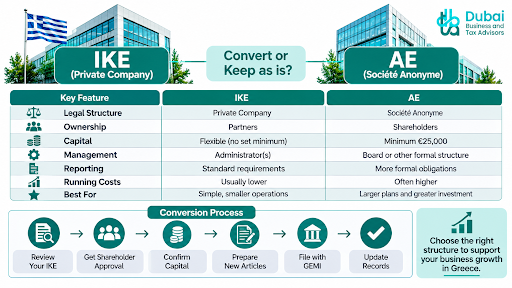
The AE (Anonymi Etaireia) is Greece’s société anonyme. Ownership sits in shares, governance is more formal, and the AE minimum share capital in Greece is €25,000. Confirm that figure and the payment rules against current law.
| IKE | AE | |
| Ownership | Company interests held by partners | Shares held by shareholders |
| Capital | Flexible | €25,000 statutory minimum |
| Management | Administrator(s) | Board or other permitted arrangement |
| Governance | Lighter | More formal |
| Best for | Simple ownership | Investors, financing, complex shareholding |
| Running costs | Usually lower | Usually higher |
So is the Greek AE company simply better? No. A profitable, simple IKE can stay an IKE for decades. The real IKE vs AE Greece question is which structure fits your next five years.
Signs your subsidiary has outgrown its IKE
Watch for these business signals:
- Outside investors are coming. They expect clear share classes and defined rights.
- Financing is getting complicated. Larger funding calls for firmer financial governance.
- Your parents want real oversight. Board-level decisions suit an AE better than one administrator’s signature.
- A sale or expansion is near. Buyers read a share structure more easily.
These are commercial triggers, not legal ones. Higher turnover, more staff or bigger profits do not force a conversion.
Can an IKE become an AE directly?
Yes, through statutory conversion. Law 4601/2019 brought the Greek rules on corporate transformations together into one legislative act. That makes it the backbone of any Greek corporate transformation. Beware older online guides. They can use IKE conversion provisions of Law 4072/2012 that are no longer applicable.
The major consideration is continuity. When properly converted into an AE in Greece the legal entity will retain continuity. The IKE will not be dissolved and so you are not starting from scratch. This is important for any contracts, assets and licences you have but there are some contracts which have their own notice or consent clauses.
The conversion process, step by step
- Review the IKE. Check the articles, ownership, reserves, debts and guarantees.
- Draft the conversion proposal. Set the AE’s share capital, shareholdings and management structure.
- Get shareholder approval. Voting rules depend on the articles and Greek company law, so confirm them early.
- Settle valuation and capital. Find out whether an expert report is required.
- Prepare the new articles. Expect notarial formalities and, for foreign signatories, translations and legalisation.
- File with GEMI. This is the General Commercial Registry. Registration and publication make the conversion effective.
- Update everything else. Banks, suppliers, invoices, payroll and regulators need the new details.
We have given no timeline deliberately. Timing depends on your documents, valuation needs and registry practice. Anyone quoting a fixed duration without seeing your file is guessing.
Capital: the question that trips people up
Does the IKE’s existing capital cover the €25,000? Not automatically. The answer depends on paid-up capital, reserves, net assets and liabilities. Accumulated losses reduce net assets and can force a fresh injection. Run honest financial statements before the shareholders vote.
Contracts, staff and liabilities
Customers’ contracts will usually continue to exist. Employees are not required to enter new contracts.
However, some loan agreements and leases require that either notice is given or the consent of the lenders. Start with the assumption that there will be legal continuity but look at the terms of the contract.
Tax and accounting
Any conversion will be subject to certain conditions in order to benefit from the favourable regime of Law 5162/2024. For example entities must be Greek tax residents under the same tax regime. You will also need to consider losses, reserves, asset valuations and goodwill.
VAT information will generally require updating. An AE may have increased reporting and audit requirements. Dividend payments to the parent company in the UAE will be subject to treaty and withholding conditions so you should not assume any exemption applies.
Convert, or start a new AE?
| Convert the IKE | New AE | |
| Legal identity | Continues | New entity |
| Contracts | Generally stay, subject to terms | May need transfer or new deals |
| Assets and liabilities | Stay with the company | Need separate transfer |
| Employees | Same employer continues | Transfer rules need review |
| Tax | Qualifying transformation analysis | Restructuring tax review |
A Greek company conversion usually causes less disruption when the IKE has a track record, valuable contracts or licences. A fresh AE can suit an IKE with messy liabilities or a new ring-fenced project. Either way, Greek subsidiary restructuring works best when advisers weigh in before anyone signs.
Managing it from the UAE
Most can be done remotely. Your parents will usually need a board resolution, evidence of signatory authority and constitutional documents. Some documents will require an apostille and Greek certified translation. A Greek representative can sign on your behalf using a power of attorney. Assign one person as owner of the process.
Quick readiness checklist
Before the formal vote, confirm these:
- Articles, ownership and commercial reasons reviewed
- Financial statements, reserves and losses checked
- €25,000 capital plan agreed
- Contracts, debts and guarantees reviewed
- Tax and VAT consequences assessed
- UAE resolutions and documents ready
Frequently asked questions
Can an IKE be converted to an AE in Greece?
Yes. Statutory conversion (Law 4601/2019) means that the company can convert its status without being dissolved.
Is there a turnover threshold that forces conversion?
No. Growth or profit alone creates no automatic requirement. Investment, financing and governance goals are the usual reasons.
Can we use the existing capital of the IKE towards the €25,000?
Possibly. Paid up capital, reserves, losses and net assets will need to be analysed.
Is converting an IKE into an AE a tax free process?
Possibly. This will depend on meeting certain requirements under Law 5162/2024.
Can the parent company in the UAE control the conversion process?
In most cases. As long as the resolutions from the parent are valid, the documents are correct and there is a duly appointed representative in the local country with the correct power of attorney.
Conclusion
An IKE suits many growing businesses well.AE’s incur additional costs when greater complexity is introduced into your investment, finance or governance structures. A conversion affects your capital, shareholders, tax and ongoing bookkeeping.
Talk to our specialists at Dubai Business & Tax Advisors (DBTA) to see if it is the right option for you. We can advise on Greece company set up and conversions.
Done well, your Greece Business Setup grows with the company instead of holding it back.