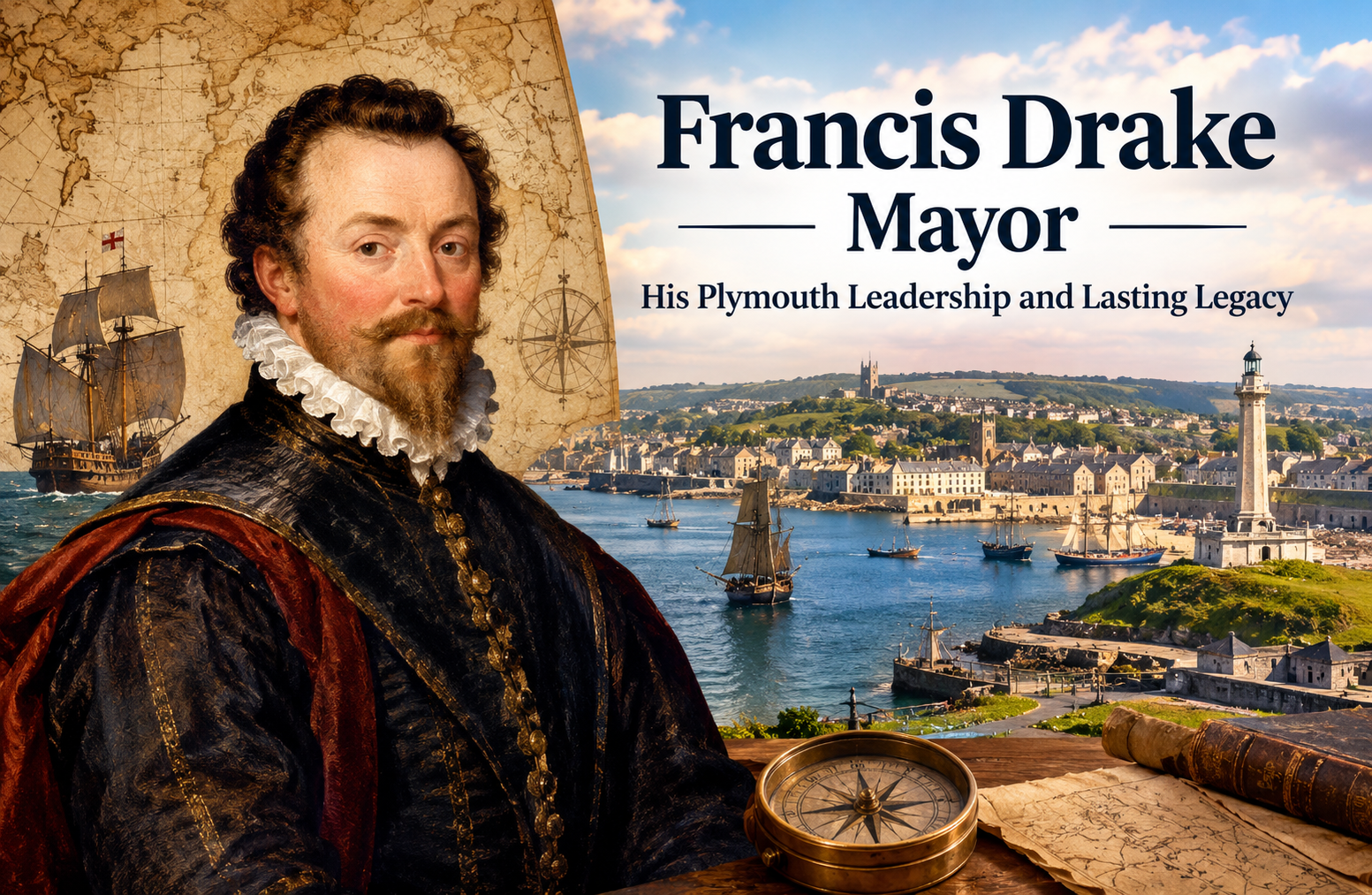
Francis Drake Mayor: His Role in Plymouth and Historical Legacy
The story of Francis Drake mayor begins in 1581, when Sir Francis Drake, the famous English seafarer, became mayor of Plymouth, a major port in southwest England. Although he is best remembered for sailing around the world, attacking Spanish ships, and serving the English Crown, his time in local government reveals another important side of his career. His appointment connected maritime experience with civic leadership during a period when England was expanding its naval power and competing with Spain for influence.
Understanding Francis Drake’s mayoral career requires looking beyond his reputation as an explorer. Plymouth depended on its harbor, fishing industry, trade networks, and coastal defenses. Its position made the town valuable to English merchants and the monarchy, but it also exposed the community to economic pressures and military threats. Drake’s experience at sea, political connections, and growing national reputation made him a notable figure in the town’s public life.
His civic career also raises an important historical question: how did a celebrated sea captain contribute to the administration of a port town? Historical accounts associate his mayoralty with local improvements, including a measure regulating the pilchard trade and plans connected with bringing water into Plymouth. These activities help explain why his political career deserves attention alongside his voyages.
This article examines his appointment, responsibilities, documented civic activities, political background, and lasting significance. It also separates established historical facts from claims that require caution, providing a clear explanation of what his year as mayor tells us about sixteenth-century England.
Who Was Francis Drake Before Becoming Mayor?
Sir Francis Drake was an English navigator, naval commander, privateer, and politician who lived during the reign of Queen Elizabeth I. He was born around 1540 in Devon, England, and grew up in a period when maritime trade, religious conflict, and competition between European powers shaped national policy.
Drake developed his reputation through seafaring and expeditions that brought him into conflict with Spanish interests. Spain controlled an extensive overseas empire, and English efforts to challenge Spanish maritime dominance were closely connected to commercial ambitions and political rivalry.
Drake’s voyages brought him wealth, recognition, and royal favor. His expedition around the world from 1577 to 1580 made him one of the most celebrated English mariners of his age. He returned to England in September 1580, having completed a journey that greatly strengthened his public reputation.
Queen Elizabeth I knighted him in April 1581 aboard his ship, the Golden Hind, while it was at Deptford. Later that year, Drake became mayor of Plymouth and entered another sphere of public responsibility.
His career was unusual because it combined several roles:
- Navigator: He led long-distance maritime expeditions.
- Privateer: He attacked enemy shipping under royal authorization, although the legality and morality of his actions were contested by Spain.
- Naval commander: He later played a significant role in England’s naval operations against Spain.
- Politician: He served as a member of Parliament as well as mayor of Plymouth.
- Civic figure: His position in Plymouth connected his maritime reputation with local government.
These roles were closely linked. A successful sea captain could gain the wealth, connections, and public standing needed to enter civic and national politics. Drake’s appointment reflected that relationship between maritime power and political influence.
Francis Drake Mayor: Why Was He Appointed in 1581?
Drake became mayor of Plymouth in September 1581, following his celebrated return from circumnavigating the globe and his knighthood earlier that year. His appointment is recorded in historical biographies, including the account published by the National Park Service.
National Park Service
+1
The timing matters. Drake was not an obscure sailor suddenly entering local government. He had returned from a major expedition, gained royal recognition, and established himself as a prominent figure in Devon’s maritime community.
Plymouth was a natural setting for his public career. Its harbor connected England to Atlantic shipping routes, and its residents had strong economic interests in fishing, trade, ship movements, and maritime security.
Plymouth’s importance to England
During the sixteenth century, Plymouth occupied a strategic position on England’s southwestern coast. The town’s harbor supported ships traveling along the English Channel and into the Atlantic.
Its importance came from several factors:
- Maritime commerce: Ships carried goods and supplies between ports.
- Fishing: Coastal fishing supported employment and local trade.
- Naval activity: Plymouth provided a useful base for voyages and military operations.
- Geography: Its location made it relevant to England’s defense and overseas ambitions.
- Local administration: The town needed officials who understood the practical concerns of a working port.
Drake’s maritime experience gave him a strong connection to these issues. His appointment illustrates how a town’s economic identity could influence the selection of its civic leaders.
Was Drake elected or appointed?
Historical summaries commonly state that Drake became mayor of Plymouth in 1581. However, modern readers should be careful when interpreting the process through the lens of contemporary elections.
Sixteenth-century municipal government operated under different laws, customs, and political structures from those of modern British local government. The surviving summaries do not provide enough detail to confidently reconstruct every step of the selection process.
The reliable point is that Drake held the office of mayor in Plymouth in 1581. Describing the appointment as a modern popular election without further documentary evidence would be misleading.
What Were the Main Responsibilities of Plymouth’s Mayor?
The mayor of a sixteenth-century English town had responsibilities that differed considerably from those of a modern mayor. Municipal government was closely connected to local customs, trade regulation, public order, and the relationship between the town and the Crown.
Drake’s maritime background was useful, but it did not automatically make him an experienced administrator. As mayor, he became part of an established civic system with responsibilities that extended beyond his personal achievements at sea.
1. Maintaining public order
The mayor held an important position in local justice and civic discipline. Plymouth needed officials who could help resolve disputes, enforce local rules, and maintain order in a busy commercial environment.
The town’s population included merchants, sailors, fishermen, craftspeople, and visiting traders. Their activities sometimes created disputes over property, contracts, market practices, and public behavior.
The mayor’s responsibilities formed part of a wider municipal structure involving other civic officers. It would therefore be inaccurate to attribute every local decision made during Drake’s term directly to him.
2. Supporting trade and economic activity
Trade was central to Plymouth’s prosperity. Ships brought goods and people into the harbor, while local fishing and maritime services supported employment.
Drake’s career gave him a practical understanding of the sea and the commercial opportunities connected to it. His political prominence could also help Plymouth communicate its needs to influential figures beyond the town.
A port’s success depended on more than the number of ships arriving. It also required predictable rules, functioning facilities, and cooperation between merchants and civic authorities.
3. Protecting the town’s maritime interests
Plymouth’s harbor had economic and strategic value. A well-functioning port supported civilian commerce while also helping supply ships involved in national defense.
During Elizabeth I’s reign, relations with Spain became increasingly hostile. The possibility of conflict made coastal towns and their harbors important to English security.
Drake’s experience gave him an unusual perspective on these concerns. He understood the demands of long voyages, the need for supplies, and the practical challenges faced by ships returning from sea.
However, his mayoralty in 1581 should not be confused with his later naval command. His role as a civic leader and his service in military expeditions were separate responsibilities, even when their broader interests overlapped.
4. Representing Plymouth’s interests
A mayor could serve as an important connection between local residents and the wider political establishment.
Drake’s growing reputation gave him access to influential people and eventually helped him establish a career in Parliament. Plymouth could benefit from having a prominent figure who understood both local maritime concerns and national political priorities.
This relationship is one of the most revealing aspects of his civic career. His public standing was useful to Plymouth, while his connection to the town strengthened his position as a local political figure.
What Did Francis Drake Accomplish as Mayor?
The question of what Drake actually achieved in office requires careful treatment. His reputation as a famous explorer sometimes encourages biographies to combine his later public works with his earlier mayoralty.
The available evidence supports several connections between Drake and Plymouth’s civic life, but not every achievement associated with his name occurred during his time as mayor.
The compass on Plymouth Hoe
One historical account records that a compass was installed on Plymouth Hoe during Drake’s mayoral year. The entry appears in the town’s historical record and is discussed in later accounts of his relationship with Plymouth.
Plymouth Hoe is an elevated open area overlooking Plymouth Sound. Its position made it a natural landmark for observing the harbor and the ships moving through it.
The compass is an interesting detail because it connects the town’s public space with its maritime identity. Navigation was central to Plymouth’s economy, and a compass placed in a prominent location could serve as a practical or symbolic feature.
However, the exact design and function of the historical instrument are not entirely clear from brief summaries. It is better to describe it as a recorded civic installation than to claim that it was a sophisticated navigational facility without further evidence.
Regulation of the pilchard trade
Historical summaries also associate Drake with a measure regulating Plymouth’s pilchard trade.
Pilchards, a type of small oily fish related to sardines, were commercially important in parts of southwest England. Fishing provided food and income, while the processing and movement of fish supported other local businesses.
Trade regulation could help establish expectations around commercial activity. Depending on the specific rules involved, such measures might concern the conduct of traders, the handling of goods, or the organization of the market.
The surviving summaries identify the regulation but do not provide enough detail to establish every provision or measure its economic impact. It would therefore be misleading to claim that Drake transformed the fishing industry or substantially increased the town’s income solely because of this action.
The broader significance is that his civic career was not entirely separate from the everyday economy. Fishing, shipping, and trade were central to Plymouth’s livelihood, making them natural concerns for municipal government.
The importance of local improvements
The compass and fishing regulation provide examples of activities associated with Drake’s mayoralty. They also illustrate the types of practical matters that could occupy a town’s leadership.
Neither achievement should be exaggerated. A compass installation was not equivalent to a major harbor reconstruction, and a trade regulation does not by itself prove that the local economy expanded.
Nevertheless, these details are useful because they move the story beyond famous voyages and military exploits. They show how Drake’s public career intersected with the ordinary needs of a maritime community.
Francis Drake Mayor and the Famous Plymouth Water Project
One of the most significant public works associated with Drake was the water channel commonly known as Drake’s Leat. The project helped bring water from the River Meavy on Dartmoor toward Plymouth and became an important part of the town’s infrastructure.
It is also an example of why the dates of his career matter.
Drake did not complete this project during his 1581 mayoralty. The water scheme developed later, and his involvement became particularly important during the middle and later 1580s.
Why Plymouth needed a better water supply
A dependable supply of fresh water was important to both residents and ships using the harbor.
For a growing port, water shortages could affect household life, commercial activity, and the ability to supply vessels. The problem became especially serious during dry periods, when local sources might not provide enough water for all needs.
Water infrastructure was therefore more than a convenience. It could influence public health, economic activity, and the town’s ability to support maritime operations.
Plymouth’s proposed water channel also had practical advantages for harbor management. Historical accounts connect the scheme with the aim of supplying ships and helping maintain the harbor.
How Drake became involved
The project was not simply a personal gift conceived and completed by Drake alone. Historical research indicates that Plymouth’s corporation had been considering ways to improve its water supply before Drake became closely involved.
During his parliamentary career, Drake helped advance legislation connected with the project. Construction followed later in the decade, and the channel brought water from the River Meavy toward the town.
This distinction matters because it gives credit to the civic authorities and other people involved in planning, financing, and building the system.
Drake’s role was significant, but the project emerged from cooperation between local government, political representatives, and the wider interests of Plymouth.
The economic value of the leat
The water channel supported several connected needs:
- It helped improve access to fresh water.
- It supplied water for ships using Plymouth’s harbor.
- It supported the practical needs of a busy port.
- It contributed to infrastructure intended to serve the town and its maritime economy.
- It was associated with water-powered mills along its route.
The mills are an especially interesting part of the story. They show how a water project could provide benefits beyond household supply. Water infrastructure could support food production and commercial activity while serving the needs of shipping.
Did Drake pay for the entire project himself?
Claims about the financing require care. Popular retellings sometimes present the leat as a wholly personal act of generosity. Historical research indicates that Plymouth’s corporation had a central role in the scheme and its financing.
Drake’s involvement included political support and connections to the project, while the wider undertaking involved municipal decisions and public expenditure.
This does not make his contribution unimportant. Instead, it places the project within the practical realities of sixteenth-century public works, where influential individuals and civic institutions often worked together.
Why the water project remains part of his legacy
The leat is one of the clearest examples of Drake’s relationship with Plymouth beyond his voyages.
His maritime achievements brought him national fame, but his connection to infrastructure reveals how his local, commercial, and political interests could overlap. A reliable water supply benefited residents and ships, while a stronger port served England’s wider maritime ambitions.
The project is therefore important not because it proves that Drake was a flawless civic leader, but because it demonstrates how a prominent mariner could influence a town’s development through political connections and practical infrastructure.
How Long Did Francis Drake Serve as Mayor?
The official historical list maintained by Plymouth City Council records Sir Francis Drake as mayor for the civic year 1581 to 1582. His successor was Thomas Edmonds, who served from 1582 to 1583.
This is a useful distinction because different biographies may describe his appointment as taking place in September 1581, while historical lists organize the office by civic years.
Drake’s tenure was relatively short. It is not supported by the available evidence to portray his mayoralty as a lengthy period of continuous municipal reform.
His year in office was nevertheless important in the development of his public career. He moved from being celebrated primarily for maritime achievement to holding a recognized position within local government.
A brief timeline of his civic career
| Year | Event |
| 1577 | Drake began his famous circumnavigation expedition. |
| 1580 | He returned to England after completing the voyage around the world. |
| 1581 | Queen Elizabeth I knighted him, and he became mayor of Plymouth. |
| 1582 | His mayoral term concluded, with Thomas Edmonds succeeding him. |
| 1584 | He served in Parliament for Bossiney in Cornwall. |
| 1585 | He became involved in further maritime operations and political efforts connected with England’s interests. |
| 1588 | He played an important role in the English campaign against the Spanish Armada. |
| 1596 | He died during an expedition in the Caribbean region. |
This timeline places his mayoralty within a wider period of political and maritime activity. It also makes clear that his involvement in Plymouth continued beyond his year as mayor.
Francis Drake’s Political Career Beyond the Mayoral Office
Drake’s public service did not end when he left the mayor’s office. He subsequently served in the House of Commons and used his political position to participate in matters affecting Plymouth and England’s maritime interests.
His work in Parliament
Drake entered Parliament in 1581 as the representative for Camelford. He later represented Bossiney and served as a member for Plymouth in the early 1590s.
Parliament provided another way for him to influence decisions beyond the boundaries of a single town. His experience at sea made him relevant to discussions involving naval operations, overseas expeditions, fishing, and the security of coastal communities.
For Plymouth, a prominent parliamentary representative could help bring local needs to the attention of national decision-makers.
The relationship was mutually beneficial. Drake had a strong connection to the town, while Plymouth could use his reputation and political influence to support its interests.
His contribution to maritime policy
England’s maritime policy during Elizabeth I’s reign was shaped by trade, exploration, privateering, and the growing possibility of war with Spain.
Drake’s experience gave him firsthand knowledge of long-distance voyages and the challenges of operating ships far from home. However, it is important to distinguish his expertise from the full range of decisions made by the Crown and Parliament.
England’s naval development involved many commanders, shipowners, merchants, officials, and political figures. Drake was an influential participant, not the sole architect of the country’s maritime strategy.
The connection between local and national government
Drake’s career shows how local government and national politics could reinforce one another.
A mayor could help manage a town’s affairs, while a member of Parliament could pursue legislation and represent local interests in Westminster. For a port such as Plymouth, the two roles were particularly relevant because its prosperity depended partly on decisions about shipping, defense, and infrastructure.
His later support for the water project demonstrates this connection. Work that began as a local need required political cooperation and legislative action at a wider level.
What Was Plymouth Like During Drake’s Mayoralty?
To understand his historical importance, it helps to consider the conditions in which he served.
Plymouth in the late sixteenth century was a maritime community whose economy depended heavily on its relationship with the sea. Its harbor offered opportunities for commerce, fishing, and naval activity, but it also created practical challenges.
A town shaped by shipping
Ships needed supplies, repairs, safe access to the harbor, and reliable arrangements for loading and unloading goods.
These requirements connected the fortunes of sailors and merchants with the work of local officials. Problems affecting the harbor could have consequences for businesses throughout the town.
The mayor’s office operated within this network of interests. Its responsibilities were not limited to ceremonies or representing the community at formal events.
Fishing and local livelihoods
Fishing was another important part of the regional economy. Commercial fish trading connected coastal communities with wider markets, while processing and transporting catches provided work for many people.
Regulations affecting the pilchard trade should be understood within this context. Rules governing a major local product could influence commercial relationships and the organization of market activity.
However, the available evidence does not establish the precise financial results of the regulation associated with Drake. A balanced historical account should explain the economic context without inventing figures or claiming outcomes that cannot be demonstrated.
Security and the threat of conflict
The rivalry between England and Spain created uncertainty for maritime communities. Spanish ships and settlements became targets of English privateering, while English ports could be affected by the risk of retaliation.
Plymouth’s location made it important to England’s naval interests. Ships departing from the port could undertake voyages into the Atlantic, and the town could contribute to the broader needs of the English fleet.
Drake’s experience made him a recognizable figure in this environment. His career connected Plymouth to the national debate over maritime strength, although his activities as a naval commander occurred in different periods from his work as mayor.
Was Francis Drake a Good Mayor?
There is no simple answer to this question because the surviving evidence does not provide a complete modern-style assessment of his performance.
His fame as a navigator and naval commander can make it tempting to assume that he was equally successful in every civic responsibility. Historical analysis should avoid that assumption.
What the evidence supports
Several facts help explain his significance as mayor:
- He held the office during the civic year 1581 to 1582.
- His appointment followed his successful circumnavigation and royal recognition.
- Historical accounts associate his term with a compass on Plymouth Hoe.
- A regulation concerning the pilchard trade is also associated with his mayoralty.
- He later used his political position to support matters connected with Plymouth, including the development of its water supply.
These points establish that his career included genuine civic responsibilities and connections to local affairs.
What remains uncertain
The available evidence does not provide enough information to calculate how effectively Drake performed every mayoral duty. Nor does it support a complete comparison between his administration and those of other mayors.
It is also difficult to separate the effects of his personal actions from the work of the town’s corporation and other officials.
A short tenure can include meaningful decisions without producing a record of sweeping reform. Equally, a famous public figure may benefit from a historical reputation that makes relatively modest achievements seem larger than the surviving evidence warrants.
A balanced assessment
Drake is best understood as a prominent maritime figure who also held an important civic office. His public career shows how reputation, commercial interests, local government, and royal service could intersect in Elizabethan England.
His connection with the later water project provides stronger evidence of practical influence on Plymouth’s development than any unsupported claim that he transformed the entire town during his year as mayor.
A fair assessment recognizes both his contributions and the limitations of the historical record.
The Controversial Side of Francis Drake’s Legacy
Drake’s reputation has changed over time. In England, he was celebrated for his voyages, his opposition to Spanish power, and his contribution to the defense of the country. In Spain and in communities affected by his expeditions, he could be viewed very differently.
This contrast is essential to understanding his place in history.
Explorer, privateer, and pirate
The term privateer describes a person authorized by a government to attack enemy shipping under specific conditions. Privateering was an important feature of European maritime rivalry during Drake’s lifetime.
Spanish authorities did not necessarily accept the legitimacy of English claims to such authorization. They could regard Drake’s attacks as piracy, robbery, or unlawful violence.
The distinction was political as well as legal. English royal support helped present his actions as service to the Crown, while Spain saw them as attacks on its shipping and imperial possessions.
Wealth and violence
Drake’s voyages brought valuable goods and wealth to England. They also involved raids, plunder, and violence against communities overseas.
These actions formed part of the wider struggle for trade, territory, and political influence among European powers. Their historical importance does not remove the harm they caused.
A modern account should therefore avoid presenting every expedition as a straightforward story of bravery or national achievement.
The historical debate today
Drake’s legacy is now discussed through several perspectives, including naval history, imperial expansion, colonialism, and the experiences of people affected by European exploration.
His career can be studied as an example of England’s growing maritime power while also examining the coercion and violence associated with that expansion.
His mayoralty adds another dimension. It illustrates how the same person could hold a respected civic position at home while participating in overseas activities that caused serious harm elsewhere.
Recognizing this complexity does not diminish the importance of historical evidence. It makes the account more complete.
How to Research Francis Drake’s Mayoral Career Accurately
Readers who want to investigate the subject further can use a simple research process to distinguish reliable information from repeated historical claims.
Step 1: Establish the dates
Begin with an official municipal record or a recognized historical timeline. The civic list published by Plymouth City Council identifies Drake’s mayoral year as 1581 to 1582.
This helps prevent confusion between the year of his appointment, the civic year of his service, and the dates of later projects.
Step 2: Separate his roles
Record his activities under distinct headings:
- Mayor of Plymouth
- Member of Parliament
- Navigator and expedition leader
- Privateer and naval commander
- Participant in later civic infrastructure projects
This prevents an event from one part of his life being incorrectly presented as an achievement during another.
Step 3: Check the context of public works
When researching Drake’s Leat, look for information about the town corporation, legislation, financing, construction, and the project’s intended purpose.
The history of an infrastructure project often involves multiple people and institutions. Attributing the whole undertaking to one famous individual can conceal the actual decision-making process.
Step 4: Compare historical interpretations
Older biographies sometimes emphasize national pride and military achievement. More recent scholarship may place greater weight on privateering, colonial expansion, and the interests of local institutions.
Reading more than one account can reveal which facts are widely accepted and which interpretations remain debated.
Step 5: Use authoritative references
The National Park Service biography of Sir Francis Drake provides a useful overview of his life, voyages, royal service, and political career.
For details specific to his mayoralty, Plymouth’s municipal history and specialist historical research offer additional context.
The key principle is straightforward: distinguish documented events from popular stories, and avoid adding details that cannot be supported by reliable evidence.
Frequently Asked Questions
1. When did Francis Drake become mayor of Plymouth?
Sir Francis Drake became mayor of Plymouth in September 1581, following his return from his circumnavigation voyage and his knighthood earlier that year. He served during the civic year 1581 to 1582.
2. How long was Francis Drake mayor?
Drake’s recorded mayoral term covered one civic year, from 1581 to 1582. Thomas Edmonds succeeded him for the following year.
3. What did Francis Drake do as mayor?
Historical accounts associate his mayoralty with the installation of a compass on Plymouth Hoe and a measure regulating the pilchard trade. His later political career also helped him support civic interests, including the development of Plymouth’s water supply.
4. Did Francis Drake build Drake’s Leat while he was mayor?
No. Drake became mayor in 1581, but his involvement in the water project developed later. The scheme connected Plymouth with the River Meavy on Dartmoor and helped improve water supplies for the town and its harbor.
5. Why was Francis Drake important to Plymouth?
Drake was an influential mariner with strong connections to Plymouth’s maritime economy. His reputation, civic office, and later parliamentary career made him an important figure in the town’s political and commercial history.
6. Was Francis Drake considered a hero or a pirate?
Both descriptions appear in historical interpretations. England celebrated him as a naval figure who challenged Spanish power, while Spanish authorities regarded his attacks as piracy. His voyages also involved plunder and violence, which are important parts of his legacy.
Conclusion
Sir Francis Drake’s year as mayor of Plymouth in 1581 to 1582 represents an important, though relatively brief, part of his career. Best known for his circumnavigation of the globe and his role in England’s maritime rivalry with Spain, he also participated in local government at a time when Plymouth’s economy depended heavily on shipping, fishing, and harbor activity.
The evidence connects his mayoralty with a compass on Plymouth Hoe and regulation of the pilchard trade. His later political activities also contributed to his involvement in civic matters, including Plymouth’s water supply project. The distinction between his time as mayor and his later work is important because the water project was developed several years after his term ended.
His story also demonstrates why historical reputations need careful examination. Drake’s achievements at sea brought him recognition, wealth, and political influence, but his expeditions also involved plunder and violence. Understanding both sides provides a fuller picture of his place in Elizabethan England.
Ultimately, Francis Drake mayor is a useful historical subject because it connects a famous explorer with the everyday concerns of a working port town. His career illustrates how maritime experience, civic leadership, national politics, and economic interests could intersect in sixteenth-century Britain.