Bodenxt: Understanding Sweden’s Green Transformation Platform
Bodenxt is the Municipality of Boden’s platform for managing the major green and social transformation taking place in Boden, northern Sweden. The initiative connects industrial development with the practical needs of a growing community, including skills, housing, business development, and infrastructure. Rather than being a standalone app, software product, or consumer service, Bodenxt is best understood as a coordinated framework for managing rapid regional change.
The distinction matters because the term is sometimes described online as a technology platform or digital solution. That interpretation can lead people in the wrong direction. The official municipal description presents Bodenxt as part of Boden’s broader green transition and community development work. The municipality says the coming period represents a development leap equivalent to around 20 years of societal development, which explains why several areas need to be planned together rather than handled independently.
For readers trying to understand what Bodenxt actually means, the most useful starting point is simple: it is about preparing an entire community for fast economic, industrial, and social change. That means considering not only factories and investment, but also where people will live, how businesses can participate, what skills employers will need, and how infrastructure must evolve.
What Is Bodenxt?
Bodenxt is a development platform associated with the Municipality of Boden in northern Sweden. Its purpose is to coordinate the municipality’s response to the large-scale green transition taking place in the region.
The initiative emerged because the scale and speed of expected development created challenges that could not be solved by looking at individual municipal functions in isolation. Housing affects workforce recruitment. Workforce availability affects industrial development. Industrial development affects transport and infrastructure. Business growth affects local services and employment.
These connections are at the heart of the Bodenxt approach.
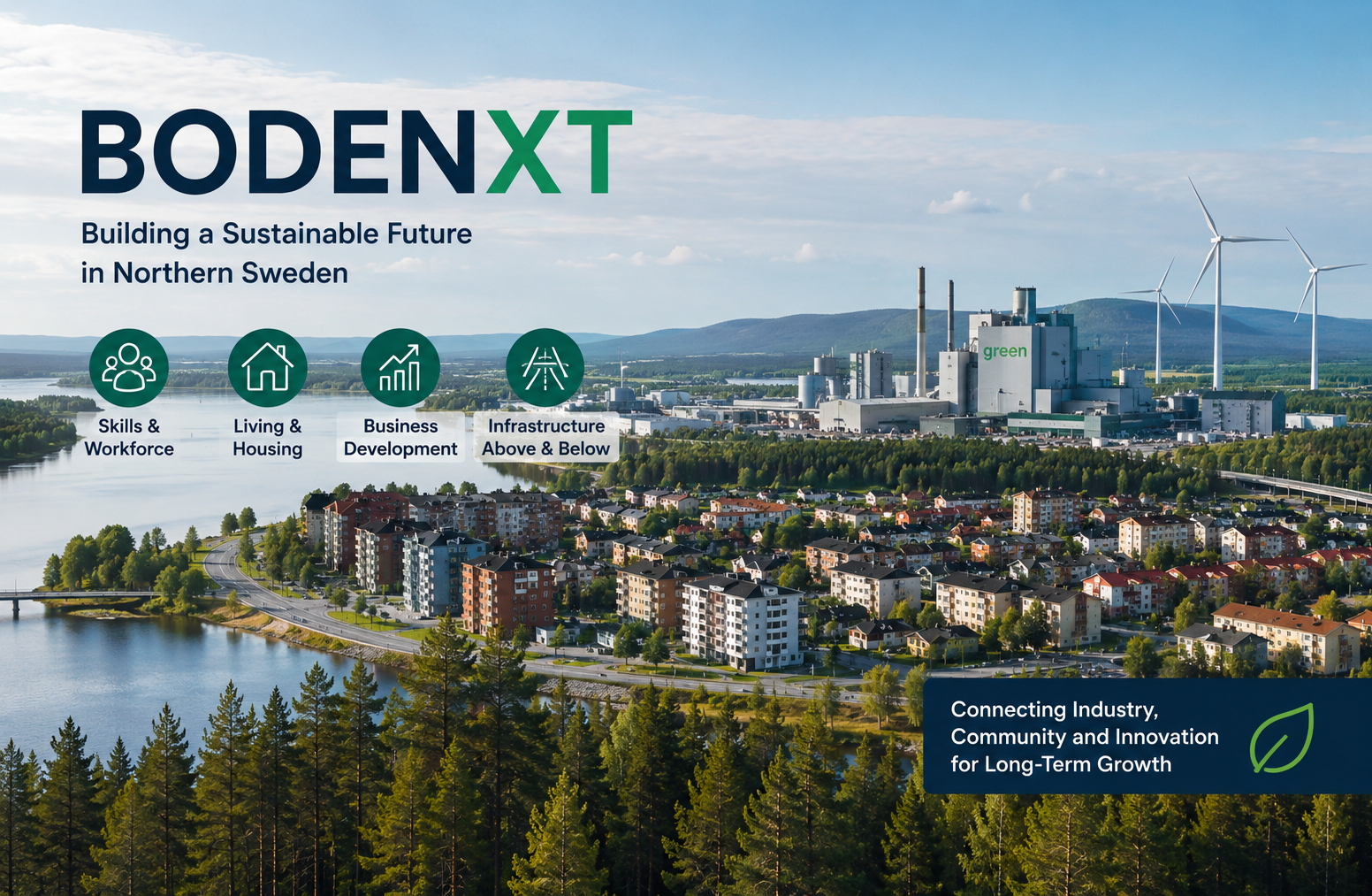
The municipality identifies several major areas of work, including skills supply, living and housing, business development, and infrastructure above and below ground.
This makes Bodenxt different from a conventional commercial product. There is no need to download an application or create a user account to understand its purpose. Its importance lies in how a municipality organizes and coordinates development.
A useful way to think about it is as a bridge between industrial investment and everyday community life.
A major industrial project can bring jobs and investment, but those benefits do not automatically create a successful community. People also need homes, schools, transport, services, opportunities for local companies, and an environment in which workers and families can build long-term lives.
Bodenxt addresses that wider picture.
Why Bodenxt Has Become Important
The significance of Bodenxt is closely connected with the rapid green industrial development occurring in northern Sweden.
Boden is positioned within a region experiencing substantial investment related to the transition toward more sustainable industry. The Municipality of Boden describes the region as an important part of the broader global transition toward sustainable societies and reports that approximately SEK 1.4 trillion is being invested in green reindustrialisation across northern Sweden.
Numbers of this scale help explain why conventional slow-growth planning is not enough.
When development happens gradually, a municipality may have years to adjust its housing stock, roads, utilities, workforce programs, and commercial services. Rapid industrial expansion changes that timeline.
The challenge is not simply to build more.
The challenge is to build the right things at the right time.
That is where coordinated planning becomes valuable.
If new employment opportunities appear before sufficient housing exists, employers may struggle to attract workers. If housing expands without adequate transport, residents can face mobility problems. Also if industrial investment grows without enough local suppliers, businesses may miss economic opportunities. If workforce programs are disconnected from employer requirements, training investments may not produce the skills that are actually needed.
Bodenxt attempts to view these issues as parts of one transformation rather than unrelated municipal problems.
Bodenxt and the Green Transition in Boden
The word “green” is important when discussing Bodenxt, but it should not be interpreted too narrowly.
A green transition is not only about reducing emissions from industrial production. It also involves changing how communities plan infrastructure, use resources, develop businesses, attract workers, and respond to long-term environmental pressures.
Bodenxt reflects this broader understanding.
The municipality describes the initiative as a platform for the major green transition of the entire society in Boden. The establishment of Stegra is identified as an important accelerator of this transformation, while the municipality has expanded its efforts to create development that is intended to remain useful for future generations.
This distinction is important.
Stegra and Bodenxt are not the same thing.
Stegra is an industrial company and its development is one major driver of change in the region. Bodenxt is the municipality’s broader framework for dealing with the wider consequences and opportunities created by rapid development.
That means someone searching for information about Bodenxt should not expect a product manual or software review. The more appropriate questions are about regional development, housing, workforce needs, infrastructure, local business opportunities, and sustainable growth.
The Main Areas Covered by Bodenxt
The strength of Bodenxt lies partly in its broad scope. Instead of concentrating on one economic sector, it brings several interconnected areas into the same development framework.
Skills and Workforce Development
Rapid industrial growth creates demand for people with different types of skills.
Some positions require highly specialized technical expertise. Others involve construction, logistics, maintenance, administration, hospitality, retail, public services, and other supporting activities.
This creates a workforce planning challenge.
A municipality cannot assume that a large investment automatically means there will be enough qualified people available locally. Workers may need training, relocation support, housing, transportation, or opportunities for their families.
Skills supply therefore becomes an important part of sustainable economic development.
For Boden, workforce planning is particularly significant because the green industrial transition can create demand across multiple parts of the economy at the same time.
A practical lesson from this approach is that workforce development should begin before jobs become difficult to fill.
That can involve:
- Identifying future skill requirements
- Working with education and training providers
- Supporting existing workers who want to retrain
- Improving awareness of new career opportunities
- Attracting qualified workers from outside the region
- Helping newcomers understand local services and opportunities
The goal is not simply to increase the number of workers.
It is to create a better match between people and the evolving needs of the local economy.
Living and Housing
Housing is one of the most visible consequences of rapid economic growth.
When new employment opportunities attract workers, demand for accommodation can increase quickly. If housing supply does not keep pace, rents and property prices can come under pressure, temporary accommodation can become more important, and employers may find recruitment more difficult.
Bodenxt therefore treats living and housing as part of the transformation rather than as a separate issue.
This is an important planning principle.
A successful industrial transition cannot be measured only by how much is produced or how many jobs are announced. The quality and availability of housing also influence whether people are willing to relocate and remain in a community.
Housing planning also needs to consider different groups.
A new employee arriving alone may have different needs from a family with children. A temporary construction worker may require different accommodation from a permanent resident. Young professionals may look for smaller homes, while families may prioritize larger properties and access to schools.
A strong development strategy therefore needs flexibility rather than a single housing solution.
Business Development
Large industrial investments can create opportunities for local companies, but those opportunities are not automatic.
Construction projects need suppliers. Growing populations need services. Industrial operations need maintenance, logistics, professional services, food, accommodation, technology, and other forms of support.
This creates the possibility of a wider economic ecosystem.
For local businesses, the important question is not simply whether a large company is arriving. The better question is how existing and new businesses can participate in the value chain surrounding that investment.
Bodenxt includes business development as one of its core areas because local economic participation can help spread the benefits of transformation across the wider community.
For smaller companies, preparation may include:
- Understanding procurement requirements
- Building reliable capacity
- Developing specialized services
- Improving workforce planning
- Forming partnerships with other local businesses
- Meeting quality, safety, and sustainability requirements
- Preparing for increased demand
This can be particularly important for smaller businesses that have the expertise to participate but lack the resources or information needed to approach major industrial customers.
Infrastructure
Infrastructure is the physical foundation of economic growth.
Roads, transport systems, utilities, energy networks, water systems, communications infrastructure, and other public systems need to support both existing residents and new activity.
Bodenxt includes infrastructure both above and below ground among its areas of work.
That wording is significant because infrastructure planning often focuses on what is immediately visible.
A new road is easy to see.
Underground systems are not.
Yet water, wastewater, energy, communications, drainage, and other hidden systems can determine whether a new development is practical and resilient.
This is one reason long-term planning is essential.
Infrastructure built only for today’s population can become a constraint tomorrow. Infrastructure designed with realistic growth scenarios can provide more flexibility.
What Makes the Bodenxt Approach Different?
One of the most interesting aspects of Bodenxt is that it recognizes the interconnected nature of regional transformation.
Traditional organizational structures often divide responsibilities into separate departments.
Housing belongs somewhere.
Infrastructure belongs somewhere else.
Business development has another team.
Workforce development may involve education authorities or employment organizations.
The problem is that residents experience these subjects as one connected reality.
A worker looking for a job may also need housing.
A company hiring workers may need transport.
A family moving to the region may need schools and services.
A growing business may need access to infrastructure and skilled employees.
Bodenxt creates a framework in which these relationships can be considered together.
An official municipal audit document describes Bodenxt as a development platform and explains that the organizational structure was designed to support work across the municipal sphere. It also notes that the work operated alongside the municipality’s ordinary line organization.
This is an important detail because it shows that Bodenxt is not simply a marketing label.
It represents an organizational response to a practical planning challenge.
Bodenxt Is Not a Software Product
One of the most common sources of confusion surrounding the term is the assumption that it refers to a digital tool.
It does not appear to be a conventional software product based on the municipality’s official description.
Bodenxt is better understood as a municipal development platform.
That distinction helps answer several common questions.
- You do not need to install Bodenxt.
- You do not need a software subscription to participate in its underlying development.
- You should not evaluate it using the same criteria used for productivity applications or technology platforms.
Instead, the relevant questions concern outcomes.
Is housing keeping pace with demand?
Are businesses able to participate in new economic activity?
Are workers gaining access to relevant skills?
Can infrastructure support growth?
Is development environmentally responsible?
Can the community remain attractive to existing and future residents?
These questions are much closer to the real purpose of the initiative.
The Role of Stegra in Boden’s Transformation
Stegra’s establishment is an important accelerator of the transformation around Boden, according to the municipality.
However, it is useful to separate the industrial project from the municipal response.
A major industrial facility can generate direct employment and investment. It can also produce indirect effects.
Suppliers may expand.
Construction activity may increase.
Demand for accommodation may rise.
More workers may relocate.
Local services may gain customers.
Transport requirements may change.
Educational institutions may need to adapt.
Municipal services may need additional capacity.
This is why the impact of a major industrial investment extends far beyond the factory boundary.
Bodenxt can therefore be understood as part of the infrastructure of adaptation.
Its purpose is not simply to celebrate industrial investment. Its broader challenge is to help the community respond to the consequences of rapid growth.
Real-World Applications of the Bodenxt Model
The most useful way to understand a development platform is to examine how its principles apply to real situations.
Supporting New Workers
Suppose a company needs hundreds or thousands of additional workers.
Recruitment alone does not solve the problem.
Workers may ask:
Where will I live?
How will I travel to work?
What services are available?
Can my partner find employment?
Are there suitable schools for my children?
What is the local community like?
A workforce strategy that ignores these questions may struggle even if the available jobs are attractive.
A coordinated approach considers the complete relocation experience.
Helping Local Businesses Adapt
A local company may already have ten employees and steady demand.
A major industrial expansion could create an opportunity to grow.
But growth creates its own risks.
The business may need more employees, equipment, working capital, facilities, logistics capacity, and management systems.
Business development initiatives can help companies identify opportunities while understanding the operational requirements associated with growth.
Planning Infrastructure Before Demand Peaks
Infrastructure takes time.
Roads require planning and construction. Utilities require engineering. Housing developments need approvals and building schedules.
If infrastructure planning begins only after demand has already increased, the community may spend years catching up.
A forward-looking platform therefore attempts to anticipate future needs.
This is one of the most important practical lessons that can be drawn from Bodenxt.
Potential Benefits of Bodenxt
The benefits of an integrated development framework can be considered at several levels.
Benefits for Residents
Residents may benefit from:
- New employment opportunities
- Improved infrastructure
- Greater business activity
- Expanded housing options
- New services
- Increased investment in the local community
However, these benefits depend on successful implementation.
Economic growth alone does not guarantee improved quality of life.
Benefits for Businesses
Businesses can potentially benefit from:
- New customers
- Industrial supply opportunities
- Workforce growth
- Investment
- New partnerships
- Access to emerging markets
Local businesses may be particularly important because they can help retain economic value within the region.
Benefits for the Municipality
From a municipal perspective, coordinated planning can make it easier to prioritize resources.
Instead of treating every challenge as an isolated issue, decision-makers can consider how projects interact.
A housing decision can be evaluated alongside workforce projections.
Infrastructure investments can be considered alongside industrial development.
Business programs can be designed around emerging economic opportunities.
This does not eliminate difficult decisions, but it can make those decisions more connected to long-term goals.
Challenges Bodenxt Must Address
A credible discussion of Bodenxt should not focus only on its opportunities.
Large-scale transformation is difficult.
Housing Pressure
Rapid population growth can place pressure on housing supply.
Building too slowly can make recruitment harder.
Building too quickly can create financial and planning risks.
The challenge is finding the right balance.
Workforce Shortages
Green industries require specialized skills, and competition for skilled workers can extend beyond one municipality or country.
Training can help, but training takes time.
Recruitment from outside the region may also create integration and housing challenges.
Infrastructure Timing
Infrastructure must be available when people and businesses need it.
At the same time, building too much infrastructure too early can create unnecessary costs.
Good planning therefore depends on realistic forecasts and regular adjustment.
Community Acceptance
Rapid change can affect the identity and daily life of an established community.
Some residents may welcome new jobs and investment.
Others may be concerned about construction, population change, environmental impacts, housing pressure, or changes to local services.
Transparent communication is therefore essential.
A sustainable transition is not only a technical project.
It is also a social process.
Economic Concentration
A major industrial investment can create significant opportunities, but communities should also consider economic resilience.
If too much local activity depends on one major industry, the region may become vulnerable to changes in global markets, technology, financing, or industrial demand.
A broader business ecosystem can help reduce that vulnerability.
What Other Regions Can Learn From Bodenxt
Bodenxt is particularly interesting because many regions face similar problems.
Cities and towns around the world are attempting to attract new industries while maintaining housing affordability, infrastructure quality, environmental responsibility, and social stability.
The transferable lesson is not that another municipality should copy Bodenxt word for word.
The more useful lesson is organizational.
When economic change is rapid, planning should cross traditional boundaries.
A factory project should be connected to workforce planning.
Workforce planning should be connected to housing.
Housing should be connected to transport.
Business development should be connected to industrial demand.
Infrastructure should be connected to population projections.
This systems-based approach can help reduce the risk of solving one problem while accidentally creating another.
How to Understand Bodenxt Without the Hype
People researching Bodenxt may encounter very different descriptions online.
Some may portray it as a futuristic city.
Others may call it a technology platform.
Some may focus almost entirely on green steel.
These descriptions can each capture a small part of the broader story, but they can also oversimplify it.
The most reliable approach is to start with primary information from the Municipality of Boden and distinguish confirmed facts from interpretation.
For example, the municipality clearly describes Bodenxt as its platform for the major green transformation of Boden. It also identifies skills supply, living and housing, business development, and infrastructure as key areas.
That gives readers a solid foundation.
From there, broader questions about economic impact, sustainability, workforce development, and urban planning can be explored without turning assumptions into facts.
This approach is especially important when researching emerging regional initiatives because their plans can evolve over time.
Is Bodenxt a Model for Sustainable Growth?
It is too early to treat any ongoing transformation as a proven universal model.
That is an important qualification.
Bodenxt provides an interesting example of how a municipality can organize around rapid industrial and social change. But whether every planned outcome will be achieved is something that can only be evaluated over time.
The most useful way to view the initiative is therefore as an active development framework rather than a finished success story.
Its long-term value will depend on implementation.
Good plans still require:
- Effective coordination
- Reliable funding
- Strong infrastructure delivery
- Workforce availability
- Housing supply
- Business participation
- Environmental responsibility
- Community trust
- Continuous evaluation
This is where real-world experience matters.
Regional transformation is rarely linear. Timelines change. Markets change. Construction costs change. Technology develops. Population forecasts can be wrong.
A successful platform needs enough structure to provide direction and enough flexibility to respond when conditions change.
Practical Lessons for Businesses and Residents
Anyone interested in Boden’s transformation can use a few practical principles.
For Businesses
Businesses should monitor emerging procurement opportunities, workforce requirements, infrastructure changes, and local development plans.
Growth should be planned carefully rather than assumed.
A company that receives a major new contract but cannot recruit enough workers may create operational problems for itself.
For Workers
People considering employment connected with the regional transformation should look beyond a single job advertisement.
The wider question is whether Boden offers the housing, services, transportation, and community environment that fit their personal circumstances.
For Entrepreneurs
Entrepreneurs can look for gaps created by growth.
These might involve accommodation, transportation, professional services, maintenance, food, technology, training, logistics, or other supporting activities.
The strongest opportunities are often found in problems that growing communities need solved repeatedly.
For Researchers and Students
Bodenxt provides a useful case for studying regional development, sustainable industrialization, municipal planning, workforce policy, and the relationship between industrial investment and community infrastructure.
It demonstrates why economic development should not be viewed only through investment figures.
The social infrastructure surrounding an investment can be just as important to its long-term impact.
Frequently Asked Questions About Bodenxt
What is Bodenxt?
Bodenxt is the Municipality of Boden’s platform for managing the city’s major green and social transformation. It brings together areas such as skills supply, housing, business development, and infrastructure.
Is Bodenxt a software platform?
No. Based on the official municipal description, Bodenxt is a development platform and organizational framework for managing regional transformation rather than a conventional software application.
Where is Bodenxt located?
Bodenxt is associated with Boden, a municipality in northern Sweden. Its work relates to the wider economic, industrial, social, and infrastructure transformation taking place in the area.
Is Bodenxt the same as Stegra?
No. Stegra is an industrial company whose establishment is an important accelerator of change in Boden. Bodenxt is the municipality’s broader development platform for responding to the transformation.
Why is housing part of Bodenxt?
Rapid industrial growth can increase demand for workers and therefore housing. Including living and housing in the development framework helps connect economic expansion with the everyday needs of residents.
What are the main areas of Bodenxt?
The Municipality of Boden identifies skills supply, living and housing, business development, and infrastructure as major areas within Bodenxt. These areas are connected because successful regional growth depends on progress across all of them.
Conclusion
Bodenxt is best understood as a coordinated municipal response to one of the most significant periods of change in Boden, northern Sweden. It is not simply a technology product or a branding concept. It is a development platform designed to connect industrial growth with the practical requirements of a functioning community.
Its focus on skills, housing, business development, and infrastructure reflects a simple but important reality: industrial transformation does not happen in isolation.
A new industrial project can create jobs, but people need homes.
New workers can increase demand, but communities need infrastructure.
Growing industries can create contracts, but local businesses need the capacity to respond.
Investment can accelerate development, but long-term success also depends on environmental responsibility and public trust.
That interconnected perspective is what makes Bodenxt worth studying.
The initiative also illustrates a broader lesson for communities facing rapid economic change. Sustainable growth requires more than attracting investment. It requires preparing the systems that allow people and businesses to benefit from that investment.
Bodenxt is still part of an evolving transformation, so its ultimate results should be judged through evidence and outcomes over time. What can already be understood, however, is the reasoning behind its structure: when change happens at exceptional speed, housing, skills, infrastructure, business development, and community planning need to move together.