Perfume Oils vs Eau de Parfum: What Actually Changes
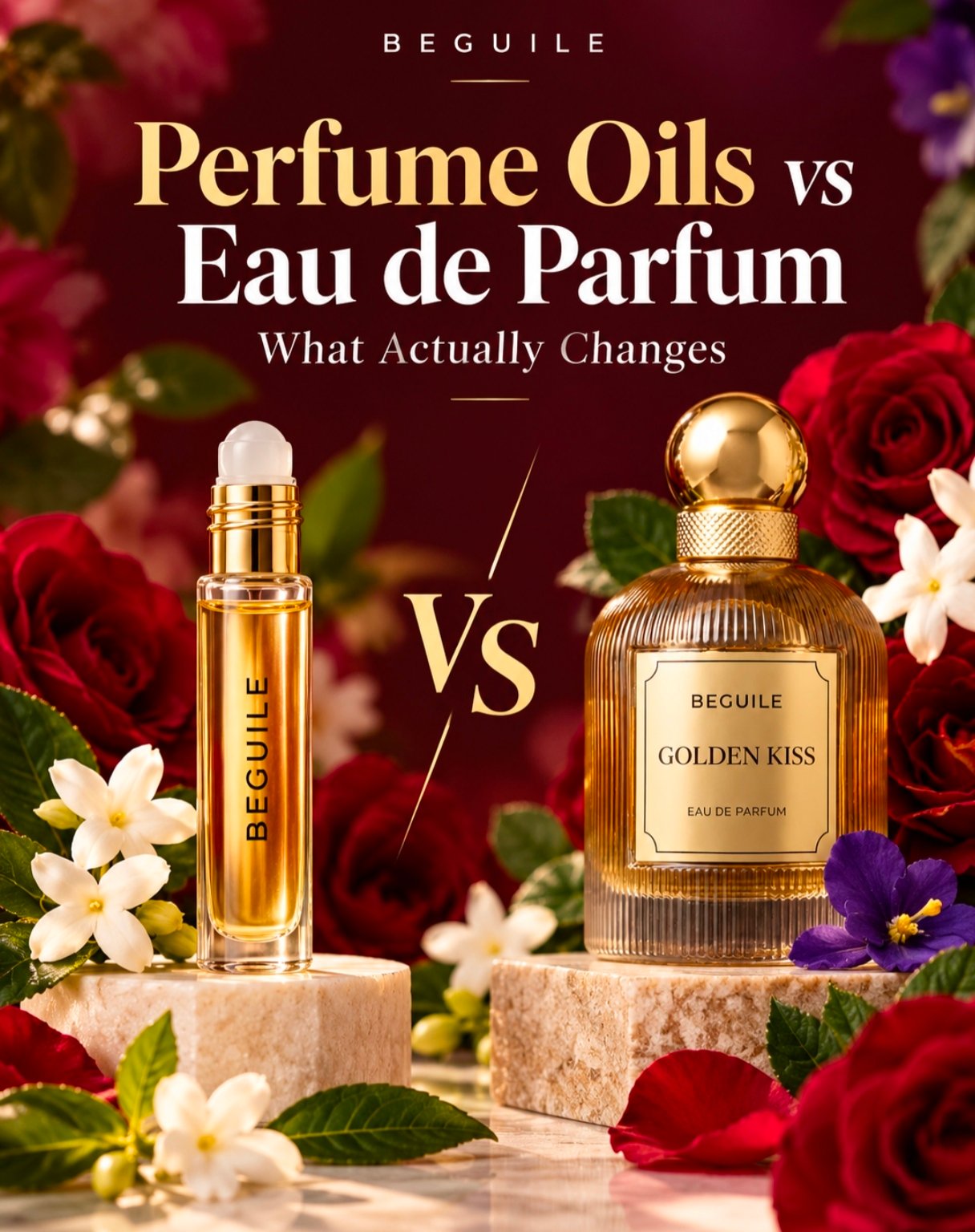
Choosing a fragrance is about more than finding notes you love. The format of the fragrance can influence how it sits on your skin, how it develops throughout the day, and how noticeable it feels to the people around you. When comparing perfume oil vs eau de parfum, the biggest differences come down to the fragrance base, concentration, application style, projection, and overall wearing experience.
At Beguile, fragrance is designed to become part of how you express yourself rather than simply something you spray before leaving home. From concentrated oils to more traditional spray formats, understanding how each option performs makes it easier to choose a scent that suits your routine. You can shop the full range to explore different fragrance profiles and discover how Beguile brings its philosophy, More Than Just A Scent, into everyday fragrance.
What Is Perfume Oil?
Perfume oil is a concentrated fragrance format in which aromatic materials are carried in an oil base rather than relying on alcohol as the primary carrier. Because oil stays close to the skin, the fragrance often develops in a smooth, intimate way instead of creating an immediate cloud of scent.
An alcohol free perfume oil can be particularly appealing to people who prefer roll-on or direct-to-skin application. The experience tends to feel controlled and personal: apply a small amount to pulse points such as the wrists and neck, then allow body warmth to gradually reveal the fragrance.
Beguile’s Oil range is designed around this style of fragrance wearing. It offers an easy way to incorporate concentrated scent into everyday routines, whether an oil is worn independently or used alongside another fragrance.
What Is Eau de Parfum?
Eau de Parfum, commonly shortened to EDP, typically combines aromatic fragrance materials with an alcohol-based carrier. The alcohol helps distribute the scent quickly after spraying, which can give Eau de Parfum a more noticeable opening and broader projection.
This is one reason EDP works well when you want your fragrance to have a stronger presence in the surrounding space. A few sprays can cover a wider area than a small application of oil, while the scent continues evolving as its top, heart, and base notes develop.
However, concentration alone does not determine performance. Ingredients, formulation, skin chemistry, climate, application, and fragrance structure can all influence how long a scent lasts and how strongly it projects.
Perfume Concentration Explained Simply
When people see terms such as perfume oil, Eau de Parfum, Eau de Toilette, and extrait, it is tempting to assume that the highest concentration automatically means the “best” fragrance. In reality, perfume concentration explained properly is less about ranking products and more about understanding their intended experience.
Higher aromatic concentration can contribute to richness and longevity, but formulation matters just as much. Oils generally remain closer to the skin because their carrier evaporates slowly. Alcohol-based sprays disperse more readily, helping fragrance travel through the air.
That means your choice should depend on how you want to wear fragrance. If you enjoy exploring multiple scent styles and application formats, shop the full range from Beguile to compare options that fit different moods, occasions, and routines.
Which Lasts Longer: Perfume Oil or Eau de Parfum?
Perfume oils often have a reputation for staying on the skin for a long time because the oil base evaporates slowly. Eau de Parfum can also offer lasting performance, but it may feel more prominent during its opening before gradually settling closer to the body.
Individual results vary considerably. Dry or moisturised skin, temperature, humidity, clothing, application amount, and even the fragrance notes themselves can change performance.
Rather than judging fragrance only by the number of hours it remains detectable, consider the entire scent journey. Projection, development, texture, and how enjoyable the fragrance feels several hours after application are equally important.
When Should You Choose Perfume Oil?
Choose perfume oil when you want precise application and a scent that feels personal and close to the skin. Oils are convenient for touch-ups because they can be applied directly to pulse points without creating a large fragrance cloud.
They are also useful for layering. For example, a clean musk oil can create a soft foundation that complements other fragrance notes, depending on the combination. Start with a small amount and build gradually rather than applying several layers at once.
The Beguile Oil range makes this approach especially versatile. Different oils can become part of a fragrance wardrobe, allowing you to adjust your scent according to your setting, mood, or personal style.
When Is Eau de Parfum the Better Fit?
Eau de Parfum makes sense when you enjoy the ritual and coverage of a spray fragrance. Its wider distribution can be useful for evenings, events, or everyday situations where you want your fragrance to be more noticeable beyond close contact.
There is no requirement to choose only one format. Perfume oils and Eau de Parfum can serve different purposes within the same collection. Before deciding, shop the full range and consider how you actually wear fragrance: where you apply it, how much projection you prefer, and whether portability or spray coverage matters more.
Perfume Oil vs Eau de Parfum: The Final Difference
Ultimately, perfume oil vs eau de parfum is not a question of which format is universally better. Perfume oil generally provides targeted application and a closer-to-skin scent experience, while Eau de Parfum typically offers easier diffusion and broader projection.
The right choice depends on the experience you want from your fragrance. Beguile approaches both as different ways to express scent, giving modern fragrance wearers the freedom to choose according to the moment. Whether you prefer the intimacy of an oil, the presence of an Eau de Parfum, or a combination of both, fragrance can become something personal, expressive, and memorable.