Leather Motorcycle Jackets: Balancing Fashion and Functionality
Few garments carry as much cultural weight as the leather motorcycle jacket. It has been worn by rebels, rock stars, and film icons, and it still signals attitude the moment you put it on. But before it was a symbol, it was gear: a thick, tough shell designed to keep skin off the pavement. Somewhere along the way, the look and the job got separated, and many riders now have to choose between a jacket that turns heads and one that actually protects.
You don’t have to choose. A well-made leather motorcycle jacket can look sharp and still do the job it was built for. Brands like Vanson Leather have long proven that craftsmanship, protection, and style can live in the same garment.
Why Leather Remains the Gold Standard for Riders
Leather has protected riders for over a century, offering unmatched abrasion resistance, lasting durability, and timeless character that synthetic and textile alternatives still struggle to match on the road.
Abrasion Resistance
When a rider slides across asphalt, the jacket has seconds to resist being ground through. Quality leather is dense and fibrous, so it holds up far longer than most alternatives. Denim wears through quickly at speed, and many everyday textiles melt or shred. Modern technical textiles with abrasion-resistant weaves and liners can perform well, but leather’s natural toughness is hard to beat, especially in thicker cuts.
Durability and Patina
Leather doesn’t just last; it improves. With wear, a good jacket softens, molds to your shoulders and elbows, and develops a patina: a unique pattern of creases, color shifts, and sheen that reflects the miles you’ve ridden. That aging process is part of the appeal, and it’s why a well-built jacket from a maker like Vanson Leather can stay in your closet for decades rather than seasons.
A Quick Guide to Leather Types
| Leather | Weight and feel | Flexibility | Typical cost | Best for |
| Cowhide | Heavy, rugged | Stiff at first, breaks in well | Moderate | All-round riding, classic looks |
| Goatskin | Lighter, pebbled grain | Soft and supple from day one | Moderate to high | Comfort, warmer climates, everyday wear |
| Buffalo | Thick, distinctive grain | Firm, softens with time | Moderate to high | Heavy-duty use, a robust vintage feel |
| Kangaroo | Very light, very strong for its weight | Highly flexible | High | Performance riding, slim-fit racing styles |
There’s no single best choice. Cowhide offers a traditional look and sturdy protection, goatskin trades a little bulk for comfort, buffalo adds character, and kangaroo delivers strength in a lightweight package.
What Makes a Jacket Functional
A functional jacket does more than keep you warm. Certified armor, a rider-specific fit, smart ventilation, and reinforced construction work together to protect you and keep you comfortable on every ride.
Protective Armor and CE Ratings
Leather slows abrasion, but it does little to absorb impact. That’s what armor is for. When shopping, especially for a mens leather motorcycle jacket with armor, look for padding in the shoulders, elbows, and back. Armor is typically certified to CE standards, with two levels:
- Level 1: the baseline level of impact protection.
- Level 2: transmits less force to your body and generally offers higher protection, often with a bit more bulk.
If a jacket says “CE-rated,” check what is rated: the armor, the whole garment, or both. A rated armor insert in a poorly constructed shell still leaves gaps.
Safety Standards: EN 17092, Explained Simply
EN 17092 is the European standard for motorcycle protective clothing. It tests abrasion resistance, seam strength, and impact cut resistance, and sorts garments into classes:
- Class AAA: the highest protection, intended for demanding, higher-speed riding.
- Class AA: strong protection suited to most road riding.
- Class A: lighter protection for lower-risk, urban, or casual riding.
- Class B and C: limited protection, with B covering abrasion and seams only and C covering only specific zones like the shoulders and elbows.
In simple terms: the more A’s, the tougher the garment. Always check the label rather than assuming a jacket meets any standard.
Fit That Stays Put in a Riding Position
A jacket that fits perfectly while you stand can feel wrong the moment you lean forward and reach for the bars. Check three things:
- Arm length: sleeves should reach your wrists while you’re gripping the handlebars, not ride up to your forearms.
- Shoulder articulation: look for pre-curved arms and panels that let you reach forward without pulling the jacket up.
- Hem length: a slightly longer back hem keeps your lower back covered when you’re leaned over.
Armor must sit directly over the joints it protects. If it shifts to the side, the fit is wrong.
Ventilation, Liners, & Weather
Comfort affects safety: a rider who’s overheated or freezing loses focus. Look for zippered vents or perforations for summer heat, and removable thermal liners for cold days. Leather alone isn’t waterproof, so consider rain layers for wet commutes. A jacket you can adjust across seasons will get far more use than one built for a single temperature range.
Practical Details that Matter
- Pockets: zippered or snap-closed pockets keep your belongings put at speed.
- Collar: a snug but comfortable collar blocks wind without choking you.
- Adjusters: waist and cuff straps or snaps let you fine-tune the fit over layers.
- Zippers and stitching: heavy-duty zippers and double or triple-stitched, reinforced seams keep the jacket together in a slide. Seam failure is one of the most common ways a weak jacket fails.
What Makes a Jacket Fashionable
A fashionable jacket balances silhouette, color, and finish. From classic Perfecto lines to sleek café racer cuts, the right style reflects your personality both on the bike and off it.
Classic Styles
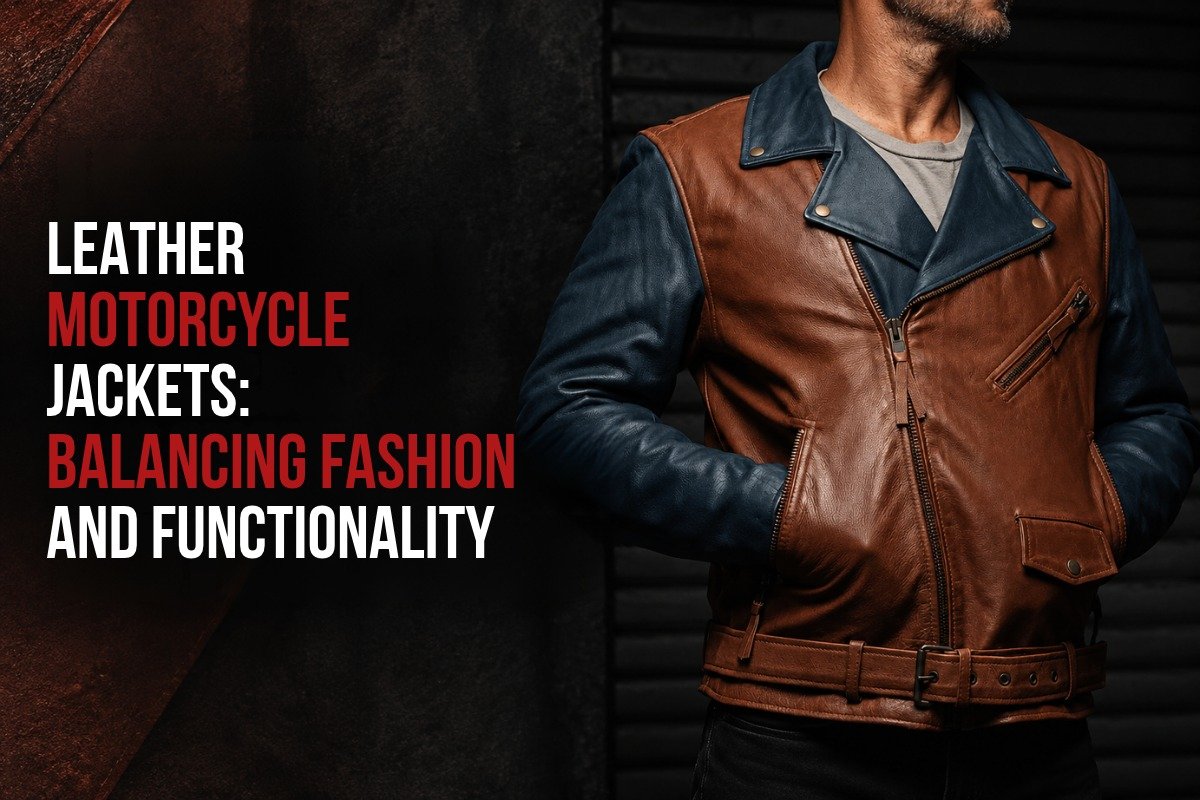
- Perfecto/biker: the asymmetrical zipper, wide lapels, and belted waist made famous in the mid-20th century. It’s the one most people picture.
- Café racer: minimalist and clean, with a snug collar and a straight front zipper. It’s a favorite for riders who like a streamlined look.
- Bomber: a relaxed, rib-knit silhouette that works as easily on the street as on the bike.
- Racing-inspired: panelled, athletic, and often with more built-in protection and performance features.
Color, Hardware, & Finish
Black remains the default, but brown, tan, oxblood, and olive have their own loyal followings. Hardware matters too: antiqued brass reads vintage, while nickel or matte black feels modern. Finishing changes the whole personality of a jacket. Matte, distressed leather looks lived-in and relaxed, while glossy, polished leather looks sharper and more formal.
Styling on and off the bike
On the bike, keep things simple: the jacket is the statement, so pair it with well-fitting riding jeans or pants and proper boots. Off the bike, a leather jacket works with a plain tee and denim, a knit sweater, or even a button-down for a smarter look. Because the jacket is the focal point, keep the rest of the outfit uncluttered.
Where Style & Safety Meet: Features That Do Both
The good news is that manufacturers have gotten very good at hiding protection inside stylish garments.
- Hidden or removable armor: pockets that hold CE-rated armor without changing the jacket’s outline. You can remove the armor when you’re off the bike if you want a slimmer profile.
- Slim-cut jackets with stretch panels: strategically placed stretch in the elbows, shoulders, or back lets you keep a tailored fit without restricting movement.
- Perforated leather: small, evenly placed holes let air flow through in hot weather without sacrificing the classic look. Be aware that perforation reduces abrasion protection in those areas, so quality construction and proper armor matter even more.
Style-first vs. Safety-first vs. Hybrid
| Feature | Style-first jacket | Safety-first jacket | Hybrid jacket |
| Primary goal | Look and fashion | Maximum protection | Balanced look and protection |
| Armor | Usually none | CE Level 1 or 2, shoulders, elbows, back | Removable CE-rated armor |
| Leather thickness | Thin, soft | Thick, heavy-duty | Medium weight |
| Certification | Typically none | Often EN 17092 Class AA or AAA | Often Class A or AA |
| Fit | Fashion cut, often loose or boxy | Close, riding-position cut | Slim cut with riding articulation |
| Best for | Casual wear only | Sport and high-speed riding | Daily riding and everyday wear |
How to Choose the Right Jacket for You
Choosing the right jacket starts with how and where you ride. Consider your climate, budget, and fit in a riding position so your jacket delivers real protection and lasting comfort.
Riding Style & Climate
A rider who commutes through city traffic has different needs than someone who takes long highway trips or carves canyon roads. Hot climates favor goatskin, perforation, and vents. Cold or mixed climates call for thicker hides and thermal liners. Higher speeds call for higher certification classes.
Budget Ranges
- Entry level: more affordable jackets, often thinner leather and basic armor. Fine for occasional, low-speed riding if the armor and stitching are sound.
- Mid range: better hides, better construction, certified armor, and more thoughtful details. This is where most daily riders find the best value.
- Premium: heavy-duty leather, exceptional stitching, and long-term durability. Makers such as Vanson Leather and First Manufacturing Co. sit in this world of craftsmanship, where the jacket is built to last for many years and can be repaired rather than replaced.
Fit Checklist
Try the jacket on in your riding position, not just standing in front of a mirror:
- Sit or lean as if you’re holding the handlebars.
- Check that the sleeves still reach your wrists.
- Make sure the shoulders and back don’t bunch or pull.
- Confirm the armor stays over the joints.
- Test it over the layers you’ll actually wear.
- Make sure you can breathe and move freely, but nothing flaps or shifts.
Men’s, Women’s, & Unisex Considerations
Women’s leather motorcycle jackets are generally cut with a narrower shoulder, a shaped waist, and adjusted sleeve and armor placement, so protection lines up with the body. Men’s cuts are generally broader through the chest and shoulders. Unisex jackets can work well, but pay close attention to armor position and sleeve length. Whatever the label says, the right jacket is the one that fits your body and keeps the armor where it belongs.
Caring for Your Leather Jacket
Proper care keeps your leather jacket supple, strong, and looking great. Regular cleaning, conditioning, and smart storage protect your investment and help your jacket age beautifully with every mile.
Cleaning, Conditioning, & Storage
- Cleaning: wipe the jacket with a soft, damp cloth after rides. For deeper cleaning, use a cleaner made for leather, never household detergents.
- Conditioning: apply a quality leather conditioner a few times a year, or more often in dry climates or if you ride daily. It keeps the leather supple and prevents cracking.
- Storage: hang the jacket on a wide, padded hanger in a cool, dry spot away from direct sunlight. Avoid plastic covers, which trap moisture.
Handling Rain and Salt
If your jacket gets wet, let it air-dry naturally, away from heaters, radiators, and direct sun, which can dry out and stiffen the leather. Once it’s dry, condition it. Road salt and sweat can stain and dry out leather, so wipe salt off promptly with a damp cloth and condition afterward. Taking care of these small things protects your investment for years.
Common Mistakes to Avoid
- Buying a fashion jacket and assuming it protects: A thin, unarmored leather jacket made for style may look the part but offer little protection in a crash.
- Choosing too large or too tight: Too loose, and the armor shifts and the jacket can ride up. Too tight, and you’ll restrict movement and be uncomfortable on longer rides.
- Skipping armor or replacing it incorrectly: Armor only works if it’s certified, correctly sized, and positioned over the right areas. If you replace inserts, choose ones designed to fit your jacket’s pockets.
Conclusion
The best motorcycle jacket is the one you’ll actually wear every ride, and that means finding the sweet spot between how it looks and how it protects. Look for quality leather, certified armor, and a fit that works in your riding position, and the style will follow. Treat it well, and it will reward you with decades of service and a patina that tells your story.
FAQs
Is a leather jacket enough protection for riding?
A quality, thick leather jacket gives excellent abrasion resistance, but it’s only part of a complete setup. For real protection, you also need certified armor, a proper fit, and a helmet, gloves, pants, and boots. A fashionable leather jacket with no armor is not a substitute for riding gear.
What does CE-rated mean on a motorcycle jacket?
CE-rated means the armor or garment has been tested to meet European safety standards. For armor, Level 1 and Level 2 describe how much impact force is transmitted to the body, with Level 2 allowing less. For whole garments, look for EN 17092 classes such as AA or AAA.
How tight should a leather motorcycle jacket be?
It should be snug, but not restrictive. In your riding position, the armor should stay put over your shoulders, elbows, and back, the sleeves should reach your wrists, and you should be able to move your arms and breathe freely. New leather will loosen slightly as it breaks in, so a snug fit at first is normal.
Cowhide or goatskin: which is better?
Neither is universally better. Cowhide is heavier and more rugged, with a classic feel and strong abrasion resistance. Goatskin is lighter and softer from day one, making it comfortable and well-suited for warmer weather and everyday wear. Choose based on how and where you ride.
Can I wear a motorcycle jacket as everyday fashion?
Absolutely. Many riding jackets, especially hybrid styles with removable armor, look great off the bike. Pair one with jeans and a tee, or dress it up with a sweater or shirt.
How often should I condition a leather jacket?
A good rule of thumb is two to four times a year, depending on climate and how often you ride. Condition it more often if it gets wet, if you ride in dry or hot conditions, or if the leather starts to feel stiff or dry.