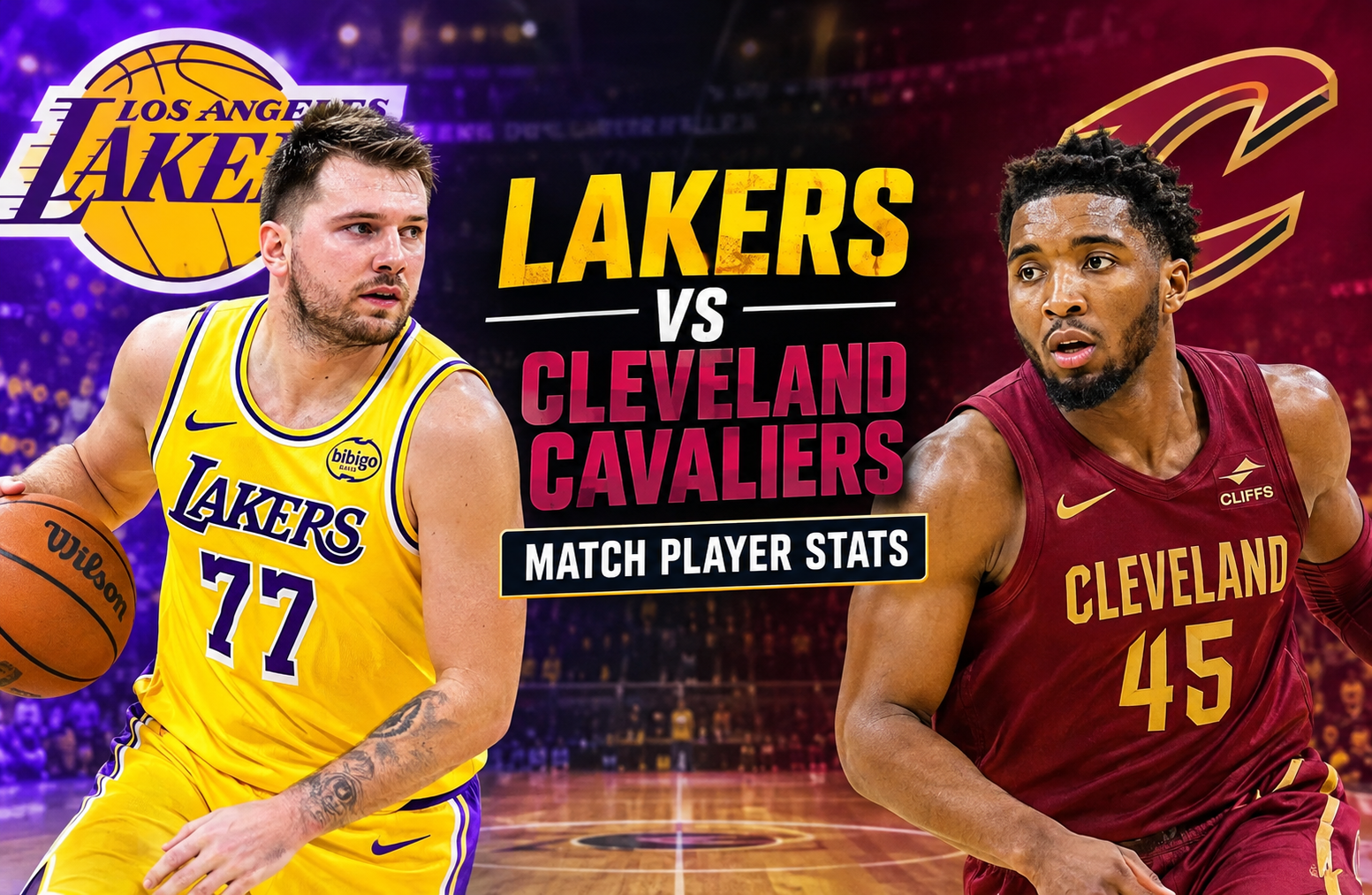
Lakers vs Cleveland Cavaliers Match Player Stats
The lakers vs cleveland cavaliers match player stats from the April 1, 2026 matchup show how quickly a close game can turn when one team takes control of the middle quarters. The Los Angeles Lakers defeated the Cleveland Cavaliers 127-113 at Crypto.com Arena, with Luka Doncic producing 42 points, 12 assists, 5 rebounds, and 2 steals while shooting 13-of-26 from the field. The Lakers also received important contributions from Austin Reaves, Deandre Ayton, LeBron James, Jake LaRavia, and Rui Hachimura.
Cleveland had its own strong individual performances. Jarrett Allen led the Cavaliers with 18 points on an efficient 9-of-11 shooting, while James Harden added 17 points. Thomas Bryant scored 14, Max Strus contributed 11, and Donovan Mitchell finished with 10 points. However, Cleveland’s offensive production could not match the Lakers’ 45-point third quarter, which became the decisive stretch of the contest.
This game was particularly interesting because the Cavaliers actually led after the opening quarter. Cleveland scored 34 points in the first period compared with Los Angeles’ 32. The Lakers then responded with a 33-point second quarter and a massive 45-point third quarter before entering the final period with a 27-point advantage.
lakers vs cleveland cavaliers match player stats at a glance
The basic numbers tell an important part of the story.
| Category | Cleveland Cavaliers | Los Angeles Lakers |
| Final Score | 113 | 127 |
| Q1 | 34 | 32 |
| Q2 | 19 | 33 |
| Q3 | 30 | 45 |
| Q4 | 30 | 17 |
| Field Goals | 43-87 | 45-83 |
| Field Goal % | 49% | 54% |
| Three-Pointers | 13-39 | 13-31 |
| Three-Point % | 33% | 42% |
| Free Throws | 14-19 | 24-26 |
| Free Throw % | 74% | 92% |
| Rebounds | 35 | 37 |
| Assists | 26 | 26 |
| Turnovers | 14 | 10 |
| Steals | 5 | 9 |
| Blocks | 2 | 4 |
The difference was not simply about one category. Los Angeles was more efficient from the field, converted free throws at a much higher rate, committed fewer turnovers, and generated more steals and blocks.
The Lakers also made 13 three-pointers, exactly the same number as Cleveland. The difference came from volume and efficiency. Los Angeles attempted 31 threes and made 42% of them, while Cleveland attempted 39 and made only 33%.
That distinction matters because the Cavaliers actually took eight more three-point attempts. Their problem was that the extra volume did not produce an advantage on the scoreboard.
How the game developed quarter by quarter
First quarter: Cleveland makes the early statement
Cleveland started the game with 34 points and led Los Angeles by two after the opening period.
The Cavaliers’ early success demonstrated that they were capable of attacking the Lakers’ defense before Los Angeles could establish its preferred rhythm. Jarrett Allen was especially effective around the basket, eventually finishing the night with 18 points on 9-of-11 shooting.
The Lakers scored 32 points in the first quarter, so the game immediately developed into a high-scoring contest.
At this point, there was little indication that Los Angeles would eventually win by 14 points.
Second quarter: Lakers change the momentum
The second quarter produced the first major shift.
Los Angeles scored 33 points while Cleveland managed only 19. That 14-point difference transformed a two-point deficit into a 12-point halftime lead for the Lakers.
The Lakers entered halftime ahead 65-53.
One reason this stretch mattered was shooting efficiency. Los Angeles continued generating quality offensive opportunities while Cleveland’s scoring dropped significantly from the first quarter.
This was also where the Lakers began creating the separation that later allowed them to control the game.
Third quarter: The decisive 45-point explosion
The third quarter was the most important statistical period of the game.
Los Angeles scored 45 points.
Cleveland scored 30.
That gave the Lakers a 15-point advantage during the quarter and pushed the overall lead to 27 points entering the fourth.
The Lakers led 110-83 after three quarters.
Luka Doncic was central to the offensive attack. His ability to combine scoring with playmaking meant Cleveland had to account for both his shooting and his passing.
The Lakers did not simply rely on Doncic scoring every possession. His 12 assists show how much his playmaking contributed to the overall offensive structure.
Fourth quarter: Cleveland responds, but the gap is too large
Cleveland actually outscored Los Angeles 30-17 in the fourth quarter.
That was an important positive for the Cavaliers, but it was not enough to overcome the damage done during the second and third quarters.
The Lakers entered the final period with a 27-point advantage. Even after Cleveland won the fourth-quarter scoring battle by 13 points, Los Angeles still finished with a 127-113 victory.
This is a useful example of why quarter-by-quarter analysis is often more informative than looking only at the final score.
Luka Doncic delivers the headline performance
Luka Doncic was the standout performer in this matchup.
His final line was:
- 34 minutes
- 42 points
- 13-of-26 field goals
- 6-of-13 three-pointers
- 10-of-10 free throws
- 5 rebounds
- 12 assists
- 2 steals
- 0 turnovers
- +21 plus/minus
The most impressive part of the performance was the combination of scoring and playmaking.
Scoring 42 points is already a major offensive contribution. Adding 12 assists means Doncic was directly involved in a large portion of Los Angeles’ offensive production.
His perfect 10-of-10 performance from the free-throw line also helped the Lakers take advantage of scoring opportunities when Cleveland sent him to the line.
Perhaps most notable from a ball-control perspective was the zero in the turnover column.
A player handling the ball extensively while producing 42 points and 12 assists can naturally be exposed to turnover risk. Doncic avoided that problem in this game.
His +21 plus/minus also reflected the Lakers’ strong overall performance while he was on the floor.
Austin Reaves provides valuable secondary scoring
Austin Reaves finished with 19 points in 37 minutes.
His complete line included:
- 19 points
- 6-of-16 field goals
- 2-of-9 three-pointers
- 5-of-5 free throws
- 6 rebounds
- 4 assists
- 5 turnovers
- 2 steals
- 1 block
- +4 plus/minus
Reaves’ shooting efficiency was mixed, particularly from three-point range, but his overall contribution went beyond scoring.
He collected six rebounds, recorded four assists, and added two steals and a block.
His five turnovers were a weakness in the individual box score. However, the Lakers still maintained enough offensive production elsewhere to compensate.
This is an important reminder that player statistics should not be judged using points alone.
Deandre Ayton controls the interior
Deandre Ayton added 18 points and nine rebounds in 28 minutes.
His shooting line was particularly efficient:
- 18 points
- 8-of-13 field goals
- 2-of-3 free throws
- 9 rebounds
- 1 assist
- 1 steal
- 1 block
- +10 plus/minus
Ayton did not attempt a three-pointer.
Instead, his contribution came primarily from inside the arc, where he converted eight of 13 field-goal attempts.
His nine rebounds were also important because the Lakers finished with a 37-35 advantage on the glass.
Although that two-rebound difference was not enormous, it prevented Cleveland from creating a clear rebounding advantage.
LeBron James contributes without needing a huge scoring night
LeBron James scored 14 points in 31 minutes.
His final statistics were:
- 14 points
- 4-of-8 field goals
- 1-of-3 three-pointers
- 5-of-6 free throws
- 5 rebounds
- 6 assists
- 3 turnovers
- 1 steal
- 1 block
- +4 plus/minus
James did not need to become the Lakers’ leading scorer in this matchup.
With Doncic scoring 42, James could contribute through playmaking, rebounding, defense, and efficient scoring opportunities.
His six assists were particularly useful because they helped keep the Lakers’ offense moving without requiring him to dominate the ball.
This type of supporting statistical profile is important when evaluating a veteran player in a team that has multiple offensive creators.
Rui Hachimura makes an impact off the bench
Rui Hachimura was the Lakers’ leading bench scorer.
He scored 14 points in only 19 minutes.
His notable numbers included:
- 14 points
- 6-of-8 field goals
- 2-of-3 three-pointers
- 1 steal
- 1 block
- +10 plus/minus
Hachimura’s 6-of-8 shooting was one of the most efficient individual shooting performances among the Lakers’ rotation players.
He also made two of his three attempts from three-point range.
The combination of efficient shooting, perimeter spacing, and defensive activity made his minutes valuable.
Bench production can be especially important in games where the opposing team has several high-level scorers. The Lakers received enough secondary production to prevent the offense from becoming completely dependent on Doncic.
Jake LaRavia adds another 14-point contribution
Jake LaRavia also finished with 14 points.
His scoring was part of a balanced supporting group that included Hachimura and LeBron James at 14 points each.
This meant the Lakers did not need every possession to end with Doncic attempting a shot.
The distribution was important:
- Luka Doncic: 42
- Austin Reaves: 19
- Deandre Ayton: 18
- LeBron James: 14
- Jake LaRavia: 14
- Rui Hachimura: 14
That scoring structure gave Los Angeles multiple ways to produce points.
Jarrett Allen leads Cleveland’s scoring
Jarrett Allen was Cleveland’s leading scorer with 18 points.
He was highly efficient from the field, making 9 of 11 attempts.
His statistics included:
- 18 points
- 9-of-11 field goals
- 4 rebounds
- 2 assists
- 1 turnover
- 1 steal
- 2 offensive rebounds
- 2 defensive rebounds
- -7 plus/minus
Allen’s 81.8% field-goal shooting was excellent.
The challenge for Cleveland was that his efficiency did not translate into enough overall offensive production for the Cavaliers to keep pace with Los Angeles.
His four rebounds were also lower than Ayton’s nine, although rebounding is a team responsibility rather than the job of one player.
James Harden produces 17 points
James Harden finished with 17 points in 28 minutes.
His line:
- 17 points
- 6-of-13 field goals
- 2-of-5 three-pointers
- 3-of-5 free throws
- 3 assists
- 3 turnovers
- 0 rebounds
- -19 plus/minus
Harden’s 17 points made him Cleveland’s second-leading scorer.
However, his overall box score also shows some areas where the Cavaliers lacked balance. He recorded three assists but did not collect a rebound, while his three turnovers added to Cleveland’s team total.
The -19 plus/minus also reflected how difficult the game became for Cleveland during his minutes.
Donovan Mitchell struggles to find his scoring rhythm
Donovan Mitchell finished with 10 points.
He shot:
- 4-of-10 from the field
- 0-of-3 from three-point range
- 2-of-2 from the free-throw line
He also added:
- 3 rebounds
- 6 assists
- 2 turnovers
- -24 plus/minus
Mitchell’s six assists show that he contributed as a passer even though his scoring was limited.
The bigger issue for Cleveland was his shooting from outside. Going 0-for-3 from three meant the Lakers did not have to respect his perimeter scoring in the same way they would have if he had been converting consistently.
His -24 was also the lowest plus/minus among the key players listed from either team.
Plus/minus should never be treated as a complete individual evaluation, but in the context of this game it reflects how strongly Los Angeles controlled the overall run while Mitchell was on the court.
Max Strus provides perimeter shooting
Max Strus scored 11 points in 23 minutes.
His shooting line:
- 4-of-8 field goals
- 3-of-7 three-pointers
- 3 rebounds
- 1 assist
- -10 plus/minus
Strus was one of Cleveland’s better three-point shooters in this particular game.
He made three of seven attempts from deep, accounting for nine of his 11 points.
However, Cleveland as a team made only 13 of 39 three-point attempts.
That 33% conversion rate meant the Cavaliers did not receive enough value from their high three-point volume.
Evan Mobley’s all-around contribution
Evan Mobley scored only six points, but his box score included several other contributions.
He finished with:
- 6 points
- 2-of-4 field goals
- 2-of-2 free throws
- 4 rebounds
- 4 assists
- 1 turnover
- 1 offensive rebound
- 3 defensive rebounds
- -18 plus/minus
Mobley’s four assists were useful because they added another passing option to Cleveland’s frontcourt.
His scoring, however, remained limited.
When a team is attempting to overcome a 14-point final deficit, it generally needs contributions from several offensive areas. Cleveland received strong efficiency from Allen, but the overall scoring distribution did not match Los Angeles’ production.
Comparing the team shooting numbers
The shooting statistics provide one of the clearest explanations for the result.
The Lakers shot 45-of-83 from the field.
That works out to approximately 54%.
The Cavaliers shot 43-of-87, or approximately 49%.
The difference was not enormous in field-goal percentage, but it mattered because Los Angeles also converted more free throws.
The Lakers made 24 of 26 free throws.
Cleveland made 14 of 19.
That created a 10-point advantage in made free throws.
Los Angeles also converted 42% from three compared with Cleveland’s 33%.
So the Lakers had advantages in:
- Overall field-goal efficiency
- Three-point efficiency
- Free-throw efficiency
- Turnover control
- Steals
- Blocks
Those combined advantages explain why a 14-point final margin developed despite Cleveland shooting nearly 50% from the field.
Three-point shooting tells an interesting story
At first glance, both teams made 13 three-pointers.
That might suggest that three-point shooting was relatively even.
The attempts reveal a different picture.
Cleveland:
- 13 made
- 39 attempts
- 33% shooting
Los Angeles:
- 13 made
- 31 attempts
- 42% shooting
The Lakers needed eight fewer attempts to make the same number of three-pointers.
This is an important efficiency distinction.
Cleveland relied on greater volume but did not convert at the same rate.
Los Angeles generated the same number of made threes while taking fewer attempts.
Turnovers gave the Lakers another advantage
Cleveland committed 14 turnovers.
Los Angeles committed 10.
That four-turnover difference may appear small, but it matters in a game decided by 14 points.
The Lakers also recorded nine steals compared with Cleveland’s five.
That means Los Angeles combined better ball security with more defensive activity.
The Lakers’ 26 assists against 10 turnovers also produced a strong assist-to-turnover profile.
Doncic was particularly effective in this area because he recorded 12 assists without committing a turnover.
Rebounding was close
The rebounding battle was relatively balanced.
Los Angeles finished with 37 rebounds.
Cleveland had 35.
The two-rebound difference was not large enough by itself to explain the result.
Instead, the game was decided more clearly through shooting efficiency, free throws, turnovers, and the massive third-quarter scoring difference.
This is why looking at a complete box score is more useful than focusing on one category.
The third quarter changed everything
If there is one period to study when analyzing this matchup, it is the third quarter.
The Lakers scored 45 points.
Cleveland scored 30.
Los Angeles entered the half with a 12-point advantage.
By the end of the third quarter, the advantage had grown to 27.
That means the Lakers added 15 points to their lead in just one quarter.
The third quarter also demonstrated the value of having multiple offensive options.
Doncic could create his own shot.
James could facilitate.
Reaves could attack and shoot.
Ayton could finish inside.
Hachimura provided efficient bench scoring.
That combination made it difficult for Cleveland to stop the Lakers’ offense through one defensive adjustment.
Why Luka Doncic’s 42-point performance mattered
Doncic’s scoring total naturally attracts the most attention, but the deeper story is how complete the performance was.
He did not simply score 42 points.
He also produced 12 assists and five rebounds.
He made six three-pointers.
He made all 10 free throws.
He committed zero turnovers.
He finished with two steals.
This means his statistical contribution extended across scoring, playmaking, rebounding, defense, and possession control.
The official NBA game record lists the same 42-point, 12-assist, five-rebound performance and records the Lakers’ 127-113 victory. NBA official game box score
Season series context
The Lakers and Cavaliers split their two meetings during the 2025-26 regular season.
The earlier matchup went in Cleveland’s favor, with the Cavaliers defeating the Lakers 129-99 on January 29, 2026.
The second meeting produced a completely different result.
On April 1, the Lakers won 127-113.
That means the season series finished 1-1.
The contrast between the two games is significant because it shows that the matchup cannot be understood through one result alone.
The January meeting featured a 30-point Cleveland victory.
The April meeting featured a 14-point Lakers victory.
Across the two games, each team recorded one win.
What the player stats reveal about both teams
The most useful lesson from this matchup is that individual statistics become more meaningful when they are connected to team performance.
For Los Angeles, the formula was clear:
- Doncic supplied elite scoring and playmaking.
- Ayton provided efficient interior scoring and rebounding.
- Reaves added secondary scoring and defensive activity.
- James contributed across several categories.
- Hachimura delivered efficient bench offense.
- The team protected the ball better than Cleveland.
- The Lakers converted free throws at a very high rate.
For Cleveland, there were also clear positives:
- Allen was highly efficient around the basket.
- Harden scored 17 points.
- Strus provided three made three-pointers.
- Mitchell created six assists despite a difficult shooting night.
- Mobley added four assists and four rebounds.
- Cleveland scored 34 points in the first quarter and 30 in the fourth.
The main difference was consistency across the middle of the game.
Player efficiency versus raw scoring
A common mistake when reading basketball statistics is assuming that the highest scorer automatically had the most efficient game.
Doncic’s 42 points were outstanding, but Allen’s 18 points on 9-of-11 shooting were also highly efficient.
The difference is volume.
Doncic attempted 26 field goals and scored 42 points.
Allen attempted only 11 and scored 18.
Both performances were valuable, but they served different roles.
Doncic was responsible for creating a large portion of the Lakers’ offense.
Allen operated more as an efficient interior finisher.
That distinction helps explain why a box score should be read as a complete statistical profile rather than as a list of point totals.
The importance of free throws
Free throws were another major separator.
Los Angeles:
24-of-26, 92%
Cleveland:
14-of-19, 74%
The Lakers therefore scored 10 more points from the free-throw line.
That is significant in a game decided by 14 points.
Doncic was perfect at 10-of-10.
LeBron James made five of six.
Austin Reaves made all five of his attempts.
Ayton made two of three.
These contributions collectively helped Los Angeles maximize scoring opportunities.
What the plus/minus numbers tell us
The plus/minus figures were generally favorable for the Lakers’ main contributors.
Doncic finished at +21.
Ayton was +10.
Hachimura was +10.
James and Reaves were both +4.
On Cleveland’s side:
- Jarrett Allen: -7
- Max Strus: -10
- Evan Mobley: -18
- James Harden: -19
- Donovan Mitchell: -24
Plus/minus does not isolate individual performance. It measures the team’s scoring margin while a player is on the court.
Therefore, it should be used alongside shooting, assists, rebounds, turnovers, and defensive statistics rather than treated as a standalone judgment.
Still, the distribution here matches the broader story of the game. Los Angeles’ key players generally experienced stronger stretches, while Cleveland’s principal players were on the floor during portions of the game when the Lakers created their largest advantage.
A practical way to read this box score
If you are analyzing this matchup for fantasy basketball, statistical research, historical comparison, or general basketball study, a useful approach is to work through the numbers in five steps.
Step 1: Start with the final score
The Lakers won 127-113.
This establishes the basic result but tells you very little about how the game was won.
Step 2: Check the quarter splits
The quarter scores reveal the turning point.
Cleveland started well.
Los Angeles dominated the second and third quarters.
That explains the final margin.
Step 3: Compare shooting efficiency
The Lakers shot 54% from the field and 42% from three.
Cleveland shot 49% from the field and 33% from three.
This shows that Los Angeles was more efficient.
Step 4: Check possession-related statistics
The Lakers committed 10 turnovers.
Cleveland committed 14.
Los Angeles also recorded nine steals.
This suggests that ball security and defensive activity contributed to the final result.
Step 5: Look beyond the leading scorer
Doncic’s 42 points are the headline.
But Ayton’s nine rebounds, Reaves’ six rebounds and four assists, James’ six assists, and Hachimura’s efficient 14 points helped create the complete team performance.
This five-step method can be applied to almost any NBA box score.
Key statistical takeaways
The most important numbers from the matchup can be summarized as follows:
- Lakers won 127-113.
- Luka Doncic scored 42 points.
- Doncic added 12 assists and five rebounds.
- Doncic committed zero turnovers.
- Deandre Ayton scored 18 points and grabbed nine rebounds.
- Austin Reaves scored 19 points.
- LeBron James scored 14 points and added six assists.
- Rui Hachimura scored 14 points in 19 minutes.
- Jarrett Allen led Cleveland with 18 points.
- James Harden scored 17 points.
- Donovan Mitchell scored 10 points and added six assists.
- Max Strus made three three-pointers.
- Los Angeles shot 54% from the field.
- Cleveland shot 49%.
- Both teams made 13 three-pointers.
- The Lakers shot 42% from three.
- Cleveland shot 33% from three.
- Los Angeles made 24 free throws.
- Cleveland made 14.
- The Lakers committed four fewer turnovers.
- Los Angeles dominated the third quarter 45-30.
- The season series finished tied at 1-1.
Frequently Asked Questions
Who led the Lakers in scoring against the Cavaliers?
Luka Doncic led the Lakers with 42 points. He also recorded 12 assists, five rebounds, two steals, and zero turnovers.
Who led the Cavaliers in scoring against the Lakers?
Jarrett Allen led Cleveland with 18 points. He shot 9-of-11 from the field and also recorded four rebounds and two assists.
What was the Lakers vs Cavaliers final score?
The Los Angeles Lakers defeated the Cleveland Cavaliers 127-113.
How many points did LeBron James score against Cleveland?
LeBron James scored 14 points in 31 minutes. He also recorded five rebounds, six assists, one steal, and one block.
How many points did Donovan Mitchell score?
Donovan Mitchell scored 10 points on 4-of-10 shooting. He also had three rebounds and six assists.
Did the Lakers and Cavaliers split their season series?
Yes. Cleveland won the first meeting 129-99 on January 29, 2026, while Los Angeles won the second meeting 127-113 on April 1, 2026. The season series therefore finished 1-1.
Conclusion
The lakers vs cleveland cavaliers match player stats from this matchup provide a detailed picture of how Los Angeles turned a competitive opening quarter into a 14-point victory.
Luka Doncic was the central figure with 42 points, 12 assists, five rebounds, six made three-pointers, and no turnovers. His scoring created the headline, but his playmaking and ball security were equally important.
The Lakers also received 19 points from Austin Reaves, 18 points and nine rebounds from Deandre Ayton, 14 points and six assists from LeBron James, and an efficient 14-point contribution from Rui Hachimura.
Cleveland had strong individual performances as well. Jarrett Allen scored 18 points on 9-of-11 shooting, James Harden added 17, Thomas Bryant scored 14, Max Strus contributed 11, and Donovan Mitchell finished with 10 points and six assists.
The decisive difference came from the Lakers’ efficiency and their control of the middle quarters. Los Angeles shot 54% from the field, made 42% of its three-point attempts, converted 92% of its free throws, and committed only 10 turnovers.
The 45-point third quarter ultimately became the defining stretch. Cleveland entered the game strongly and finished the fourth quarter with a 30-17 advantage, but the Lakers’ second- and third-quarter performance created a lead that proved too large to overcome.
With the season series ending 1-1, the two games also demonstrated how different individual and team performances can be from one meeting to another.