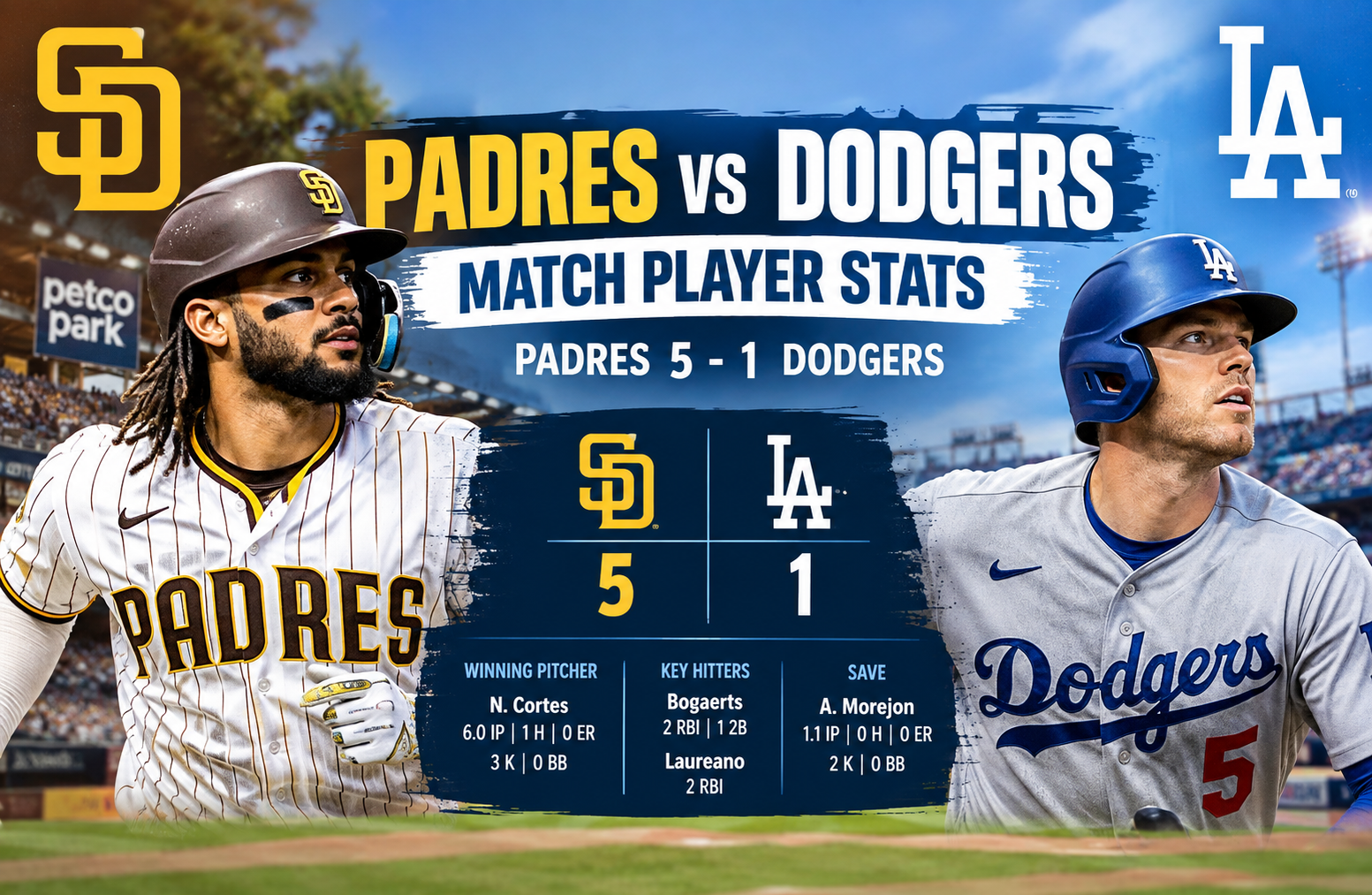
Padres vs Dodgers Match Player Stats
The padres vs dodgers match player stats from the August 24, 2025 matchup tell a story that the final 5-1 score only partly explains. San Diego defeated Los Angeles at Petco Park behind six outstanding innings from Nestor Cortes, timely run production, disciplined plate appearances, and a pitching performance that limited one of baseball’s most dangerous offenses to only two hits. The Padres finished with five runs on just three hits, while the Dodgers produced one run on two hits.
The game was played in front of 46,326 fans at Petco Park in San Diego, with the Padres improving to 74-56 and 43-21 at home. The Dodgers fell to 73-57 and 32-33 on the road. More importantly, San Diego’s performance showed how a team can win a high-pressure divisional game without relying on a large hit total.
This was not simply a case of one team hitting better. The Padres created pressure through walks, converted important opportunities, received elite starting pitching, and used their bullpen efficiently. The Dodgers, meanwhile, struggled to generate sustained traffic and found themselves chasing the game after the fourth inning.
Padres vs Dodgers Match Player Stats at a Glance
The basic scoreboard provides the starting point for understanding the matchup.
| Category | Dodgers | Padres |
| Final Score | 1 | 5 |
| Runs | 1 | 5 |
| Hits | 2 | 3 |
| Errors | 0 | 0 |
| Home Runs | 1 | 0 |
| Walks | 0 | 6 |
| Strikeouts | 7 | 5 |
| Team LOB | 1 | 4 |
| Team RISP | Not listed | 2-for-7 |
| Attendance | 46,326 | 46,326 |
| Venue | Petco Park | Petco Park |
The most striking number is the hit differential. Los Angeles had two hits and San Diego had three, yet the Padres won by four runs.
That tells us immediately that traditional batting average alone does not explain this game.
San Diego reached base six times through walks and turned those opportunities into meaningful scoring chances. The Padres also received a pitching performance that prevented the Dodgers from turning their limited opportunities into runs.
According to the official MLB game coverage, Cortes held Los Angeles to one hit over six scoreless innings, while San Diego’s offense used a three-run fourth inning to establish control.
Nestor Cortes Was the Difference Maker
The most important individual performance came from Nestor Cortes.
Cortes worked:
- 6.0 innings
- 1 hit allowed
- 0 earned runs
- 3 strikeouts
- 0 walks
- Pitching Game Score: 73
That stat line is particularly impressive against a Dodgers lineup built to punish mistakes.
The absence of walks was just as important as the strikeout total. Cortes did not need to overpower the Dodgers with a huge strikeout number. Instead, he controlled the strike zone, avoided free baserunners, and kept the lineup from building innings.
A pitcher facing a powerful lineup often gets into trouble when he falls behind hitters. That creates predictable counts and allows elite hitters to wait for pitches they can drive.
Cortes avoided that problem.
Six Scoreless Innings Changed the Game
The Padres did not need Cortes to complete eight or nine innings.
They needed him to give the bullpen a lead.
He delivered exactly that.
Six innings of one-hit, no-walk baseball meant the Dodgers never established consistent offensive momentum. Even though Los Angeles eventually scored once, the damage was minimal because San Diego had already built a three-run advantage.
The official MLB account noted that Cortes retired the first 16 Dodgers hitters he faced before surrendering a hit. That level of early control prevented Los Angeles from establishing the rhythm normally associated with its lineup.
From an analytical standpoint, this is one of the clearest lessons from the game: against an elite offense, limiting baserunners can be more valuable than chasing strikeout totals.
Tyler Glasnow Had a Difficult Outing
Tyler Glasnow started for Los Angeles and finished with:
- 4.0 innings
- 2 hits allowed
- 3 earned runs
- 4 walks
- 3 strikeouts
- Pitching Game Score: 45
At first glance, allowing only two hits in four innings might seem respectable.
The problem was the four walks.
Glasnow’s inability to consistently finish plate appearances allowed San Diego to create scoring opportunities without needing a large number of hits.
That became especially costly in the fourth inning.
The Padres were able to load the bases and then convert the opportunity into three runs. When a pitcher allows multiple free baserunners in a close divisional game, even a relatively low hit total can lead to substantial damage.
This is exactly what happened.
The Fourth Inning Changed Everything
The decisive offensive sequence came in the fourth inning.
San Diego scored three times, turning the game from a pitching battle into a 3-0 Padres advantage.
The key sequence included:
- Ryan O’Hearn reaching with the Padres’ first hit against Glasnow.
- Ramón Laureano delivering a two-run single.
- Jake Cronenworth producing a sacrifice fly.
- San Diego extending its lead without needing a home run.
Laureano’s contribution was especially important because his single produced two runs.
Cronenworth then added another run with a sacrifice fly.
This is an excellent example of situational hitting.
The Padres did not need to hit multiple home runs. They simply needed to take advantage of the opportunities created by baserunners.
The official MLB recap also highlighted the three-run fourth inning as the offensive turning point.
Xander Bogaerts Delivered in a High-Leverage Moment
Xander Bogaerts was one of the most important offensive players for San Diego.
His contributions included:
- 1 double
- 2 RBIs
- 2-out RBI production
- Double number 29
- 48 RBIs for the season according to the supplied game data
His most important moment came in the eighth inning.
Bogaerts doubled and brought home Manny Machado and Fernando Tatis Jr., pushing the Padres’ advantage to five runs.
That hit effectively removed any remaining uncertainty from the contest.
It also demonstrated why RBI opportunities cannot always be evaluated through raw hit totals.
A player can have one important extra-base hit and have a greater impact on the final result than another player who records multiple less-important singles.
Bogaerts’ eighth-inning double was exactly that type of contribution.
Ramón Laureano Provided the Initial Offensive Spark
Ramón Laureano produced one of San Diego’s biggest hits.
His fourth-inning single drove in two runs and gave the Padres breathing room.
That was especially valuable because the Padres had only three hits throughout the game.
When a team collects so few hits, each one carries greater importance.
Laureano’s two-RBI single was therefore not just another entry in the box score. It was the hit that transformed San Diego’s pressure into a meaningful lead.
His performance also illustrates the value of timely hitting.
A player does not need to collect several hits to become one of the most influential players in a game. A single high-leverage plate appearance can completely alter the scoreboard.
Jake Cronenworth Added a Valuable Insurance Run
Jake Cronenworth produced another important contribution with a sacrifice fly.
His fly ball scored Xander Bogaerts and gave San Diego a three-run fourth inning.
Sacrifice flies can be overlooked when evaluating offensive performances because they do not count as hits.
That would be a mistake in a game like this.
Cronenworth’s plate appearance accomplished the primary objective: moving a runner home and increasing the lead.
The Padres were not trying to win the box-score hit battle.
They were trying to maximize each scoring opportunity.
That distinction explains much of the final result.
Fernando Tatis Jr. Created Pressure Beyond the Box Score
Fernando Tatis Jr. contributed with his baserunning, including his 26th stolen base.
His presence on the bases creates a different challenge for opposing pitchers.
A runner with legitimate stolen-base ability can affect a pitcher even before attempting to steal. The pitcher may become more conscious of holding the runner, potentially changing timing, attention, and pitch selection.
Tatis’ stolen base therefore represents more than one additional statistic.
It reflects pressure.
The Padres also benefited from having multiple players capable of affecting the game in different ways. Some produced RBIs, others drew walks, while Tatis added value through aggressive baserunning.
That variety makes an offense difficult to defend.
Alex Freeland Supplied the Dodgers’ Only Run
Alex Freeland accounted for the Dodgers’ only run.
He hit a home run in the eighth inning, traveling approximately 388 feet according to the supplied game data.
Freeland’s homer cut the deficit from five runs to four, but it was not enough to trigger a larger rally.
The Dodgers had only two hits overall and did not produce the repeated baserunner traffic required to build a comeback.
That is an important distinction.
A solo home run can change the score, but it does not necessarily change the game.
The Dodgers needed additional baserunners around Freeland’s home run. They did not get them.
The Dodgers’ Offensive Numbers Explain the Loss
The Dodgers finished with:
- 29 at-bats
- 1 run
- 2 hits
- 1 RBI
- 1 home run
- 0 walks
- 7 strikeouts
- 1 team LOB
That combination is extremely revealing.
Los Angeles did not walk once.
San Diego walked six times.
That six-walk difference created a major contrast in offensive opportunity.
The Dodgers also left only one runner on base, which sounds efficient but in this context reflects how rarely they had sustained traffic.
A team cannot manufacture many runs when hitters are consistently making outs without reaching base.
The Seven Strikeouts Were Not the Main Problem
Seven strikeouts stand out, but the bigger issue was the lack of baserunners.
Strikeouts are only one type of out.
The more damaging pattern was that Los Angeles did not receive free opportunities through walks and managed only two hits.
Against Cortes, the Dodgers were unable to force extended innings.
Against the Padres bullpen, they faced the same problem.
That made the solo home run their only meaningful scoring mechanism.
Padres Pitching Won the Statistical Battle
San Diego’s pitching staff finished with:
- 9.0 innings
- 2 hits allowed
- 1 run allowed
- 1 earned run
- 0 walks
- 7 strikeouts
- 1 home run allowed
The most important number may be zero walks.
The Padres gave the Dodgers no free passes.
When a team allows only two hits and zero walks, it becomes extremely difficult for the opposition to score multiple runs without hitting the ball over the fence.
The Dodgers did hit one home run.
But because there were no runners on base, it produced only one run.
That is efficient run prevention.
Adrian Morejon Closed the Door
Adrian Morejon completed the game for San Diego and earned the save.
His line was:
- 1.1 innings
- 0 hits
- 0 earned runs
- 2 strikeouts
- 0 walks
Morejon’s ability to record four outs without allowing a hit was critical.
Once San Diego had built the lead, the priority shifted from creating offense to preventing a Dodgers comeback.
Morejon did exactly that.
His performance also demonstrates how bullpen usage can influence the shape of a game.
A four-run advantage allows a manager to use relief pitchers according to matchup and workload considerations rather than needing every pitch to be perfect.
Why the Padres Won Despite Only Three Hits
This is probably the most useful lesson from the entire game.
The Padres had only three hits.
Yet they scored five runs.
How?
1. Six walks created baserunners
Free passes gave San Diego additional opportunities without requiring a hit.
2. The Padres converted high-leverage chances
Laureano’s two-run single was the biggest early example.
3. Sacrifice fly produced another run
Cronenworth added a run without needing a hit.
4. Bogaerts produced a two-RBI double
The eighth inning provided additional insurance.
5. Pitching eliminated extra opportunities
Cortes and the Padres bullpen limited Los Angeles to two hits and one walk-free game.
This is why a basic hits comparison can be misleading.
The Padres did not dominate the Dodgers by simply hitting the ball more often.
They dominated by converting the opportunities that existed.
Padres vs Dodgers Match Player Stats and the Importance of Plate Discipline
The most obvious statistical contrast was walks.
San Diego: 6 walks.
Los Angeles: 0 walks.
That is a major difference in a single game.
A walk gives an offense another baserunner without requiring contact. Once runners are on base, a single can produce multiple runs.
This was exactly what happened in the fourth inning.
The Padres created enough traffic to make two hits extremely productive.
The Dodgers never created the same environment.
This is why on-base ability is so important when interpreting individual player performance.
A hitter who reaches base without recording a hit may contribute substantially to winning, especially when the lineup behind him converts that opportunity.
The RISP Number Adds More Context
San Diego went 2-for-7 with runners in scoring position.
That is not an extraordinary conversion rate.
Yet the Padres still scored five runs.
Why?
Because run scoring was not dependent entirely on traditional RISP efficiency.
They combined:
- Walks
- Timely singles
- A sacrifice fly
- A double
- Stolen-base pressure
- Strong pitching
This is a useful reminder that offensive success is multidimensional.
A team can have a modest RISP percentage and still score efficiently if it consistently creates baserunners and limits opposing production.
Game Flow by Inning
The inning-by-inning scoring pattern makes the game easier to understand.
| Inning | Dodgers | Padres |
| 1st | 0 | 0 |
| 2nd | 0 | 0 |
| 3rd | 0 | 0 |
| 4th | 0 | 2 |
| 5th | 0 | 3 |
| 6th | 0 | 0 |
| 7th | 0 | 0 |
| 8th | 1 | 0 |
| 9th | 0 | 0 |
| Final | 1 | 5 |
The central pattern is simple.
San Diego created its separation in the middle innings, while Los Angeles waited until the eighth inning to score.
By that point, the Padres had enough of a cushion to absorb a solo home run.
The Defensive Side Was Clean
Neither team committed an error.
The Padres and Dodgers both finished with zero errors.
That matters because the game was decided through execution rather than defensive mistakes.
San Diego’s pitching and situational offense created the advantage.
Los Angeles did not lose because of a string of fielding errors.
The Padres simply executed better in the areas that mattered most.
What the Game Says About Tyler Glasnow’s Line
Glasnow’s two-hit allowance might make the performance look better than it actually was.
The four walks tell the deeper story.
When a starting pitcher allows four walks in four innings, the defense is exposed to additional pressure and the pitcher’s pitch count can rise quickly.
The Padres exploited that.
They did not need to crush Glasnow with a barrage of hits.
They simply waited for opportunities and capitalized when they appeared.
That is one of the clearest tactical conclusions from the game.
What the Game Says About Nestor Cortes
Cortes demonstrated that efficiency can be more valuable than raw velocity or strikeout volume.
His three strikeouts were enough because he did not give Los Angeles extra baserunners.
His zero-walk performance was especially important.
The Dodgers had to earn almost every opportunity.
They earned only one hit against Cortes through six innings.
That is an extremely difficult environment for any offense, even one as talented as Los Angeles.
The Home-Field Factor Mattered
The Padres entered the game with a 43-21 home record.
The Dodgers were 32-33 on the road.
Those records provide useful context.
Petco Park was filled with 46,326 fans, and the atmosphere added pressure to a divisional matchup that carried major standings implications.
Home-field advantage is not simply about crowd noise.
It can also affect communication, comfort, routine, and the psychological environment surrounding high-leverage moments.
San Diego played like a team comfortable in its surroundings.
What Fans Should Take From the Player Stats
The most useful way to read this game is not to ask only, “Who had the most hits?”
Instead, ask:
- Who created scoring opportunities?
- Who prevented scoring opportunities?
- Who delivered in high-leverage situations?
- Who avoided damaging mistakes?
- Which players influenced the game without appearing prominently in the hit column?
Using those questions changes the interpretation.
Cortes was the biggest pitching factor.
Laureano and Bogaerts were major offensive contributors.
Cronenworth added situational value.
Tatis contributed through baserunning.
Morejon finished the job.
For Los Angeles, Freeland’s home run was the most visible offensive highlight, but the larger lineup failed to generate enough opportunities.
Padres vs Dodgers Match Player Stats: Key Player Impact
A simplified impact ranking looks like this:
Nestor Cortes
The clear pitching standout.
His six scoreless innings, one hit allowed, and zero walks controlled the game.
Xander Bogaerts
His two-RBI double provided the game’s most important insurance runs.
Ramón Laureano
His two-run single created the initial three-run cushion.
Jake Cronenworth
His sacrifice fly supplied an important run without requiring a hit.
Fernando Tatis Jr.
His stolen base added pressure and demonstrated the Padres’ ability to create value on the bases.
Adrian Morejon
He protected the lead with 1.1 scoreless innings and two strikeouts.
Alex Freeland
His solo home run prevented a shutout but did not create a larger Dodgers rally.
Historical and Divisional Context
This game carried more weight than an ordinary August contest.
San Diego entered the matchup with a 74-56 record, while Los Angeles was 73-57.
That made the contest particularly important in the National League West race.
The result moved San Diego ahead at that point in the standings.
The rivalry had also produced dramatic swings during the surrounding series, making every game more significant than its individual win-loss value might suggest.
MLB’s official coverage described San Diego’s victory as a move into sole possession of first place with 32 games remaining.
For readers studying the season, that context is essential.
The statistics are not isolated numbers.
They represent performance under pressure in a divisional race.
How to Evaluate This Matchup More Accurately
When researching this game, a strong approach is to combine traditional box-score statistics with context.
Start with:
- Runs
- Hits
- Walks
- Strikeouts
- RBIs
- Extra-base hits
- Starting pitcher workload
- Bullpen performance
- Situational hitting
- Baserunning
Then ask how those categories interacted.
For example, San Diego’s three hits alone do not explain five runs.
The six walks help explain the difference.
Likewise, the Dodgers’ one home run does not mean their offense performed well overall.
The zero walks and two total hits show why the home run produced only one run.
That is the kind of context that turns a basic box score into meaningful analysis.
Frequently Asked Questions
Who won the Padres vs Dodgers game on August 24, 2025?
The San Diego Padres defeated the Los Angeles Dodgers 5-1 at Petco Park.
Who was the winning pitcher?
Nestor Cortes earned the win after throwing six innings of one-hit, scoreless baseball with three strikeouts and no walks.
Who was the best offensive player for the Padres?
Xander Bogaerts was one of the biggest offensive contributors, driving in two runs with a double. Ramón Laureano also drove in two runs with a fourth-inning single.
How many hits did the Padres have?
San Diego recorded three hits and scored five runs.
How many hits did the Dodgers have?
Los Angeles recorded two hits and scored one run.
Who hit the Dodgers’ home run?
Alex Freeland hit a solo home run in the eighth inning. The supplied game data lists the distance at 388 feet.
Conclusion
The Padres’ 5-1 victory was built on efficiency rather than overwhelming offensive production.
San Diego collected only three hits, but six walks, timely hitting, a sacrifice fly, aggressive baserunning, and two crucial RBIs from Xander Bogaerts helped turn limited offensive opportunities into five runs.
The biggest difference, however, came from the pitching.
Nestor Cortes delivered six scoreless innings while allowing only one hit and no walks. That performance gave the Padres control of the game and allowed the bullpen to protect the advantage. Adrian Morejon then completed the job with 1.1 scoreless innings.
For Los Angeles, Alex Freeland’s eighth-inning home run provided the only run, but the Dodgers could not create enough traffic to mount a serious comeback. Two hits and zero walks made sustained offense extremely difficult.
The larger lesson from the padres vs dodgers match player stats is that winning baseball is not always about collecting the most hits. San Diego won by controlling the strike zone, creating opportunities, executing in important situations, and preventing Los Angeles from building innings.
That combination made the difference in a high-pressure National League West matchup.