How Can I Prepare My Child For Surf Lessons?
Your eight-year-old has talked about surfing since you booked the trip. The lesson is tomorrow morning, and now you are wondering if they are really ready for the ocean. You want the day to be fun, but you also want them to be safe.
On Maui, most beginner lessons take place in Kīhei at Kalama Beach Park and The Cove, where the waves are small and gentle. Trade winds often pick up in the afternoon and make the water choppier. Maui County also requires mineral sunscreen, and non-mineral sunscreens have been banned since October 2022.
The best way to prepare is to work on three things before the lesson: water confidence, basic ocean safety, and the right gear. Families who book kids’ surf lessons in Maui will find that a little practice at home makes the first session much easier, as the instructors teach at these breaks. A well-prepared child spends less time nervous and more time riding waves.
Why the Ocean Is a Big Step for Kids
The ocean is very different from a pool, and many children are not ready for it on their first try.
Waves knock kids over, currents can pull them sideways, and the sun wears them out quickly. These risks are real in Hawaii, where the Hawaiʻi Department of Health reports that drowning is the top cause of death for children ages 1 to 15. The same report found that fewer than 2% of the state’s second graders have the basic skills to avoid or recover from drowning.
A child who panics after a fall can tire out fast, and good preparation lowers that risk.
The Risk of Teaching Your Child Yourself
Teaching your child yourself can backfire if you do not know local conditions.
- Wrong spot: A beach that looks calm may have reef, rocks, or a strong current.
- No lifeguard: Many Maui beaches have no lifeguard on duty.
- Wrong board: A hard, short board is harder to balance on and can hurt when it hits a child.
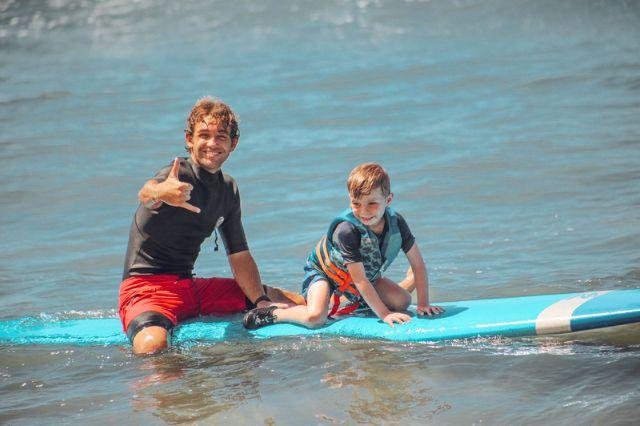
Instructors know which breaks suit beginners and stay close to kids in the water. That is why many families start with kids’ surf lessons Maui schools run at gentle beaches like The Cove.
Practical Steps to Prepare Your Child
Start a few days before the lesson.
- Check their swimming. Make sure your child can float on their back and swim a short distance without help, and ask the school about its swim requirements.
- Practice the pop-up on land. Have them lie on a towel, push up, and jump to their feet a few times a day.
- Teach rip current basics. NOAA advises staying calm, floating, swimming parallel to the shore instead of fighting the current, and waving for help.
- Show them how to fall. Teach them to fall flat rather than diving headfirst and to cover their head when they come up.
- Book a morning lesson. Calmer morning water is easier for a first-timer.
Before you leave for the beach, run through this quick checklist:
- Long-sleeve rash guard for sun and board rub
- Mineral sunscreen with zinc oxide or titanium dioxide
- Water and a small snack
- A towel and dry clothes for after
FAQs
What age can kids start surf lessons?
There is no single rule, and each surf school sets its own minimum age. Comfort in the water matters more than age, so ask the school before you book.
Does my child need to be a strong swimmer?
They do not need to be fast, but they should be comfortable swimming and floating in deep water. Instructors stay nearby, yet basic skills give your child more confidence after a fall.
What if my child gets scared during the lesson?
Let the instructor slow things down and keep them in the shallow whitewater. Ending on a good wave, even a small one, keeps them excited for next time.
Key Takeaways
- Kīhei’s Kalama Beach Park and The Cove have small, gentle waves that suit young beginners.
- Drowning is the leading cause of death for Hawaii children ages 1 to 15, so water skills come first.
- Practicing the pop-up and safe falls at home makes the first lesson easier.
- Kids should know to float, swim parallel to shore, and wave for help in a rip current.
- Maui County only allows mineral sunscreen, so pack one with zinc oxide or titanium dioxide.
- Morning lessons usually offer calmer water than afternoons.