Dentiloquent: Meaning, Origin, Examples, and Usage
The word Dentiloquent describes a fascinating and unusual way of speaking that involves talking through closed or clenched teeth. Although it is rarely heard in everyday conversations, this distinctive expression offers an interesting way to describe a particular style of speech. It can help writers explain tense conversations, dramatic reactions, controlled emotions, and moments when someone speaks without fully opening their mouth. Understanding this unusual vocabulary term also provides an opportunity to explore the relationship between language, pronunciation, facial expressions, and human communication.
English contains thousands of words that describe how people communicate. Some explain the meaning of spoken messages, while others describe the tone, volume, or physical manner of speaking. This particular term belongs to the second category. Rather than focusing on what someone says, it draws attention to how the words are produced. A person speaking through tightly held teeth may sound controlled, strained, irritated, or simply unusual, depending on the situation.
Despite its interesting meaning, the term deserves some linguistic caution. It is not a common modern English adjective, and its dictionary recognition is limited. However, related vocabulary provides useful evidence for understanding its meaning and construction. Exploring its definition, possible linguistic roots, grammatical role, examples, and practical applications helps readers understand both its value and its limitations.
What Does Dentiloquent Mean?
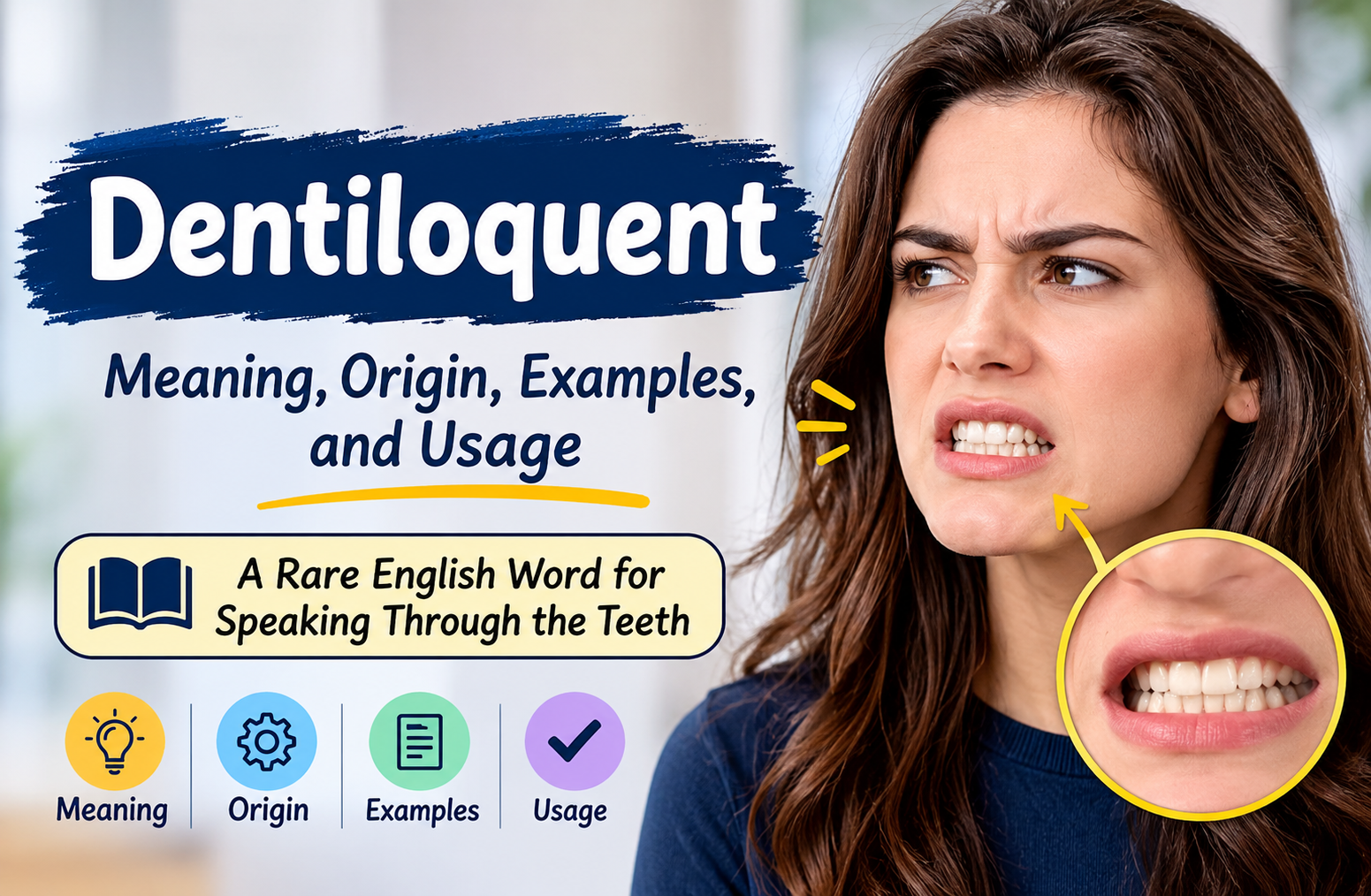
Dentiloquent means speaking through the teeth, particularly when the teeth are held close together or clenched while producing words. It describes the physical manner in which someone speaks rather than the emotional meaning of the message.
Imagine a person who is extremely frustrated but wants to avoid shouting. Instead of opening their mouth normally, they keep their jaw tight and say, “I told you not to do that again.”
The words may sound sharp, controlled, and tense. The person is communicating verbally, but their teeth remain closely held together. This is the kind of speaking behavior that the term is intended to describe.
The expression is particularly interesting because it combines an unusual vocabulary structure with a recognizable human behavior.
Consider these important characteristics:
- The speaker keeps their teeth close together.
- The jaw may remain tight or relatively restricted.
- Words are produced without the usual degree of mouth opening.
- The voice may sound strained, controlled, or unusually sharp.
- The physical delivery can communicate tension even when the words appear ordinary.
It is important to understand that the word does not automatically mean anger. Someone might speak through their teeth because they are cold, uncomfortable, frightened, trying to remain quiet, or deliberately controlling their reaction.
The physical action is central to the meaning. The emotion behind it depends on the circumstances.
A Simple Explanation for Everyday Readers
The easiest way to understand this rare expression is to think about the familiar phrase “speaking through clenched teeth.”
Most people have seen this behavior in real conversations, films, or everyday situations.
For example, someone might smile politely while quietly saying something unpleasant through tightly held teeth. Their facial expression may appear controlled, but their speech reveals physical tension.
Another example is a person who is trying not to interrupt an argument with a loud response. They keep their jaw tight and deliver a short sentence.
In both situations, the manner of speaking is more important than the actual words.
This distinction makes the term useful for describing a specific physical feature of communication that ordinary vocabulary sometimes explains through longer phrases.
Why Is Dentiloquent an Unusual English Word?
One reason this expression attracts attention is its rarity. Most English speakers are familiar with words such as articulate, eloquent, whispering, mumbling, and shouting. However, comparatively few people encounter specialized expressions describing speech produced through closed teeth.
The word is unusual because it is not part of regular everyday vocabulary.
A reader might discover it while exploring rare English words, studying unusual dictionary entries, reading older literature, or researching expressions connected with speech.
Its rarity does not mean that the behavior it describes is uncommon. People speak through clenched teeth in many situations. What is uncommon is using this particular word to identify that behavior.
There is also an important difference between a recognizable expression and a fully established dictionary entry.
The word appears in the new-word suggestion section of Collins Dictionary, where it is defined as talking through one’s teeth. Collins records a submission dated August 23, 2012, and describes its status as being monitored for evidence of usage.
This means readers should not assume that it is a widely accepted standard adjective simply because it appears on a dictionary website.
Nevertheless, the expression has a meaningful linguistic structure and can be understood when its intended meaning is explained.
The Linguistic Roots and Possible Origin
Understanding the construction of an unfamiliar word often makes it easier to remember. The structure of this expression appears connected with two Latin-related elements: one associated with teeth and another associated with speaking.
The Tooth-Related Element
The beginning of the word resembles the Latin root dens, meaning tooth. Its related form, dentis, appears in the historical development of several English words.
Examples include:
- Dental: Connected with teeth.
- Dentist: A professional who treats teeth and oral health.
- Dentition: The development or arrangement of teeth.
- Denture: An artificial replacement for missing teeth.
These familiar expressions help readers recognize the tooth-related element.
When someone encounters the beginning of this unusual vocabulary term, the connection with dental language provides a useful clue about its intended subject.
However, the presence of a recognizable root does not independently prove the exact historical development of the complete word.
The Speaking-Related Element
The second part resembles the Latin verb loqui, which means to speak.
This root appears in several English words connected with communication and speech.
For example:
- Eloquent describes someone who expresses ideas effectively and persuasively.
- Loquacious describes someone who talks a great deal.
- Soliloquy refers to a speech delivered by a person, traditionally while alone or expressing private thoughts.
- Ventriloquism describes the performance technique of producing the impression that a voice comes from somewhere other than the speaker.
These words show how Latin-derived elements have contributed to English vocabulary.
The relationship between tooth-related and speech-related elements makes the proposed meaning understandable. Nevertheless, a plausible word construction should not be confused with a fully documented etymological history.
The Related Word Dentiloquy
One of the most useful words for understanding the subject is dentiloquy.
Dentiloquy is a noun referring to the practice of speaking through the teeth or with the teeth closed.
Unlike the adjective under discussion, this related form has a stronger historical dictionary record. The Online Etymology Dictionary dates dentiloquy to 1737.
Another related expression is dentiloquist, which refers to a person who speaks through the teeth.
These related forms help explain the vocabulary family:
| Word | Grammatical role | Meaning |
| Dentiloquent | Adjective | Describing speech through the teeth |
| Dentiloquy | Noun | The practice of speaking through the teeth |
| Dentiloquist | Noun | A person who speaks through the teeth |
The distinction is useful when selecting the correct form for a sentence.
For example, a writer could use the adjective to describe a response, the noun to identify the speaking behavior, or the person-related noun to describe the speaker.
However, these terms are all uncommon, so familiar alternatives may be more appropriate when writing for a general audience.
How Dentiloquent Speech Works
Speaking is a coordinated physical process. It involves the movement of the tongue, lips, jaw, teeth, and other structures that help produce recognizable sounds.
During ordinary conversation, the jaw moves naturally as a person forms different sounds. The lips and tongue also change position to create the words being spoken.
When someone speaks through tightly held teeth, this movement becomes more restricted.
The mouth does not open as freely as it normally would. The speaker may compensate by adjusting the movement of the tongue, lips, and jaw.
The result can sound noticeably different from relaxed conversation.
The Role of the Jaw
The jaw plays an important part in normal speech production.
When a person clenches their teeth, the muscles around the jaw become more engaged. This can restrict comfortable mouth movement.
As a result, certain words may sound compressed or less clearly articulated.
A person who deliberately speaks this way may also create a tense or controlled vocal delivery.
The Role of the Teeth
The teeth help shape airflow and contribute to the production of particular speech sounds.
When the teeth remain tightly together, the speaker may have less freedom to produce some sounds naturally.
This is why speaking through clenched teeth can sound different from ordinary conversation.
It is not simply a matter of lowering the voice. The physical position of the mouth changes how the words are delivered.
The Role of the Lips and Tongue
The lips and tongue continue working during restricted speech.
They help produce recognizable sounds even when the jaw movement is limited.
A person may still communicate a complete sentence, but the delivery can become less relaxed and sometimes less clear.
The degree of restriction varies between individuals and situations.
This is one reason that not every person who speaks through their teeth sounds exactly the same.
Dentiloquent vs. Normal Speech
Understanding the difference between ordinary speech and speaking through clenched teeth makes the definition much easier to remember.
In normal conversation, people generally allow their jaws and mouths to move naturally. Their speech may be loud, quiet, emotional, or neutral, but their mouth is not deliberately held in a restricted position.
In contrast, this unusual speaking style involves reduced jaw movement and closely held teeth.
| Feature | Normal speech | Speech through clenched teeth |
| Jaw movement | Generally natural | Often restricted |
| Teeth position | Usually not tightly clenched | Held closely together |
| Mouth opening | Relatively unrestricted | More limited |
| Sound | Usually natural | May sound tense or compressed |
| Emotional meaning | Depends on context | Also depends on context |
| Clarity | Usually comfortable | May become less clear |
This comparison also highlights an important point: the physical manner of speaking does not always reveal a person’s emotional state.
A person may sound perfectly calm while speaking through tightly held teeth. Another person may express anger without clenching their jaw at all.
The two things can occur together, but they are not identical.
Dentiloquent Examples in Everyday Situations
Examples are among the best ways to understand unfamiliar vocabulary. Since this is an uncommon expression, original examples can help readers see how it might work in different contexts.
The following sentences illustrate its proposed meaning. They are original examples rather than quotations from published material.
Example 1: During an Argument
“He delivered a dentiloquent response when his colleague questioned his decision.”
This sentence describes someone responding through tightly held teeth.
The situation may involve frustration, but the word specifically describes the manner of speaking.
Example 2: In a Family Conversation
“She gave her brother a dentiloquent warning after discovering the broken window.”
Here, the expression describes a warning delivered with a restricted mouth position.
The sentence communicates tension without requiring the speaker to shout.
Example 3: During a Difficult Meeting
“The manager’s dentiloquent reply suggested that he was struggling to remain composed.”
This example shows how the physical delivery of speech can contribute to the atmosphere of a conversation.
The manager’s actual words might be polite, but the manner of speaking creates a different impression.
Example 4: In a Fictional Story
“The detective whispered a dentiloquent instruction before entering the room.”
This sentence illustrates a possible literary application.
The writer wants to communicate that the detective is speaking quietly while keeping the teeth closely held together.
Example 5: During Cold Weather
“He spoke in a dentiloquent manner as the freezing wind made it difficult to relax his jaw.”
This example demonstrates that the behavior does not always indicate anger.
Environmental discomfort can also influence how someone holds their mouth while speaking.
Example 6: In a Dramatic Scene
“Her dentiloquent words revealed more tension than her carefully controlled expression.”
The sentence highlights the relationship between facial expression and spoken communication.
The character may be trying to appear calm, but the restricted delivery suggests physical tension.
These examples demonstrate how the expression could be used in descriptive writing. Because it is rare, readers may understand the sentence more easily if the writer explains the meaning through context.
Common Situations Where This Speaking Style Appears
Although the word is unusual, the behavior it describes can be observed in different areas of everyday life.
Understanding these situations helps readers connect the vocabulary with real communication experiences.
1. Emotional Conversations
Arguments and disagreements can change the way people speak.
Someone who is trying to control frustration may tighten their jaw and speak without opening their mouth fully.
For example, a person might say, “We are not discussing this again,” while keeping their teeth clenched.
The words themselves are ordinary, but the physical delivery creates a different impression.
This is a useful distinction for anyone studying how people express emotions through speech.
2. Acting and Dramatic Performance
Actors often use facial expressions, body movements, and vocal techniques to communicate a character’s emotional state.
A character who is attempting to hide anger may deliver a line through tightly held teeth.
This technique can create a sense of tension without requiring shouting or exaggerated gestures.
Writers can describe this behavior when explaining a dramatic performance, although a familiar phrase may be more accessible to readers.
3. Fiction and Creative Writing
Authors regularly search for precise expressions that help readers imagine a character’s actions.
Instead of repeatedly writing that someone spoke through clenched teeth, a writer might use a rare adjective to vary the description.
For example:
“His dentiloquent reply made the silence in the room even more uncomfortable.”
The word adds a distinctive literary quality, but clarity should remain the priority.
If the intended audience is unfamiliar with unusual vocabulary, explaining the physical action may be more effective.
4. Quiet or Restricted Communication
People sometimes try to communicate without attracting attention.
A person may lower their voice and keep their jaw relatively tight while speaking.
This can happen during a confidential conversation, a tense meeting, or a situation where speaking loudly would be inappropriate.
However, speaking quietly is not automatically the same as speaking through clenched teeth. The restricted position of the teeth is the important feature.
5. Everyday Physical Discomfort
Cold weather, jaw tension, and discomfort can influence the way someone speaks.
For example, a person standing outside in freezing temperatures may hold their jaw tightly while trying to communicate.
This can create a similar physical speaking pattern without any connection to anger or conflict.
The example demonstrates why context is important when interpreting unusual speech behavior.
The Relationship Between Dentiloquent Speech and Human Emotions
Speech is more than the production of words. People also communicate through tone, facial expressions, pauses, posture, and physical movements.
Sometimes, these nonverbal signals communicate information that the spoken sentence does not express directly.
Speaking through clenched teeth can be one such signal.
For example, consider the sentence:
“Everything is perfectly fine.”
The sentence sounds positive when read without context.
However, imagine someone saying it with a tightly clenched jaw and a strained voice.
The physical delivery may suggest that the speaker is uncomfortable or frustrated.
This does not prove what the person is feeling. It simply changes how the message may be interpreted.
Does It Always Indicate Anger?
No. This is one of the most important distinctions to understand.
The term describes a physical manner of speaking, not a specific psychological condition or emotional diagnosis.
Possible situations include:
- Frustration during a disagreement.
- An attempt to control an emotional reaction.
- Physical discomfort or jaw tension.
- Cold weather and involuntary muscle tightening.
- A deliberate dramatic or theatrical performance.
- A personal speaking habit.
The surrounding situation provides the information needed to understand the possible emotional meaning.
It would be inaccurate to assume that every person speaking through clenched teeth is angry.
Can Facial Expressions Change Its Meaning?
Yes. Facial expressions can influence how listeners interpret speech.
A person might maintain a neutral facial expression while speaking through tightly held teeth. Another person might combine the same physical speaking style with visible irritation.
The words may be identical, but the overall communication experience can feel different.
For writers, this creates an opportunity to describe characters more precisely.
For everyday readers, it provides a useful reminder that spoken language and physical behavior often work together.
Dentiloquent vs. Mumbling, Whispering, and Speaking Through Clenched Teeth
Several familiar expressions can appear similar to this rare term. However, they do not all describe the same behavior.
Understanding the differences prevents incorrect usage.
Dentiloquent vs. Mumbling
Mumbling generally means speaking unclearly or quietly, making words difficult to understand.
A person may mumble because they are distracted, shy, tired, or speaking too softly.
Speaking through clenched teeth specifically concerns the position of the teeth and the restriction of mouth movement.
Someone can speak through their teeth without mumbling.
Likewise, a person can mumble while keeping their mouth relatively relaxed.
Dentiloquent vs. Whispering
Whispering is a quiet form of speech.
It is often used when someone wants to avoid disturbing others or when a conversation needs to remain private.
The important feature is low-volume speech.
The position of the teeth does not define whispering.
A person can whisper normally or whisper while keeping their teeth tightly together.
Dentiloquent vs. Speaking Through Clenched Teeth
These expressions are much closer in meaning.
“Speaking through clenched teeth” is a familiar phrase that directly explains the physical action.
Dentiloquent is an uncommon descriptive term intended to communicate a similar idea in a single word.
For most everyday writing, the familiar phrase is easier to understand.
The rare adjective may be appropriate in literary, vocabulary-focused, or specialized descriptive writing.
Dentiloquent vs. Being Tight-Lipped
Tight-lipped usually describes someone who refuses to reveal information or speaks very little about something.
It is commonly associated with secrecy, restraint, or unwillingness to discuss a subject.
It does not necessarily mean speaking through clenched teeth.
This distinction is important because the two expressions may sound related, but their meanings are different.
| Expression | Main meaning |
| Dentiloquent | Describing speech through the teeth |
| Mumbling | Speaking unclearly or indistinctly |
| Whispering | Speaking very quietly |
| Speaking through clenched teeth | Speaking while keeping the teeth tightly held |
| Tight-lipped | Reluctant to share information |
How to Use Dentiloquent Correctly in Writing
Using rare vocabulary can make writing more expressive, but only when the word fits naturally.
A common mistake is choosing an unfamiliar term simply because it sounds sophisticated.
Good writing focuses on meaning and clarity rather than complicated vocabulary.
Here are some practical guidelines for using this expression.
Use It as a Descriptive Adjective
The term is intended to function as an adjective.
It can describe the manner of speaking, a response, a remark, or a particular vocal delivery.
Possible constructions include:
- A dentiloquent response.
- A dentiloquent remark.
- A dentiloquent warning.
- A dentiloquent speaking style.
- A dentiloquent reply.
These examples demonstrate possible grammatical applications rather than established everyday usage.
Make the Meaning Clear Through Context
Because many readers will not recognize the term, the surrounding sentence should explain what is happening.
For example:
“His dentiloquent reply came through tightly clenched teeth, making his frustration difficult to miss.”
This sentence explains the physical action immediately.
The reader does not need to search for a definition to understand the scene.
Avoid Repeating It Excessively
Rare vocabulary becomes distracting when used repeatedly.
If a paragraph already contains the word, consider using a familiar alternative in the next sentence.
Useful alternatives include:
- Speaking through clenched teeth.
- Speaking with a tight jaw.
- Delivering a tense response.
- Speaking with restricted mouth movement.
- Giving a strained reply.
The best choice depends on the exact situation.
Do Not Use It as a Medical Diagnosis
The expression describes a way of speaking.
It should not be used to diagnose a person’s emotional condition, dental problem, or neurological issue.
A writer may describe a character as speaking through clenched teeth, but this observation alone cannot establish why the behavior is occurring.
That distinction is particularly important in health-related writing.
Benefits of Understanding This Rare Vocabulary
Learning uncommon expressions is not only about memorizing definitions. It can also improve language awareness and help readers understand how English vocabulary develops.
There are several practical benefits to understanding this term.
1. Better Vocabulary Development
Exploring unusual words introduces readers to less familiar parts of English.
It encourages them to investigate word structure, grammatical categories, pronunciation, and meaning.
This can make vocabulary learning more interesting than simply memorizing frequently used words.
2. More Precise Descriptive Writing
Writers sometimes need to describe a physical action that does not fit neatly into a common adjective.
A term associated with speaking through the teeth provides another descriptive possibility.
It can be useful in fiction, literary analysis, vocabulary discussions, and creative exercises.
However, a longer familiar phrase may still communicate the idea more clearly.
3. Improved Understanding of Communication
The expression draws attention to the physical aspects of speech.
Readers can recognize that communication involves more than words.
Jaw position, mouth movement, facial expressions, and vocal delivery all influence how a message is received.
4. Greater Awareness of Word Formation
The related vocabulary offers an opportunity to study Latin-derived word elements.
Recognizing patterns associated with teeth and speech can help readers understand other unfamiliar expressions.
It also encourages a useful habit: checking whether a word’s apparent construction agrees with its documented meaning.
5. More Effective Literary Description
Authors can use unusual vocabulary to create a particular style.
A carefully selected rare expression may add variety to character descriptions.
However, the writer must consider the reading level and expectations of the audience.
A word that improves one literary passage might make another passage unnecessarily difficult.
Challenges and Limitations of Using the Word
Despite its interesting meaning, there are several reasons to use this expression carefully.
Limited Familiarity
Most readers are unlikely to recognize it immediately.
This can interrupt the reading experience if the word appears without explanation.
A simple phrase such as “speaking through clenched teeth” is often more effective.
Uncertain Standard Dictionary Status
The term appears in Collins as a new-word suggestion rather than an ordinary established dictionary entry.
Its presence in a submission section does not mean that it has achieved widespread acceptance.
This distinction matters for teachers, editors, students, and professional writers.
Risk of Incorrect Interpretation
Some readers might assume the word means speaking angrily, whispering, or mumbling.
These interpretations are not identical to its proposed definition.
The physical action should remain central to its explanation.
Limited Everyday Applications
Although the behavior occurs in ordinary life, people generally use familiar expressions to describe it.
Consequently, the rare term has limited practical value in casual conversations.
Possible Confusion About Its Origin
The word’s structure suggests connections with Latin elements related to teeth and speaking.
However, those apparent connections should not be presented as proof of a fully documented origin story.
Reliable language research separates established evidence from reasonable interpretation.
Is Dentiloquent a Real English Word?
This question requires a careful answer.
The expression has been recorded as a proposed English word and appears in historical discussions of unusual vocabulary. It is therefore not simply an arbitrary combination of letters.
However, its status as a standard modern English adjective is limited.
Collins includes it in its New Word Suggestion section, where its meaning is given as talking through one’s teeth. The entry states that the word is being monitored for evidence of usage.
There is also historical evidence of the adjective in discussions of obscure dictionary vocabulary. Linguist Arthur G. Kennedy discussed unusual historical entries, including dentiloquent, in his work on so-called hothouse words.
The term is therefore interesting from a historical and linguistic perspective.
Still, three separate ideas should not be confused:
- A word can appear in a historical or specialized source.
- A word can have a recognizable meaning.
- A word can become widely accepted in standard modern English.
These are different levels of linguistic recognition.
The safest approach is to describe the expression as a rare or obscure English term associated with speaking through the teeth.
Practical Steps for Learning and Remembering Dentiloquent
Remembering unusual vocabulary can be challenging, especially when a word is not used regularly.
A practical learning method makes the process easier.
Step 1: Understand the Basic Meaning
Begin with the simplest explanation: speaking through the teeth.
Avoid trying to memorize complicated linguistic details before understanding the central idea.
Step 2: Connect It With Familiar Vocabulary
Associate the beginning of the word with dental terminology.
Words such as dental and dentist provide familiar examples.
Then connect the speaking-related element with words such as eloquent and loquacious.
These associations can make the unusual construction easier to remember.
Step 3: Create Your Own Sentence
Writing an original sentence helps move a word from passive recognition to active vocabulary.
For example:
“She gave a dentiloquent reply while trying to control her frustration.”
The sentence connects the term with a recognizable situation.
Step 4: Compare It With Common Expressions
Compare the term with phrases such as:
- Speaking through clenched teeth.
- Talking with a tight jaw.
- Delivering a strained response.
This comparison helps establish its meaning without confusing it with whispering or mumbling.
Step 5: Use It Only When Appropriate
Do not force unusual vocabulary into ordinary conversation.
Use it when discussing rare words, descriptive language, or literary expression.
When clarity matters most, choose the familiar phrase.
Step 6: Check Reliable Language Sources
When researching unusual vocabulary, check more than one source.
Look for:
- Dictionary entries.
- Historical references.
- Documented examples.
- Grammatical information.
- Clear explanations of editorial status.
This method helps prevent unsupported claims from becoming part of your understanding.
Frequently Asked Questions About Dentiloquent
1. What does Dentiloquent mean?
Dentiloquent describes speaking through the teeth, especially when the teeth are held closely together or clenched. It is an uncommon descriptive term associated with a restricted manner of speaking.
2. Is Dentiloquent a recognized English word?
It appears in historical vocabulary discussions and in Collins Dictionary’s New Word Suggestion section. However, it is not a widely established everyday English adjective. Its dictionary status should therefore be described carefully.
3. What is the origin of Dentiloquent?
Its construction suggests a connection with Latin dens, meaning tooth, and loqui, meaning to speak. These elements help explain its intended meaning, although they do not independently establish its complete historical origin.
4. Does Dentiloquent mean speaking angrily?
Not necessarily. It describes the physical manner of speaking through closely held teeth. Anger may accompany this behavior, but a person can also speak this way because of cold weather, discomfort, or an attempt to control their reaction.
5. What is the difference between Dentiloquent and mumbling?
Mumbling means speaking unclearly or indistinctly. Dentiloquent refers specifically to speaking through the teeth. A person can speak through clenched teeth without mumbling, and someone can mumble without clenching their teeth.
6. What is the noun form related to Dentiloquent?
The related noun is dentiloquy, which describes the practice of speaking through the teeth or with the teeth closed. Another related term is dentiloquist, referring to a person who speaks in this manner.
7. Is Dentiloquent commonly used in everyday conversation?
No. It is an extremely uncommon expression. Most English speakers would use phrases such as “speaking through clenched teeth” or “talking with a tight jaw” instead.
8. Can Dentiloquent be used in creative writing?
Yes. It can be used as a descriptive adjective in literary writing, fictional dialogue, and discussions of unusual vocabulary. Because many readers may not recognize it, providing enough context is important.
Conclusion
Dentiloquent is an unusual English expression that describes speaking through closely held or clenched teeth. Its meaning is connected with a recognizable physical behavior that can appear during emotional conversations, dramatic performances, uncomfortable situations, and everyday communication.
The word is particularly interesting because it highlights the relationship between physical speech production and the way people express themselves. A person’s jaw position, mouth movement, and vocal delivery can influence how spoken words sound and how listeners interpret them.
Its linguistic structure also provides an opportunity to explore Latin-related vocabulary. The tooth-related element resembles dens, while the speaking-related element connects with loqui. Related expressions such as dentiloquy and dentiloquist provide additional context for understanding the term.
However, its rarity should not be overlooked. Although it appears in historical vocabulary discussions and a dictionary suggestion entry, it is not a widely established expression in modern everyday English. Writers and students should therefore use it carefully and explain its meaning when necessary.
Ultimately, the most important thing to remember is that this word describes a particular manner of speaking, not a specific emotion or personality trait. Understanding that distinction makes it easier to recognize, interpret, and use the expression accurately.