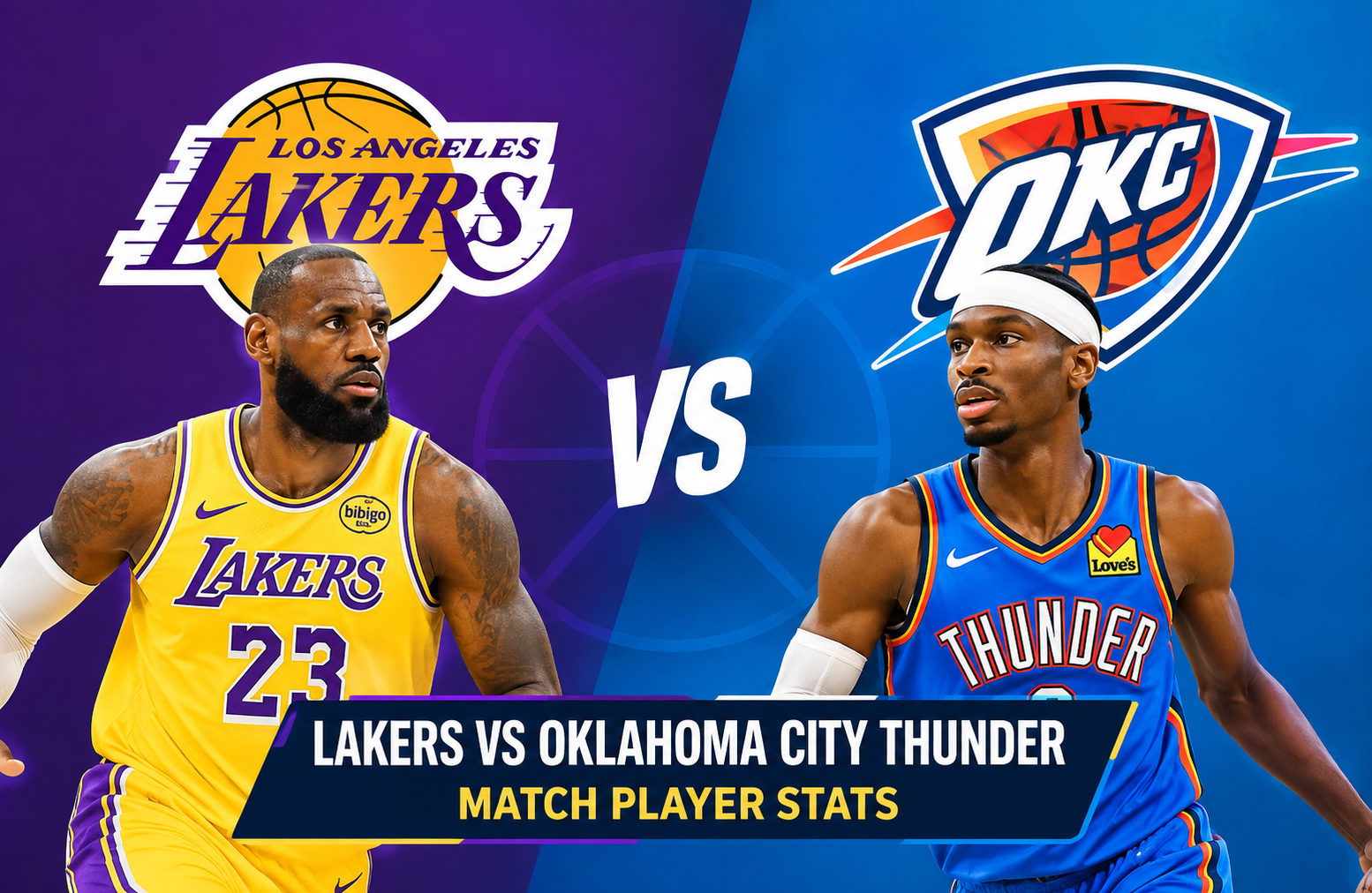
Lakers vs Oklahoma City Thunder Match Player Stats
The lakers vs oklahoma city thunder match player stats from May 12, 2026, tell the story of a playoff game that changed dramatically in the fourth quarter. The Oklahoma City Thunder defeated the Los Angeles Lakers 115-110 at crypto.com Arena in Los Angeles, completing a 4-0 sweep in the Western Conference Semifinals. The Lakers entered the final period with an 84-80 lead, but Oklahoma City responded with a 35-point fourth quarter to erase the deficit and close out the series.
Shai Gilgeous-Alexander led Oklahoma City with 35 points and 8 assists, while Ajay Mitchell produced 28 points on highly efficient shooting. For Los Angeles, Austin Reaves scored 27 points, Rui Hachimura added 25, and LeBron James finished with 24 points and 12 rebounds. The final score suggests a close contest, but the underlying numbers reveal several important differences in efficiency, turnovers, ball pressure, and fourth-quarter execution.
For readers studying the game beyond the final score, this matchup provides a useful example of how individual production and team execution can tell different parts of the same story. Los Angeles had strong scoring performances from several starters and received 18 points from Jaxson Hayes off the bench. Oklahoma City, however, combined efficient shooting with defensive pressure and superior ball security during the decisive stretch.
Lakers vs Oklahoma City Thunder Match Player Stats at a Glance
The game took place on May 12, 2026, at crypto.com Arena in Los Angeles, with an announced attendance of 19,057.
| Category | Oklahoma City Thunder | Los Angeles Lakers |
| Final Score | 115 | 110 |
| Field Goals | 42-81 | 38-75 |
| Field Goal Percentage | 52% | 51% |
| Three-Pointers | 11-31 | 10-28 |
| Three-Point Percentage | 35% | 36% |
| Free Throws | 20-24 | 24-27 |
| Free Throw Percentage | 83% | 89% |
| Rebounds | 34 | 37 |
| Assists | 19 | 18 |
| Turnovers | 11 | 19 |
| Steals | 12 | 3 |
| Blocks | 0 | 5 |
The most important statistical difference was not shooting percentage. Both teams shot above 50% from the field, and the Lakers actually had a slightly better three-point percentage and free throw percentage.
The major separation came through possessions.
Oklahoma City committed only 11 turnovers compared with 19 by Los Angeles. The Thunder also recorded 12 steals, while the Lakers had only 3. That combination gave Oklahoma City more opportunities to attack before the Lakers could establish their defense.
How the Game Unfolded
The quarter-by-quarter scoring shows why the final result was difficult to predict after three periods.
| Quarter | Thunder | Lakers |
| First | 21 | 26 |
| Second | 28 | 19 |
| Third | 31 | 39 |
| Fourth | 35 | 26 |
| Total | 115 | 110 |
Los Angeles started well, winning the opening quarter 26-21. Oklahoma City responded in the second period, outscoring the Lakers 28-19 and taking control of the middle portion of the game.
The Lakers then produced their best offensive quarter in the third. They scored 39 points and entered the fourth period ahead 84-80.
That lead ultimately disappeared.
Oklahoma City scored 35 points in the final quarter, while Los Angeles managed 26. The Thunder therefore won the final period by 9 points and turned a four-point deficit into a five-point victory.
That fourth-quarter turnaround is arguably the single most important part of the game when interpreting the player statistics.
Shai Gilgeous-Alexander Leads the Thunder
Shai Gilgeous-Alexander was Oklahoma City’s leading scorer with 35 points.
His statistical line was:
- 35 points
- 11-of-22 field goals
- 1-of-4 three-pointers
- 12-of-15 free throws
- 1 rebound
- 8 assists
- 3 turnovers
- 1 steal
The scoring total immediately stands out, but his 8 assists were almost as important.
Gilgeous-Alexander did not need to dominate the three-point line to control the game. He shot 50% from the field and generated significant value by attacking the defense, reaching the free throw line 15 times.
His 12 made free throws accounted for a substantial portion of his scoring. This matters because playoff defenses often become more aggressive when a primary ball handler repeatedly attacks the paint.
His 8 assists also demonstrate that Oklahoma City’s offense was not dependent solely on individual scoring. When defensive attention increased, he could create opportunities for teammates.
The combination of scoring, playmaking, and free throw generation made Gilgeous-Alexander the central offensive figure in the Thunder’s comeback.
Ajay Mitchell Provides a Major Scoring Boost
Ajay Mitchell finished with 28 points and was one of the biggest statistical differences in the game.
His numbers included:
- 28 points
- 12-of-19 field goals
- 1-of-4 three-pointers
- 3-of-3 free throws
- 3 rebounds
- 4 assists
- 1 turnover
- 4 steals
Mitchell’s 12-of-19 shooting was especially impressive.
He converted approximately 63% of his field goal attempts, giving Oklahoma City an efficient second scoring option alongside Gilgeous-Alexander.
His four steals also deserve attention. The steals were not simply defensive statistics sitting beside his scoring total. They represented additional possessions and contributed to the Thunder’s ability to keep pressure on Los Angeles.
The 4-to-1 assist-to-turnover relationship is another positive element of his performance. Mitchell generated four assists while giving the ball away only once.
That is the type of efficiency that can become particularly valuable in a close playoff game.
Isaiah Hartenstein Controls the Glass
Isaiah Hartenstein did not lead Oklahoma City in scoring, but his impact appeared in several areas.
He recorded:
- 10 rebounds
- 5 points
- 5 assists
- 3 steals
The 10 rebounds made Hartenstein Oklahoma City’s leading rebounder.
His five assists were also notable for a center. Rebounding is often the first statistic associated with a big man, but his passing contribution helped Oklahoma City maintain offensive flow.
The three steals added another layer to his defensive impact.
Although the Lakers finished with 37 total rebounds compared with 34 for Oklahoma City, the Thunder still found ways to win possessions through steals and turnovers.
This is an important distinction. A team does not necessarily need to dominate total rebounds to control the possession battle.
Alex Caruso Adds Valuable Bench Production
Alex Caruso supplied 9 points off the bench.
His line included:
- 9 points
- 3-of-7 field goals
- 3-of-5 three-pointers
- 4 rebounds
- 1 assist
- 2 steals
Caruso’s three made three-pointers were particularly useful because they came on five attempts.
He also added two steals, continuing the defensive pressure that was visible throughout Oklahoma City’s team statistics.
His contribution was not as large as the scoring totals of Gilgeous-Alexander or Mitchell, but playoff games often turn on smaller contributions from role players.
Caruso provided spacing, perimeter shooting, rebounding, and defensive activity.
Austin Reaves Leads the Lakers in Scoring
Austin Reaves was Los Angeles’ leading scorer with 27 points.
His complete statistical line was:
- 27 points
- 8-of-16 field goals
- 3-of-7 three-pointers
- 8-of-9 free throws
- 7 rebounds
- 6 assists
- 8 turnovers
- 2 blocks
There is a lot to like in this performance.
Reaves shot 50% from the field, made three three-pointers, converted 8 of 9 free throws, collected 7 rebounds, and distributed 6 assists.
However, the eight turnovers are an important counterpoint.
Those eight turnovers were more than any other listed Lakers player and represented a major issue in a game decided by five points.
This is one of the clearest examples of why evaluating a player only by points can be misleading. Reaves was productive offensively, but his turnovers created opportunities for Oklahoma City.
His two blocks also demonstrate that his contribution extended beyond scoring.
Rui Hachimura Delivers Efficient Offense
Rui Hachimura produced 25 points for Los Angeles.
His numbers were:
- 25 points
- 9-of-15 field goals
- 4-of-8 three-pointers
- 3-of-3 free throws
- 5 rebounds
- 2 assists
- 1 block
Hachimura’s shooting efficiency was one of the strongest aspects of his performance.
He made 60% of his field goal attempts and connected on half of his three-point attempts.
Four made three-pointers gave Los Angeles valuable perimeter scoring, while his perfect 3-of-3 performance from the free throw line added to his efficiency.
Unlike Reaves, Hachimura did not have a major turnover total listed in the provided statistics.
His performance therefore stands out as one of the cleaner offensive games for the Lakers.
LeBron James Posts an All-Around Line
LeBron James finished with 24 points, 12 rebounds, and 3 assists.
His shooting numbers were:
- 24 points
- 8-of-18 field goals
- 2-of-6 three-pointers
- 6-of-8 free throws
- 12 rebounds
- 3 assists
- 4 turnovers
- 1 block
The 12 rebounds were the highest total among the listed Lakers players and showed his importance on the glass.
He also contributed a block.
From a scoring perspective, James shot 44% from the field and made two of his six three-point attempts.
His four turnovers were significant in a game where Los Angeles committed 19 as a team.
Still, the overall line shows that James contributed in several categories rather than relying solely on scoring.
His 12 rebounds were especially valuable because Los Angeles ultimately finished with a 37-34 advantage on the boards.
Jaxson Hayes Gives the Lakers a Strong Bench Performance
Jaxson Hayes scored 18 points off the bench.
His numbers were:
- 18 points
- 6-of-8 field goals
- 6-of-6 free throws
- 5 rebounds
- 1 assist
- 1 block
Hayes shot 75% from the field and was perfect from the free throw line.
That combination produced one of the most efficient scoring performances among the Lakers players listed in the game data.
His five rebounds and one block also added value away from scoring.
For Los Angeles, the bench contribution was therefore not the obvious reason the team lost. Hayes provided an efficient scoring boost, particularly when the Lakers needed production beyond their primary stars.
Comparing the Main Scorers
The scoring leaders provide an interesting picture.
| Player | Team | Points | FG | 3PT | FT | REB | AST | TO |
| Shai Gilgeous-Alexander | Thunder | 35 | 11-22 | 1-4 | 12-15 | 1 | 8 | 3 |
| Ajay Mitchell | Thunder | 28 | 12-19 | 1-4 | 3-3 | 3 | 4 | 1 |
| Austin Reaves | Lakers | 27 | 8-16 | 3-7 | 8-9 | 7 | 6 | 8 |
| Rui Hachimura | Lakers | 25 | 9-15 | 4-8 | 3-3 | 5 | 2 | Not listed |
| LeBron James | Lakers | 24 | 8-18 | 2-6 | 6-8 | 12 | 3 | 4 |
The first thing that stands out is that the Thunder’s top two scorers combined for 63 points.
The Lakers’ top three scorers combined for 76 points.
Yet Los Angeles still lost.
That difference demonstrates why team basketball cannot be evaluated through scoring totals alone.
Oklahoma City’s leading scorers combined efficient shooting with strong playmaking and defensive activity. Meanwhile, Los Angeles received significant production from several players but suffered from a much higher turnover total.
Shooting Was Not the Deciding Factor
It would be easy to look at the final score and assume Oklahoma City won because it shot significantly better.
The team numbers do not support that conclusion.
The Thunder shot 52% from the field.
The Lakers shot 51%.
That is only a one-percentage-point difference.
The Lakers actually had the slightly better three-point percentage, shooting 36% compared with Oklahoma City’s 35%.
Los Angeles also shot 89% from the free throw line compared with 83% for Oklahoma City.
So how did Oklahoma City win?
The answer is that shooting efficiency was only one part of the game.
Turnovers and steals created a much more meaningful separation.
The Turnover Battle Explains a Major Part of the Result
Oklahoma City committed 11 turnovers.
Los Angeles committed 19.
That is an eight-turnover difference.
The Thunder also recorded 12 steals compared with only 3 for the Lakers.
This combination strongly favors Oklahoma City in terms of defensive pressure and extra possessions.
A team can shoot 51% from the field and still lose if it repeatedly gives the opponent opportunities to attack in transition.
The Lakers’ 19 turnovers were especially costly because the game finished with a five-point margin.
In a close playoff contest, every possession becomes more valuable.
An eight-turnover difference does not automatically equal eight points because the resulting possessions can produce different outcomes, but it highlights the scale of the problem.
The Fourth Quarter Changed Everything
The Lakers entered the final period with an 84-80 advantage.
They had scored 39 points in the third quarter.
Then Oklahoma City scored 35 points in the fourth while Los Angeles managed only 26.
That nine-point fourth-quarter advantage was enough to transform the game.
The Thunder’s final-period performance deserves special attention because the comeback happened when the pressure was highest.
Instead of allowing the Lakers to protect the lead, Oklahoma City increased its offensive output.
The Thunder scored more points in the fourth quarter than in any other period.
This is an important sign of late-game execution.
Why the 35-Point Fourth Quarter Matters
The Thunder scored 21 points in the first quarter, 28 in the second, 31 in the third, and 35 in the fourth.
That progression shows a steady increase in offensive output.
The Lakers followed a different pattern.
They scored 26, then 19, then 39, before dropping to 26.
Los Angeles therefore had the highest-scoring third quarter of either team, but could not carry that offensive momentum into the closing period.
This contrast is one of the clearest tactical lessons from the game.
Strong offense in one quarter does not guarantee late-game success.
Teams must maintain execution when defenses adjust and possessions become more important.
Rebounding Was Surprisingly Close
Los Angeles finished with 37 rebounds.
Oklahoma City had 34.
That gave the Lakers a three-rebound advantage.
LeBron James led Los Angeles with 12 rebounds, while Hartenstein led Oklahoma City with 10.
This means the Thunder did not win because of overwhelming dominance on the boards.
The Lakers actually had a small advantage in total rebounding.
That reinforces the importance of looking at multiple categories together.
Oklahoma City’s edge came from other areas, particularly steals and turnovers.
Assists Were Nearly Even
The assist totals were also close.
Oklahoma City recorded 19 assists.
Los Angeles recorded 18.
That one-assist difference does not explain a five-point victory.
The Thunder’s advantage therefore came from the quality and efficiency of possessions rather than simply generating dramatically more assisted baskets.
Gilgeous-Alexander’s 8 assists and Mitchell’s 4 assists accounted for 12 of Oklahoma City’s 19 assists.
For Los Angeles, Reaves produced 6 assists while James added 3.
The primary creators on both teams were involved heavily in generating offense.
Free Throw Efficiency Favored Los Angeles
The Lakers went 24-of-27 from the free throw line.
That equals 89%.
The Thunder went 20-of-24 for 83%.
Los Angeles therefore made four more free throws despite taking only three more attempts.
This was a clear area of strength for the Lakers.
However, free throw efficiency could not compensate for the turnover gap.
That is an important reminder that statistical advantages in one category can be overwhelmed by disadvantages in another.
Three-Point Shooting Was Also Close
The Lakers made 10 of 28 three-point attempts.
Oklahoma City made 11 of 31.
The Thunder therefore made only one more three-pointer despite attempting three additional shots.
The Lakers’ 36% accuracy was marginally better than Oklahoma City’s 35%.
Rui Hachimura was especially effective from outside, making 4 of 8 attempts.
Austin Reaves made 3 of 7.
For Oklahoma City, Alex Caruso made 3 of 5 from three-point range.
These contributions helped keep the game competitive, but neither team produced a massive perimeter shooting advantage.
Defensive Pressure Was the Hidden Difference
The most striking defensive statistic is the steals total.
Oklahoma City had 12 steals.
Los Angeles had 3.
That nine-steal difference is substantial.
The Thunder used active defense to disrupt Los Angeles’ offensive rhythm.
The Lakers did record five blocks compared with zero for Oklahoma City, which shows that Los Angeles did provide rim protection.
But blocks and steals affect the game differently.
A block can prevent one shot from becoming a score.
A steal can immediately change possession and potentially create a fast-break opportunity.
In this game, Oklahoma City’s ability to generate steals was closely connected to its ability to overcome the Lakers’ late lead.
What the Player Stats Say About Oklahoma City’s Win
The individual numbers suggest several reasons for the Thunder’s victory.
1. Two Efficient Primary Scorers
Gilgeous-Alexander scored 35 points on 50% shooting.
Mitchell scored 28 on 12-of-19 shooting.
Together, they produced 63 points.
2. Strong Ball Security
Mitchell committed only one turnover.
The entire Thunder team had 11.
That helped preserve possessions during a game where every possession mattered.
3. Defensive Activity
Mitchell recorded four steals.
Hartenstein had three.
Caruso had two.
Gilgeous-Alexander had one.
The team reached 12 steals overall.
4. Late Offensive Execution
The Thunder scored 35 points in the fourth quarter.
That was their highest-scoring period of the game.
5. Contributions Beyond the Stars
Hartenstein contributed rebounds, assists, and steals.
Caruso supplied efficient three-point shooting and defensive activity.
These supporting performances helped Oklahoma City avoid becoming too dependent on one scorer.
What the Player Stats Say About the Lakers’ Loss
The Lakers’ numbers tell a different story.
1. Strong Individual Scoring
Reaves, Hachimura, and James all scored at least 24 points.
Hayes added 18 from the bench.
That is substantial production.
2. Efficient Shooting
Los Angeles shot 51% from the field.
The team also shot 36% from three and 89% from the free throw line.
3. Good Rebounding
The Lakers won the rebound battle 37-34.
James alone collected 12.
4. Too Many Turnovers
The biggest issue was the 19-turnover total.
Reaves was responsible for eight.
James added four.
5. Fourth-Quarter Drop-Off
Los Angeles scored 39 points in the third quarter but only 26 in the fourth.
The offense lost momentum when the game was decided.
Series Context
The game was not simply another regular-season meeting.
It was Game 4 of the Western Conference Semifinals.
Oklahoma City entered the matchup with a 64-18 overall record and a 30-10 road record.
Los Angeles entered with a 53-29 record and a 28-13 home record.
The Thunder ultimately completed the series sweep 4-0.
The four series scores were:
- Game 1: Oklahoma City 108, Los Angeles 90
- Game 2: Oklahoma City 125, Los Angeles 107
- Game 3: Oklahoma City 131, Los Angeles 108
- Game 4: Oklahoma City 115, Los Angeles 110
The progression is interesting.
The first three games were decided by much larger margins.
Game 4 was different.
Los Angeles finally pushed the Thunder into a close fourth-quarter battle and held a lead entering the final period.
Yet Oklahoma City still found a way to finish the series undefeated.
Why Game 4 Was Different From the First Three Games
The first three games produced margins of 18, 18, and 23 points.
Game 4 was decided by only five.
That suggests Los Angeles was much more competitive in the final matchup.
The Lakers also produced 110 points, their highest scoring total of the series.
However, Oklahoma City scored 115, giving the Thunder four consecutive victories.
The final game therefore showed improvement from Los Angeles without changing the overall series outcome.
The Importance of Home Court
Los Angeles entered the game with a 28-13 home record.
The Thunder entered with a 30-10 road record.
Those records provide useful context.
Oklahoma City had already demonstrated strong performance away from home during the season.
Los Angeles had been successful at home.
The final result showed the Thunder’s road strength continuing into the postseason.
A Closer Look at Efficiency
One of the most useful ways to understand this game is to separate shooting efficiency from possession efficiency.
Shooting Efficiency
Lakers:
- 51% field goals
- 36% three-pointers
- 89% free throws
Thunder:
- 52% field goals
- 35% three-pointers
- 83% free throws
Los Angeles performed very well in these categories.
Possession Efficiency
Lakers:
- 19 turnovers
- 3 steals
Thunder:
- 11 turnovers
- 12 steals
This is where Oklahoma City gained a clearer advantage.
The lesson is simple: good shooting does not always overcome poor possession management.
The Reaves Turnover Question
Austin Reaves’ eight turnovers deserve individual attention.
His offensive production was excellent.
He scored 27 points, grabbed 7 rebounds, and delivered 6 assists.
But eight turnovers are significant.
His performance is therefore best described as productive but costly.
This is an important analytical distinction.
A player can simultaneously be one of his team’s most important offensive contributors and one of the biggest sources of lost possessions.
That is exactly why box-score analysis should look at several categories together.
Hachimura’s Efficiency Stands Out
Hachimura may have had the cleanest offensive statistical profile among the Lakers’ leading scorers.
He scored 25 points on 9-of-15 shooting.
He also made 4 of 8 three-pointers and all three free throws.
That means his scoring came with strong efficiency from every major shooting area.
His five rebounds and one block added further value.
The challenge for Los Angeles was that strong individual efficiency from Hachimura did not translate into enough team success during the fourth quarter.
LeBron’s Rebounding Impact
James’ 12 rebounds were a major positive.
Los Angeles finished three rebounds ahead of Oklahoma City overall, and James accounted for nearly one-third of the Lakers’ 37 rebounds.
His 24 points also gave the Lakers another high-level scoring source.
However, his four turnovers were part of the team’s overall possession problem.
The numbers therefore show both sides of his performance.
He supplied scoring and rebounding while also being involved in some lost possessions.
Hartenstein’s Versatility
Hartenstein’s five points might appear modest compared with the scoring totals around him.
But his five assists and three steals make the line much more meaningful.
A center who can rebound, pass, and generate defensive possessions provides value without requiring high-volume scoring.
His 10 rebounds were also crucial in limiting the Lakers’ interior advantage.
A Statistical Summary of the Decisive Factors
When all the numbers are considered together, the game can be reduced to several major themes.
Oklahoma City’s biggest advantages:
- 115 points
- 52% field-goal shooting
- 11 turnovers
- 12 steals
- 63 combined points from Gilgeous-Alexander and Mitchell
- 35 fourth-quarter points
Los Angeles’ biggest advantages:
- 37 rebounds
- 89% free throw shooting
- 36% three-point shooting
- 5 blocks
- 76 combined points from Reaves, Hachimura, and James
- 39 third-quarter points
The most important contrast is that Los Angeles won several traditional efficiency categories but Oklahoma City controlled more of the disruptive possession battle.
What Readers Should Take From the Box Score
For anyone analyzing NBA playoff games, this matchup offers a useful lesson.
Do not stop at the leading scorer.
Do not assume the team with the better field-goal percentage automatically controlled the game.
Do not treat turnovers as a minor statistic.
And do not ignore the fourth quarter.
The Lakers had four players with at least 18 points.
They shot 51% from the field.
They won the rebounding battle.
They shot 89% from the free throw line.
Yet they still lost.
Oklahoma City achieved the result through a combination of efficient scoring, defensive pressure, low turnover volume, and excellent fourth-quarter execution.
Frequently Asked Questions
Who was the top scorer in the Lakers vs Thunder game?
Shai Gilgeous-Alexander was the game’s leading scorer with 35 points for Oklahoma City. He shot 11-of-22 from the field and added 8 assists.
How many points did Austin Reaves score?
Austin Reaves scored 27 points for the Lakers. He also recorded 7 rebounds and 6 assists, but committed 8 turnovers.
How many points did LeBron James score against Oklahoma City?
LeBron James scored 24 points and collected 12 rebounds. He also recorded 3 assists, 4 turnovers, and 1 block.
Which team won the fourth quarter?
Oklahoma City won the fourth quarter 35-26. The Thunder entered the period trailing 84-80 and finished the game with a 115-110 victory.
How many turnovers did each team have?
Oklahoma City committed 11 turnovers, while Los Angeles committed 19. The eight-turnover difference was one of the major statistical differences in the game.
Did Oklahoma City sweep the Lakers?
Yes. Oklahoma City won the Western Conference Semifinals series 4-0. The Thunder won Game 4 by a score of 115-110.
Conclusion
The lakers vs oklahoma city thunder match player stats from May 12, 2026, show how a playoff game can be decided by much more than scoring totals.
Shai Gilgeous-Alexander led all scorers with 35 points and added 8 assists. Ajay Mitchell delivered 28 points on 12-of-19 shooting and recorded four steals. Isaiah Hartenstein contributed 10 rebounds, five assists, and three steals, while Alex Caruso provided efficient perimeter shooting and defensive activity.
For Los Angeles, Austin Reaves scored 27 points, Rui Hachimura added 25, LeBron James recorded 24 points and 12 rebounds, and Jaxson Hayes produced 18 efficient bench points.
The Lakers’ shooting numbers were strong. They shot 51% from the field, 36% from three, and 89% from the free throw line. They also won the rebounding battle and recorded five blocks.
But Oklahoma City controlled the possession battle more effectively. The Thunder had 12 steals and committed only 11 turnovers, compared with 3 steals and 19 turnovers for Los Angeles.
The fourth quarter ultimately provided the clearest explanation for the result. After the Lakers entered the final period with an 84-80 advantage, Oklahoma City scored 35 points and limited Los Angeles to 26. That nine-point swing turned a four-point deficit into a five-point victory.
The result completed Oklahoma City’s 4-0 series sweep and showed why playoff basketball often comes down to late-game execution, ball security, defensive pressure, and the ability of multiple players to contribute when the stakes are highest.



One Comment