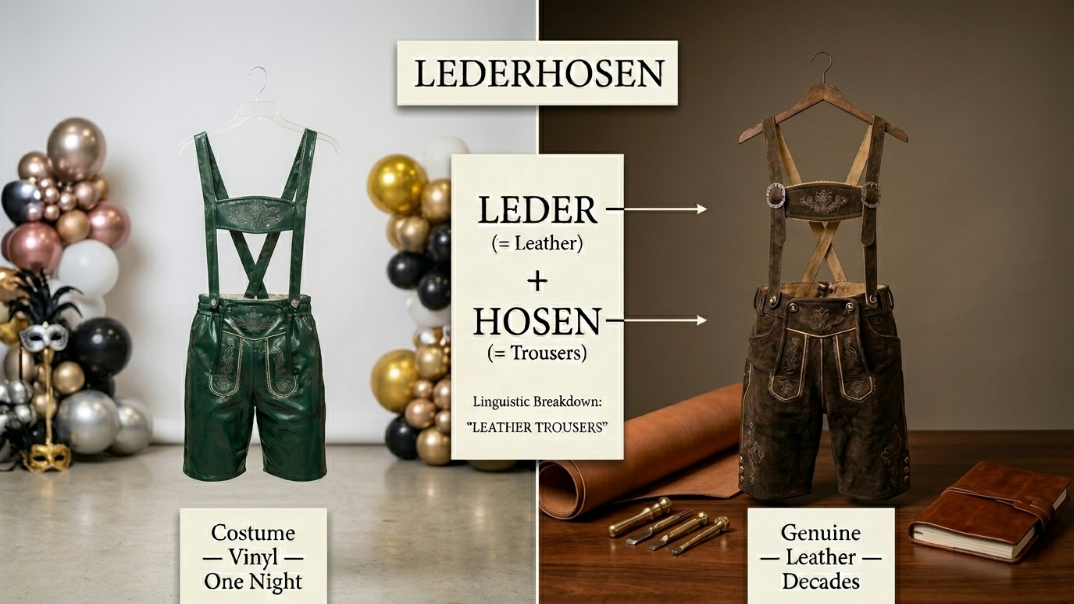
Lederhosen Costume vs the Real Thing — and What the Word Actually Means
The search term does double duty, and buyers pay for the ambiguity. Lederhosen costume returns two products wearing one name: the party-shop imitation — vinyl shorts with printed suspenders, engineered for a single themed night — and the genuine garment shopped by people who simply mean “the traditional outfit” and land on costume as the nearest English word. Both buyers deserve straight answers: the party purchaser should know exactly what the imitation tier delivers and where it honestly suffices; the festival-bound buyer should know why the genuine article is a different product entirely — and both benefit from the word itself being unpacked, because the name carries the whole story. This guide serves all of it: the meaning decoded, the two products compared honestly, the right-buy map by occasion, the genuine article’s quick specification, and the upgrade path between the tiers.
The Word Itself: Lederhosen Meaning Decoded
Start with the name, because it settles half the confusion. The word is German, and literally plain: Leder — leather; Hosen — trousers. Leather trousers: that’s the entire lederhosen meaning at the dictionary level — a compound as ordinary in German as “rain-coat” in English, with the singular/plural quirk (Hosen is grammatically plural, like “pants”) explaining why English speakers say “a pair of lederhosen.” The cultural layer sits on top: over two-plus centuries the word narrowed from any leather trousers to the specific Alpine garment — the above-knee and knee-length leather breeches of Bavarian and Austrian dress, with their button fronts, suspender systems and embroidered detailing — so that today the word names both a material fact and a living tradition.
The decode’s practical payoff: the name promises leather. A “lederhosen” product in vinyl is contradicting its own noun — which is the entire two-product problem in one sentence.
The Two Products, Compared Honestly
Side by side, the tiers separate in every column. Material: genuine suede-finished hide (cowhide to deerskin) that molds, breathes and ages — versus polyurethane sheeting that shines, sweats and cracks. Construction: sewn button fronts, finished interiors, stitched embroidery, real suspender buttons — versus elastic waists, glued seams, printed detailing, clip-on strap sets. Fit: measurement-sized patterns that break in toward custom — versus S/M/L stretch shells. Lifespan: five-to-fifteen-plus years improving throughout — versus one-to-three wearings declining from the first. Read in context: the genuine article disappears correctly into any festival crowd; the imitation reads as vinyl at thirty paces in the same rooms. And price honesty: the tiers sit closer than buyers assume — the imitation at party-product pricing, the accessible genuine tier at modest multiples that amortize across a decade.
The comparison’s summary is the whole guide in one line: these aren’t a budget and premium version of one product — they’re different products for different nights, sharing a search term — and sharing the lederhosen meaning neither tier can change: the noun promises leather.
The Right-Buy Map
Occasion sorts every purchase cleanly. Imitation-tier correct: single-night themed parties, Halloween, fancy-dress events where the outfit is a bit rather than an entrance ticket — bought knowingly, expectations matched to engineering. Genuine-tier required: any actual festival — Oktoberfest at every scale, beer gardens, German heritage events — where the traditional standard is the room’s social dress code and the imitation fails visibly and physically (the shine, the sweat, the second-hour regret). The gray-zone rule: unsure if it’s one night? It rarely stays one — festivals recruit — and the accessible genuine tier’s cost-per-wear passes the party product within two occasions. And the kids’ corner the category includes: children’s festival wear follows the same split, with the genuine children’s builds (real hide, room to grow via lacing) serving festival families the same honest economics.
The Genuine Article: The One-Minute Specification
For the buyer the map sends to the real tier, the specification compresses. Material named: suede cowhide at the accessible standard, goatskin and deerskin ascending — the “PU/leather-look” vocabulary disqualifying on sight. Construction checked: functional buttons, finished seams, stitched embroidery with dimension (one photo zoom decides), sewn suspender buttons. Sized by measurement: waist and seat against the maker’s chart, fitted snug for the molding — the pattern-work signature the S/M/L tier can’t fake. System completed: the shorts joined by the woven shirt, H-bar suspenders, wool socks and sturdy shoes — the five-piece outfit the tradition specifies, assembled once and worn for years. Ordered ahead: festival season sells sizes through — the early-summer purchase chooses from everything.
The Upgrade Path Between Tiers
The tiers connect by a well-worn road: the imitation owner whose party purchase met a real festival — and the staged path from there is short and satisfying. First the shirt: a woven check replacing the printed panel, the cheapest visible jump. Then the foundation: genuine lederhosen retiring the vinyl to fancy-dress duty permanently — the stage where the outfit changes category. Then suspenders and socks — the zones experienced eyes check — and finally proper shoes and the register upgrades (vest, jacket, hat) as occasions arrive. Each stage improves the read on its own; completed, the path lands where buying genuine first would have — with the costume chapter as the origin story most of the tents’ well-dressed veterans privately share.
Frequently Asked Questions
What does lederhosen literally mean?
Leather trousers — Leder (leather) plus Hosen (trousers) — narrowed by two centuries of tradition to the specific Alpine garment the word names today.
Is a lederhosen costume the same as real lederhosen?
No — the imitation is a vinyl party product for single-night wear; the genuine article is a leather garment built on decade economics. Same search term, different products.
When is the costume tier the right purchase?
Knowing single-night use: themed parties, Halloween, fancy dress — where its engineering honestly matches its job.
What should festival-goers buy instead?
The genuine five-piece system: real-hide lederhosen sized by measurement, woven shirt, H-bar suspenders, wool socks, leather shoes.
How do I verify genuine in one minute?
Material named, embroidery stitched with dimension, functional construction, measurement-chart sizing — plus pricing above the real-hide floor.
Can a costume set be upgraded piece by piece?
The classic path: real shirt, then genuine lederhosen, then suspenders and socks, then shoes and registers — each stage a visible jump.