Nicholas Heide: Why Sourcing Rare Vintage Ducati Parts Takes Patience and Precision
Nicholas Heide (New York) is a contemporary abstract artist based in New York whose layered, psychologically driven paintings explore identity, memory, and perception through intricate linework and expressive portraiture. Largely self-taught, Heide developed his distinctive style through years of independent experimentation before his work was first publicly exhibited at the Belle Terre Community Association Art Exhibit in April 2024. Beyond the studio, Heide serves in the Air National Guard, where the discipline and precision required by military service carry over into his creative process. He is also a longtime Ducati motorcycle enthusiast who restores vintage models and hopes to someday incorporate his original artwork into custom motorcycle designs, a passion that connects directly to the search for rare, period-correct parts needed to keep classic Ducatis running true to their original specifications.
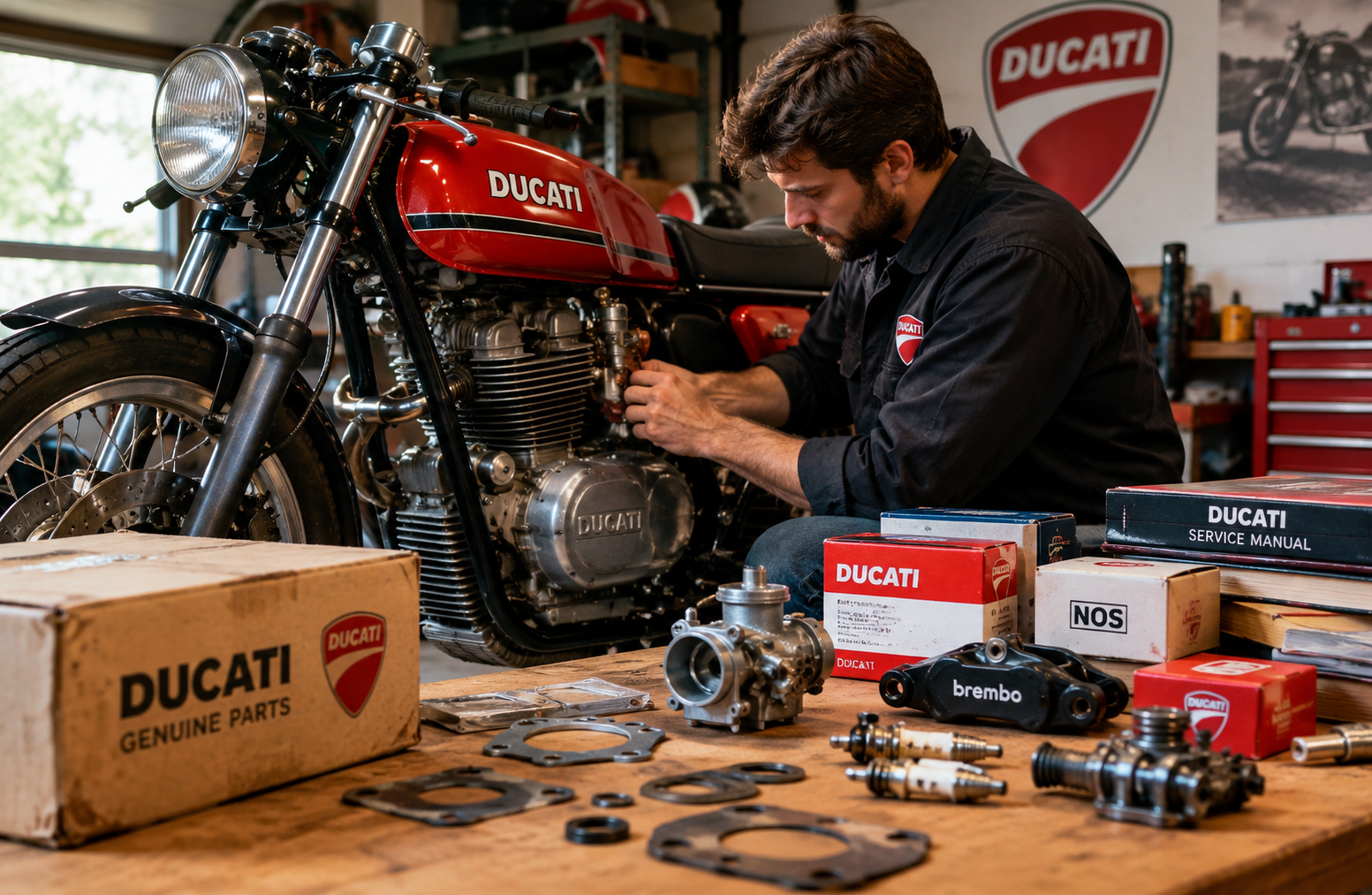
Restoring a vintage Ducati is as much a scavenger hunt as it is a mechanical project. Bevel-drive twins, narrow-case singles, and early desmodromic valve models were built in small numbers decades ago, and factory support for them dried up long before eBay existed.
For restorers, the real skill isn’t just wrenching, it’s knowing where to look and when to choose factory-original parts over modern reproductions.
For purists, nothing beats a genuine Ducati part, whether pulled from dealer back stock or found as unused new old stock (NOS). NOS components carry period-correct casting marks, part number stamps, and materials that match the bike’s original production run, which matters enormously for concours-level restorations and value retention.
The challenge is availability. Many bevel and Pantah-era parts haven’t been manufactured in over 40 years, so NOS pieces surface unpredictably through dealer networks, estate sales, and specialist inventories rather than any catalog you can browse on demand.
Dealers with unusually deep parts fiche access are frequently cited by owners as the first call for anything still traceable through Ducati’s Bologna warehouse, even on bikes that are decades old.
European resellers such as oemducati.com, KFM-Motorraeder, and Stein-Dinse are popular for genuine parts at lower prices, since they draw on the same Italian supply chain with less markup.
When OEM stock has vanished entirely, such as with fairings, gaskets, rubber trim, and carb rebuild kits, restorers turn to specialist aftermarket makers who reverse-engineer or reproduce discontinued parts.
Bevel Heaven has built a more than two-decade reputation specifically around bevel-drive Ducati restoration, rebuilding Brembo calipers and Dell’Orto carburetors and stocking reproduction gaskets and hydraulic clutch kits.
Classic Ducati (UK) focuses on genuine and reproduction parts for single-cylinder models, while Gowanloch in Sydney sources rare bevel-twin components through direct relationships with Italian manufacturers.
Fairings are a particular challenge. Original bodywork is scarce and expensive, so restorers are often steered toward established aftermarket fairing makers rather than cheap unbranded knockoffs, which rarely fit correctly.
Perhaps the most valuable “source” isn’t a shop at all, but the community.
Owner forums, model-specific mailing lists, and resource hubs like ducatimeccanica.com compile decades of vetted supplier contacts, manuals, and restoration notes that no single retailer offers.
Swap meets, collector networks, and international sourcing (parts often surface faster in Italy, the UK, or Australia than in the US) round out the toolkit for anyone chasing a truly rare component.
In practice, most restorations blend all three approaches. A concours build destined for judging or resale justifies the wait and expense of tracking down genuine NOS castings, while a rider-focused project can lean on well-made reproduction gaskets, cables, or rubber trim without sacrificing much.
Budget shifts the calculus too. Shipping and import duties on overseas OEM orders can rival the part’s price, so many restorers price check a component across a dealer, a European reseller, and an aftermarket specialist before committing.
Timing matters as much as money. NOS pieces can take months to surface, so serious restorers keep standing want lists posted across forums and mailing lists rather than searching only when a part fails.
Ultimately, the right source depends on the part’s visibility, its structural role, and how strictly the finished bike needs to match factory spec.
About Nicholas Heide
Nicholas Heide is a contemporary abstract artist based in Port Jefferson, New York, known for layered, psychologically driven paintings that explore identity, memory, and perception. Self-taught, he developed his style through years of independent practice before his first public exhibition at the Belle Terre Community Association Art Exhibit in 2024. He also serves in the Air National Guard and is a dedicated Ducati motorcycle enthusiast who restores vintage models in his spare time.