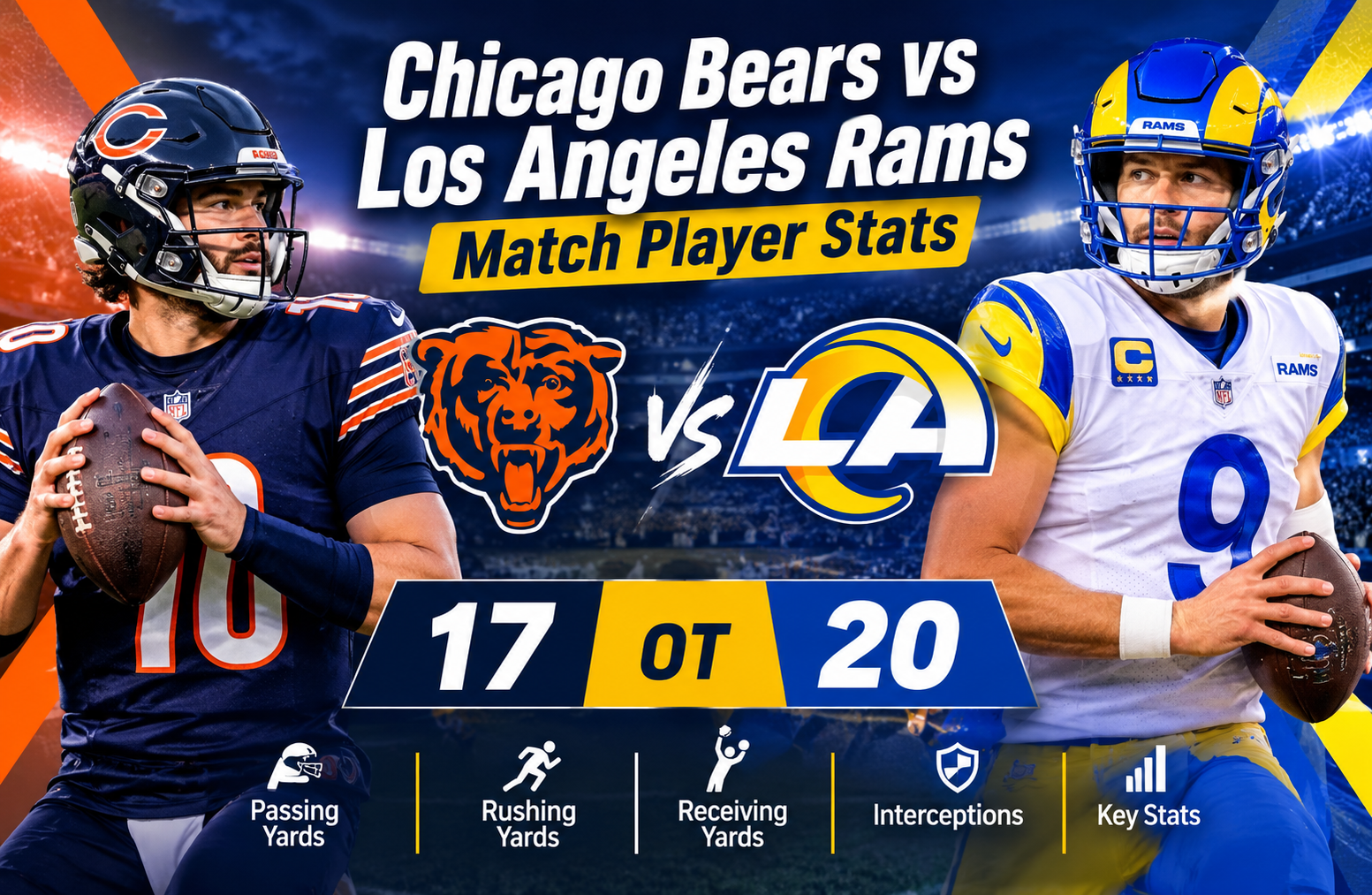
chicago bears vs los angeles rams match player stats
The chicago bears vs los angeles rams match player stats from the January 19, 2026, NFC Divisional Playoff game reveal how a closely contested postseason matchup was decided by defensive pressure, rushing touchdowns, and costly turnovers. The Los Angeles Rams defeated the Chicago Bears 20–17 in overtime, earning a hard-fought victory after four quarters of competitive football and a tense extra period.
The game featured two quarterbacks with very different statistical outcomes. Matthew Stafford delivered 258 passing yards for Los Angeles without throwing a touchdown or an interception. Caleb Williams produced 257 passing yards and two touchdown passes for Chicago, but his three interceptions became one of the most important factors in the final result.
The Rams also received a decisive contribution from running back Kyren Williams, who scored twice on the ground. Chicago’s defense recorded four sacks, while Los Angeles made the most of its opportunities by forcing three interceptions.
This detailed breakdown examines the player performances, offensive statistics, defensive contributions, scoring progression, and tactical factors that shaped the Rams’ overtime win.
Game Overview: Rams 20, Bears 17
NFC Divisional Round | Soldier Field | January 18, 2026
The Los Angeles Rams advanced to the NFC Championship after defeating the Chicago Bears in overtime. The final score was 20–17, with Harrison Mevis delivering the winning 42-yard field goal.
The matchup was played at Soldier Field in Chicago. Although both teams finished with two touchdowns, their paths to those scores were different. Los Angeles relied heavily on its running game and defensive takeaways, while Chicago used its passing game and late-game resilience to stay in contention.
Note: The game was played on January 18, 2026, in Chicago. Some international listings may show January 19 because of time-zone differences.
Final Score
| Team | Q1 | Q2 | Q3 | Q4 | OT | Final |
| Los Angeles Rams | 7 | 3 | 0 | 7 | 3 | 20 |
| Chicago Bears | 0 | 10 | 0 | 7 | 0 | 17 |
The Rams scored first and held a 7–0 advantage after the opening quarter. Chicago responded with 10 points in the second quarter to take a 10–7 lead, but Los Angeles tied the game before halftime.
Neither team scored in the third quarter. The Rams moved ahead 17–10 in the fourth, only for the Bears to produce a dramatic late touchdown that forced overtime.
The extra period ultimately belonged to Los Angeles. A late interception by Kam Curl gave the Rams another possession, and Mevis converted the decisive field goal.
Chicago Bears vs Los Angeles Rams Match Player Stats
The following statistics summarize the most important individual performances from the game.
Quarterback Statistics
| Player | Team | Completions | Attempts | Passing Yards | TD | INT |
| Matthew Stafford | Rams | 20 | 42 | 258 | 0 | 0 |
| Caleb Williams | Bears | 23 | 42 | 257 | 2 | 3 |
Matthew Stafford and Caleb Williams finished with almost identical passing yardage. Stafford recorded 258 yards, while Williams finished with 257.
The difference was not the number of yards gained through the air. It was how each quarterback protected the football.
Stafford threw no interceptions. Williams threw three, including two interceptions by cornerback Cobie Durant and one by safety Kam Curl.
Williams also threw two touchdown passes, both of which helped Chicago remain competitive. His final touchdown pass to Cole Kmet tied the game with only seconds remaining in regulation.
Rushing Statistics
| Player | Team | Carries | Rushing Yards | Average | TD |
| Kyren Williams | Rams | 21 | 87 | 4.1 | 2 |
| Blake Corum | Rams | 6 | 19 | 3.2 | 0 |
| D’Andre Swift | Bears | 19 | 76 | 4.0 | 0 |
| Caleb Williams | Bears | 8 | 40 | 5.0 | 0 |
Kyren Williams was the most productive scoring runner in the game. He recorded 87 rushing yards and two touchdowns on 21 carries.
D’Andre Swift produced 76 yards on 19 attempts, giving Chicago a steady rushing option. Caleb Williams added 40 rushing yards, including several important scrambles that helped extend drives.
Receiving Statistics
| Player | Team | Receptions | Receiving Yards | TD |
| Puka Nacua | Rams | 5 | 56 | 0 |
| Colby Parkinson | Rams | 3 | 56 | 0 |
| Colston Loveland | Bears | 4 | 56 | 0 |
| DJ Moore | Bears | 3 | 52 | 1 |
| Cole Kmet | Bears | 2 | 30 | 1 |
The receiving numbers show how evenly several players contributed.
Puka Nacua and Colby Parkinson each recorded 56 yards for Los Angeles. Chicago’s Colston Loveland also finished with 56 receiving yards, while DJ Moore scored a touchdown and gained 52 yards.
Cole Kmet became one of the most important players in the closing moments. His 14-yard touchdown reception tied the game and gave Chicago another chance to win in overtime.
Defensive Statistics
| Defensive Player | Team | Key Contribution |
| Cobie Durant | Rams | 2 interceptions |
| Kam Curl | Rams | 1 interception |
| Jared Verse | Rams | Important tackle for loss and pressure |
| Omar Speights | Rams | Late fourth-down pass breakup |
| Bears defensive unit | Bears | 4 sacks |
| Rams defensive unit | Rams | 3 interceptions |
The Rams defense recorded three interceptions and made several critical stops on fourth down. Chicago’s defense also played an aggressive game, recording four sacks and limiting Stafford’s passing efficiency.
The defensive battle was central to the result. Los Angeles did not need a passing touchdown because its defense repeatedly gave the offense opportunities to score.
Matthew Stafford’s Performance: Efficient Enough to Win
Matthew Stafford’s final passing line was unusual for a playoff victory. He completed 20 of 42 attempts for 258 yards, with no passing touchdowns and no interceptions.
His completion rate was approximately 47.6%, which was lower than his usual standard. The Rams also struggled to sustain consistent passing drives, especially during the middle portion of the game.
However, Stafford’s performance should not be judged only by his completion percentage.
Stafford protected the football
The most important part of Stafford’s game was his ability to avoid interceptions.
Chicago’s defense created pressure and recorded four sacks. Stafford was also involved in a strip-sack situation, but he recovered the ball himself. Despite those difficult moments, he did not throw an interception.
That distinction mattered because the Bears’ quarterback gave the Rams three additional opportunities through interceptions.
In a playoff game decided by three points, avoiding a turnover can be more valuable than adding another 50 passing yards.
Stafford made important throws when needed
Stafford connected with several receivers during the Rams’ scoring drives.
One important completion went to Tyler Higbee for 27 yards, helping Los Angeles move into scoring range before halftime. He also connected with Davante Adams and Puka Nacua during the overtime possession that eventually led to the winning field goal.
The overtime drive did not require a touchdown. Stafford only needed to move the Rams close enough for Mevis to attempt a manageable kick.
This was a good example of situational quarterback play. The objective was not to produce a spectacular passing line. It was to make the necessary throws, protect the ball, and put the team in position to win.
Stafford’s limitations in the game
Stafford’s performance was not flawless.
He completed fewer than half of his passes, and the Rams’ offense had several empty possessions. Los Angeles punted eight times, which shows how difficult it was to maintain offensive rhythm.
The Rams also finished with 229 net passing yards after accounting for sack yardage. Their passing game generated enough production to support the rushing attack, but it was not consistently dominant.
The most accurate assessment is that Stafford played a controlled, turnover-free game in which the defense and running game carried much of the scoring responsibility.
Caleb Williams’ Performance: Big Plays and Costly Turnovers
Caleb Williams finished with 257 passing yards, two touchdown passes, and three interceptions. He completed 23 of 42 attempts, giving him a completion rate of approximately 54.8%.
His performance contained both impressive moments and costly mistakes.
Williams kept Chicago in the game
Williams made several important throws that helped the Bears compete against the Rams.
He connected with DJ Moore for a 3-yard touchdown in the second quarter. That score tied the game at 7–7 and demonstrated Chicago’s ability to finish a drive after reaching the red zone.
Williams also found Rome Odunze for a 27-yard completion during the second quarter. The play helped Chicago move into field-goal range and take a 10–7 lead.
His most memorable moment came late in regulation.
With the Bears trailing 17–10, Williams led a drive that reached the Rams’ 14-yard line. On fourth down, he threw a touchdown pass to Cole Kmet with 18 seconds remaining.
That completion tied the game at 17–17 and forced overtime.
Williams’ ability to extend plays and make difficult throws under pressure was a major reason Chicago remained competitive.
The three interceptions changed the game
The biggest problem in Williams’ performance was ball security.
The Rams intercepted him three times:
- Cobie Durant intercepted Williams during Chicago’s opening drive.
- Durant recorded another interception later in the game.
- Kam Curl intercepted Williams during overtime.
The first interception was particularly damaging because Chicago had moved into Rams territory. Instead of producing points, the Bears gave Los Angeles possession.
The second interception also interrupted a promising offensive opportunity. Chicago had been able to move the ball, but the turnover ended the drive.
The overtime interception was the most decisive. It gave Los Angeles possession after Chicago had failed to score on its opening drive of the extra period.
Williams’ two touchdown passes showed his ability to create scoring opportunities, but three interceptions made it difficult for Chicago to control the game.
Williams’ rushing ability added another dimension
Williams also gained 40 rushing yards.
His mobility helped Chicago escape pressure and create additional first-down opportunities. One of his late scrambles helped the Bears move closer to the Rams’ end zone during the fourth quarter.
The quarterback’s rushing contribution was important because the Rams recorded no sacks against him in the official team statistics, while Chicago’s offensive line allowed Stafford to be sacked four times.
Williams was able to use his mobility to extend plays, but the Rams’ secondary remained dangerous when he attempted passes under pressure.
Kyren Williams: The Rams’ Most Important Scoring Player
Kyren Williams finished with 87 rushing yards and two touchdowns on 21 carries.
His average of approximately 4.1 yards per carry was not overwhelming, but his touchdowns were crucial.
First touchdown: Establishing the Rams’ lead
Williams scored the game’s opening touchdown with a 4-yard rushing attempt.
The Rams had taken a long opening drive and used their running game to finish it. The touchdown gave Los Angeles a 7–0 lead and immediately put pressure on Chicago to respond.
The scoring drive also demonstrated the Rams’ willingness to use a patient offensive approach. Rather than relying entirely on Stafford’s arm, Los Angeles used its running back to finish a drive near the goal line.
Second touchdown: Restoring the Rams’ advantage
Williams scored again in the fourth quarter, this time on a 5-yard run.
The touchdown gave Los Angeles a 17–10 lead with 8:50 remaining in regulation.
At that point, the Rams appeared to be in a strong position. They had a seven-point advantage and needed their defense to prevent Chicago from scoring a touchdown.
Williams’ second score was important because it gave Los Angeles a lead late in the game, even though the Bears eventually tied the score.
Why Williams’ contribution mattered
The Rams’ passing offense did not produce a touchdown. That made the running game especially important.
Williams supplied both of Los Angeles’ touchdowns, while Blake Corum added 19 rushing yards on six attempts.
The Rams finished with 111 net rushing yards as a team. Although Chicago gained more rushing yardage overall, Los Angeles was more effective at converting its ground-game opportunities into points.
This difference helps explain why the Rams won despite finishing with fewer total yards.
D’Andre Swift and the Bears’ Rushing Attack
D’Andre Swift recorded 76 rushing yards on 19 carries, averaging 4.0 yards per attempt.
His performance gave Chicago a dependable option between the tackles and helped the Bears maintain balance on offense.
Swift’s role in Chicago’s offensive plan
Chicago finished with 160 net rushing yards, compared with 111 for Los Angeles.
The Bears also recorded 11 rushing first downs, while the Rams recorded six.
These numbers suggest that Chicago’s ground game was effective at moving the chains. Swift’s 76 yards were a major part of that production.
The Bears were able to use the run to keep the Rams’ defense from focusing entirely on Williams’ passing game.
Rushing yards did not guarantee victory
Despite gaining more rushing yards, Chicago lost.
The Bears’ 160 rushing yards were a strong team total, but their three interceptions prevented them from consistently converting offensive opportunities into points.
The Rams’ defense also made several important stops on fourth down. Chicago had opportunities to continue drives, but Los Angeles forced the Bears to surrender possession at critical moments.
The game demonstrates that rushing efficiency and total yardage are valuable, but they must be combined with ball security and successful red-zone execution.
Receiving Leaders and Their Impact
Several receivers finished with similar yardage totals, but their contributions came at different points in the game.
Puka Nacua
Puka Nacua recorded five receptions for 56 yards.
He did not score a touchdown, but his receiving contribution was important during the Rams’ passing drives.
Nacua also made a key 16-yard reception during overtime. That completion helped Stafford move Los Angeles closer to field-goal range.
His performance illustrates why receiving yardage should be evaluated in context. A catch that moves the offense into scoring range during overtime can have a greater impact than a longer reception during a less important part of the game.
Colby Parkinson
Colby Parkinson also recorded 56 receiving yards.
His production helped the Rams distribute the passing workload rather than relying exclusively on Nacua or Adams.
Parkinson’s contribution was particularly useful in a game where Stafford struggled to complete a high percentage of his attempts.
Colston Loveland
Colston Loveland finished with 56 receiving yards on four receptions.
He provided Chicago with a reliable target at tight end and helped the Bears move the ball through the middle of the field.
Loveland’s performance was valuable even though he did not record a touchdown.
DJ Moore
DJ Moore recorded 52 receiving yards and a touchdown.
His 3-yard touchdown reception from Williams tied the game in the second quarter.
Moore’s score was one of Chicago’s most important offensive plays because it prevented the Rams from building an early two-score lead.
Cole Kmet
Cole Kmet finished with 30 receiving yards and a touchdown.
His late fourth-quarter score was the defining moment of Chicago’s comeback.
The 14-yard reception came on fourth down, making it a high-pressure conversion. Kmet secured the pass and helped force overtime.
Defensive Analysis: Why the Rams Won the Turnover Battle
The Rams’ defensive performance was one of the most important factors in the result.
Los Angeles recorded three interceptions and forced Chicago to repeatedly recover from lost possessions.
Cobie Durant’s two interceptions
Cobie Durant intercepted Caleb Williams twice.
The first interception came during Chicago’s opening possession. The Bears had moved into Rams territory, but Durant’s interception ended the drive.
The Rams then took advantage of the turnover by scoring a rushing touchdown.
Durant’s second interception interrupted another Chicago possession and gave Los Angeles a chance to regain control.
Two interceptions by one defensive player are a significant contribution in any game, particularly in a postseason matchup decided by three points.
Kam Curl’s overtime interception
Kam Curl’s interception in overtime was the turning point of the extra period.
Chicago had received the ball after the Rams’ opening overtime possession ended with a punt. The Bears moved toward midfield but could not finish the drive.
Williams attempted a pass over the middle, and Curl made the interception.
The turnover gave Los Angeles another opportunity to score. Stafford then led the Rams into field-goal range, and Mevis converted the winning kick.
The Rams’ fourth-down stops
Los Angeles also stopped Chicago on several fourth-down attempts.
One important stop came when Swift was stopped for no gain on fourth-and-one. Another came late in regulation, when Omar Speights broke up Williams’ pass near the goal line.
These plays prevented Chicago from converting promising drives into touchdowns.
The Rams’ defense did more than intercept passes. It also prevented the Bears from converting critical short-yardage situations.
Chicago’s Defense: Four Sacks and Strong Pressure
Although the Bears lost, their defensive performance deserves attention.
Chicago recorded four sacks against Stafford and consistently pressured the Rams’ passing game.
The pressure affected Stafford’s rhythm and contributed to Los Angeles’ low completion percentage.
Pressure without turnovers
The Bears’ defense created several difficult situations, but it did not intercept Stafford.
That difference became important because Chicago’s offense gave the Rams three interceptions.
The Bears were able to pressure the quarterback, but they could not turn that pressure into the same level of turnover production as Los Angeles.
The Rams’ offense was not unstoppable
The four sacks and eight punts show that Chicago’s defense was competitive.
The Bears limited Los Angeles to 340 total net yards, while Chicago gained 417.
However, the Rams were more effective at turning their opportunities into points. Their two rushing touchdowns and overtime field goal were enough to win.
Team Statistics Comparison
The team statistics provide a broader explanation of the result.
| Statistic | Rams | Bears |
| First Downs | 22 | 23 |
| Total Net Yards | 340 | 417 |
| Net Rushing Yards | 111 | 160 |
| Net Passing Yards | 229 | 257 |
| Passing Completions | 20 | 23 |
| Passing Attempts | 42 | 42 |
| Interceptions Thrown | 0 | 3 |
| Sacks Allowed | 4 | 0 |
| Third-Down Conversions | 5 of 16 | 9 of 19 |
| Fourth-Down Conversions | 1 of 1 | 3 of 6 |
| Time of Possession | 32:26 | 39:15 |
| Final Score | 20 | 17 |
Chicago led in total yards, rushing yards, first downs, and time of possession.
The Bears also converted more third downs and had more successful fourth-down conversions.
However, Los Angeles won the turnover battle. The Rams did not throw an interception, while Chicago threw three.
The Rams also scored both of their touchdowns on the ground, giving them a clear advantage in rushing touchdowns.
The numbers show that Chicago was not dominated statistically. It moved the ball effectively and controlled possession for longer.
The Rams won because they were more successful in the most decisive situations.
Scoring Summary: How the Game Developed
First Quarter: Rams take the early lead
Los Angeles opened the scoring with a 4-yard rushing touchdown by Kyren Williams.
The Rams took a 7–0 lead and controlled the opening period.
Chicago had an opportunity to respond, but Durant’s interception ended an early drive.
Second Quarter: Chicago takes the lead
The Bears tied the game with a touchdown pass from Williams to Moore.
Chicago later added a 48-yard field goal by Cairo Santos to move ahead 10–7.
The Rams responded with a 32-yard field goal by Harrison Mevis, making the score 10–10 at halftime.
Third Quarter: Defensive battle
Neither team scored in the third quarter.
The Rams’ defense forced Chicago to punt, while the Bears continued to pressure Stafford.
The period was defined by defensive stops rather than offensive scoring.
Fourth Quarter: Rams lead, Bears rally
Kyren Williams scored his second rushing touchdown to give Los Angeles a 17–10 lead.
Chicago then drove toward the Rams’ goal line but failed to score on a fourth-down attempt.
The Bears received another opportunity late in the quarter. Williams connected with Kmet for a 14-yard touchdown, tying the score at 17–17.
Overtime: Mevis delivers
The Rams punted on their opening overtime possession.
Chicago then moved toward midfield, but Curl intercepted Williams.
Stafford led Los Angeles into field-goal range, and Mevis converted a 42-yard kick.
The Rams won 20–17 and advanced to the NFC Championship.
Key Tactical Lessons From the Game
1. Turnovers can outweigh total yardage
Chicago gained 77 more net yards than Los Angeles, but the Bears threw three interceptions.
The Rams’ ability to protect the football was a major advantage.
A team can move the ball effectively and still lose if it gives the opponent too many extra possessions.
2. Red-zone execution matters
Both teams recorded two touchdowns, but the Rams scored both through rushing attempts.
Chicago’s touchdowns came through the passing game.
The Rams were able to finish their scoring opportunities with a simpler, more direct approach near the goal line.
3. Defensive stops can change momentum
Los Angeles made important stops on fourth down and intercepted Williams three times.
Those plays prevented Chicago from turning several promising drives into points.
4. Overtime requires disciplined decision-making
The Rams did not force a touchdown during overtime.
They used Stafford’s passing to move into field-goal range and trusted Mevis to convert.
The approach was effective because Los Angeles had already gained possession after Curl’s interception.
What the Player Stats Reveal About the Rams’ Victory
The chicago bears vs los angeles rams match player stats show that the Rams won through a combination of rushing touchdowns, defensive takeaways, and disciplined late-game execution.
Stafford’s passing yardage was almost identical to Williams’ total, but Stafford avoided interceptions.
Kyren Williams provided the Rams with two touchdowns, while Chicago’s rushing attack gained more yards without producing a rushing score.
The Bears’ defense recorded four sacks, but the Rams’ defense made the more decisive plays by intercepting Williams three times.
Chicago’s late touchdown demonstrated resilience and forced overtime, but the final interception gave Los Angeles the opportunity to win.
For a detailed official account of the game, readers can review the Rams’ official game recap.
Frequently Asked Questions
Who won the Chicago Bears vs Los Angeles Rams game?
The Los Angeles Rams defeated the Chicago Bears 20–17 in overtime during the NFC Divisional Playoffs on January 18, 2026.
How many passing yards did Matthew Stafford record?
Matthew Stafford completed 20 of 42 passes for 258 yards. He threw no touchdowns and no interceptions.
How many touchdowns did Caleb Williams throw?
Caleb Williams threw two touchdown passes, one to DJ Moore and another to Cole Kmet. He also threw three interceptions.
Who led the Rams in rushing?
Kyren Williams led Los Angeles with 87 rushing yards and two touchdowns on 21 carries.
Who scored the winning points for the Rams?
Harrison Mevis scored the winning points with a 42-yard field goal in overtime.
How many interceptions did the Rams record?
The Rams recorded three interceptions. Cobie Durant had two, while Kam Curl recorded one in overtime.
Conclusion
The Los Angeles Rams’ 20–17 overtime victory over the Chicago Bears was a close playoff contest decided by execution in key moments.
Chicago gained more total yards and controlled possession for longer, but three interceptions proved costly. The Rams protected the football, scored two rushing touchdowns through Kyren Williams, and relied on their defense to create decisive opportunities.
Matthew Stafford’s 258 passing yards were nearly identical to Caleb Williams’ 257, yet the difference in turnovers shaped the final result. Williams’ two touchdown passes and late connection with Cole Kmet kept the Bears alive, but Kam Curl’s overtime interception gave Los Angeles the final opportunity.
The game ultimately demonstrated that postseason success is not determined by yardage alone. Ball security, defensive stops, and the ability to convert a late scoring opportunity can decide a playoff game.