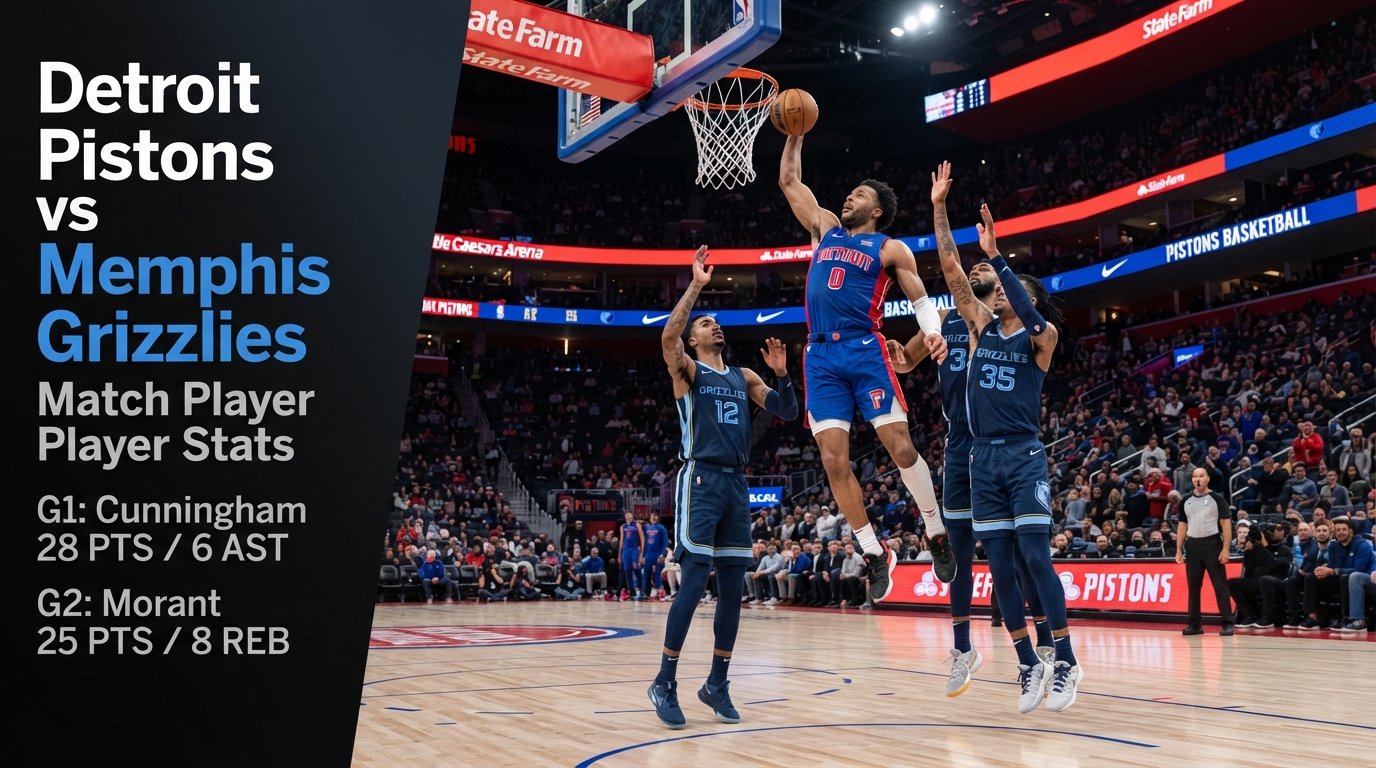
Detroit Pistons vs Memphis Grizzlies Match Player Stats
The detroit pistons vs memphis grizzlies match player stats from March 14, 2026, tell the story of a convincing 126-110 victory for Detroit at Little Caesars Arena. The Pistons combined efficient shooting, dominant rebounding, strong interior scoring, and excellent ball movement to control the game from the opening quarter through the final buzzer. Jalen Duren delivered an outstanding performance with 30 points and 13 rebounds, while Cade Cunningham directed the offense with 17 points, eight rebounds, and 15 assists. Memphis received impressive scoring contributions from its bench, particularly Javon Small, but struggled to match Detroit’s efficiency and physical presence.
The matchup offered an interesting contrast between two different offensive approaches. Detroit relied on its ability to attack the paint, create second-chance opportunities, and involve multiple players in its offense. Memphis found success from beyond the three-point line but could not overcome its disadvantages in rebounding, field-goal percentage, and assists. The final score reflected Detroit’s greater consistency across all four quarters.
For basketball fans, this game provides useful insight into individual performances, team statistics, offensive efficiency, defensive contributions, and the importance of controlling possessions. Looking beyond the final score reveals why Detroit earned the victory and how several players influenced the outcome in different ways.
Game Overview: Detroit Pistons vs Memphis Grizzlies
The Detroit Pistons hosted the Memphis Grizzlies on March 14, 2026, at Little Caesars Arena in Detroit. The home team entered the contest with a strong 48-18 record, while Memphis arrived at 23-43.
Detroit ultimately secured a 126-110 victory in front of 20,062 spectators. Although Memphis produced several productive offensive stretches, the Pistons maintained control by winning the rebounding battle and converting their scoring opportunities at a significantly higher rate.
Match Details
| Match Information | Details |
| Game | Detroit Pistons vs Memphis Grizzlies |
| Date | March 14, 2026 |
| Venue | Little Caesars Arena |
| Location | Detroit, Michigan |
| Attendance | 20,062 |
| Final Score | Detroit 126, Memphis 110 |
| Winning Team | Detroit Pistons |
| Detroit Record | 48-18 |
| Memphis Record | 23-43 |
| Season Series | Detroit won 2-0 |
The result was another positive entry in Detroit’s 2025-26 season series against Memphis. The Pistons had also defeated the Grizzlies 114-106 on November 4, giving Detroit victories in both meetings.
Quarter-by-Quarter Score
Detroit outscored Memphis in every period. This consistency was particularly important because Memphis never established a sustained scoring advantage that could change the direction of the contest.
| Quarter | Detroit Pistons | Memphis Grizzlies |
| First Quarter | 37 | 35 |
| Second Quarter | 31 | 26 |
| Third Quarter | 30 | 23 |
| Fourth Quarter | 28 | 26 |
| Final Score | 126 | 110 |
The Pistons established an early advantage by scoring 37 points in the opening quarter. Memphis remained close, scoring 35, but Detroit entered halftime with a seven-point lead.
The third quarter became another important period for the home team. Detroit added 30 points while limiting Memphis to 23. That seven-point advantage increased the margin to 14 points entering the fourth quarter.
Memphis scored 26 points in the final period, but Detroit also maintained its offensive production with 28. The Grizzlies could not reduce the deficit enough to create a serious late-game threat.
Detroit Pistons vs Memphis Grizzlies Match Player Stats
Individual performances played a major role in determining the outcome. Detroit received contributions from its starting lineup and bench, while Memphis depended heavily on its reserve players for offensive production.
The most impressive performance belonged to Jalen Duren, whose scoring efficiency and offensive rebounding created problems for Memphis throughout the evening. Cade Cunningham also played a central role by controlling the offense and consistently creating opportunities for teammates.
Detroit Pistons Player Statistics
| Detroit Player | Points | Rebounds | Assists | Additional Performance |
| Jalen Duren | 30 | 13 | Not specified | 12-of-15 FG, 2 blocks |
| Cade Cunningham | 17 | 8 | 15 | 3 steals |
| Marcus Sasser | 16 | Not specified | Not specified | 4 three-pointers |
| Duncan Robinson | 14 | 6 | Not specified | Strong perimeter scoring |
| Ronald Holland II | 12 | Not specified | Not specified | Bench contribution |
| Kevin Huerter | 11 | Not specified | Not specified | Bench scoring |
| Isaiah Stewart | 10 | Not specified | Not specified | Frontcourt contribution |
Note: Individual statistics not included in the supplied box-score summary are marked as not specified rather than estimated.
Jalen Duren: 30 Points and 13 Rebounds
Detroit’s leading performer
Jalen Duren produced the standout individual performance of the game. He finished with 30 points and 13 rebounds, establishing himself as Detroit’s most effective interior offensive option.
His shooting efficiency made the performance even more impressive. Duren converted 12 of his 15 field-goal attempts, giving him an 80% shooting percentage.
That efficiency demonstrates how effectively he converted opportunities around the basket. Rather than requiring a large number of possessions to reach 30 points, Duren consistently capitalized on high-percentage scoring chances.
His seven offensive rebounds were particularly valuable. Offensive rebounding creates additional possessions, forces defensive adjustments, and gives an attacking team opportunities to score after an initial miss.
Duren’s contributions included:
- 30 total points.
- 13 total rebounds.
- Seven offensive rebounds.
- 12 successful field goals on 15 attempts.
- Two blocked shots.
- 80% field-goal shooting.
His two blocks also demonstrated his defensive value. A center who can score efficiently, secure rebounds, and protect the rim gives his team several advantages without requiring a complicated offensive system.
One important detail is the relationship between his offensive rebounds and Detroit’s overall rebounding advantage. The Pistons collected 52 rebounds compared with Memphis’s 33. Duren’s activity around the basket helped establish that physical advantage.
His performance was not simply about scoring 30 points. It was about controlling the area where many important possessions are decided.
Cade Cunningham: The Offensive Playmaker
Cade Cunningham delivered another influential performance by combining scoring, rebounding, and playmaking.
He recorded:
- 17 points.
- Eight rebounds.
- 15 assists.
- Three steals.
His 15 assists were among the most important individual statistics of the night. They demonstrated his ability to involve teammates and organize Detroit’s offense.
Cunningham’s impact was especially visible in the team’s overall assist total. Detroit recorded 36 assists, compared with Memphis’s 20.
This difference indicates that the Pistons were more successful at creating scoring opportunities through coordinated team offense.
A point guard’s value cannot always be understood through scoring totals alone. Cunningham demonstrated why assists, decision-making, and possession management are essential parts of evaluating a player’s contribution.
His 15 assists also helped distribute scoring responsibilities across the lineup. Duren benefited from interior opportunities, while perimeter players such as Marcus Sasser and Duncan Robinson contributed from outside.
Three steals added another dimension to Cunningham’s performance. They provided defensive activity and opportunities for Detroit to transition into offense.
The combination of 17 points and 15 assists made him one of the game’s most influential players.
Marcus Sasser: Important Three-Point Production
Marcus Sasser scored 16 points and connected on four three-point attempts.
His perimeter production helped Detroit maintain offensive balance. When an opposing defense concentrates on stopping an interior scorer such as Duren, outside shooting becomes particularly important.
Sasser’s four successful three-pointers gave Memphis another area of the floor to defend.
Three-point shooting also affects defensive positioning. Opponents cannot comfortably crowd the paint when multiple Detroit players can punish open perimeter opportunities.
His 16 points provided valuable support behind Duren and Cunningham.
Although Duren received the most attention for his dominant performance, Sasser’s scoring helped prevent Detroit’s offense from becoming dependent on one player.
Duncan Robinson: Reliable Perimeter Contribution
Duncan Robinson finished with 14 points and six rebounds.
His contribution gave Detroit another productive perimeter option. Robinson’s scoring helped complement the work of the team’s interior players and primary playmaker.
The six rebounds were also useful because they added to Detroit’s collective control of the glass.
An effective offensive system requires players who can contribute in different ways. Interior scoring, outside shooting, offensive rebounding, and passing all create different problems for a defense.
Robinson’s 14 points helped maintain that balance.
Ronald Holland II: Bench Energy and Scoring
Ronald Holland II contributed 12 points off the bench.
Bench scoring is important in games where teams need to maintain their offensive rhythm when starters rest. A productive reserve can prevent an opponent from using lineup changes to create momentum.
Holland’s 12 points gave Detroit another scoring source and helped support the team’s overall offensive production.
His contribution also illustrates the importance of roster depth during a long NBA season. Teams cannot rely exclusively on their starting five if they want to remain productive throughout four quarters.
Kevin Huerter: Valuable Supporting Scoring
Kevin Huerter added 11 points.
His scoring helped Detroit maintain a balanced attack. Reaching double figures alongside several teammates meant Memphis had to account for multiple offensive threats.
When a team has several players capable of contributing 10 or more points, defensive attention becomes harder to concentrate.
Huerter’s contribution was therefore important even though he was not Detroit’s leading scorer.
Isaiah Stewart: Additional Frontcourt Production
Isaiah Stewart finished with 10 points.
His scoring added another frontcourt contribution to a game in which Detroit dominated the rebounding battle.
Stewart’s presence alongside Duren also gave Detroit additional size and physicality. Having multiple productive frontcourt players can make it difficult for opponents to control the paint or secure defensive rebounds.
His 10 points completed a strong group scoring performance for the Pistons.
Memphis Grizzlies Player Statistics and Individual Performances
Memphis had several productive offensive players despite losing by 16 points. Its scoring was distributed across multiple contributors, with Javon Small leading the team at 23 points.
The Grizzlies also received important contributions from Ty Jerome, Cam Spencer, and Olivier-Maxence Prosper.
However, individual scoring could not completely compensate for the team’s disadvantages in shooting efficiency, rebounding, and ball movement.
Memphis Grizzlies Player Statistics
| Memphis Player | Points | Rebounds | Assists | Additional Performance |
| Javon Small | 23 | Not specified | Not specified | 4 three-pointers, 7-of-7 FT |
| Ty Jerome | 21 | Not specified | Not specified | Important scoring contribution |
| Cam Spencer | 19 | Not specified | 5 | Perimeter scoring and playmaking |
| Olivier-Maxence Prosper | 17 | Not specified | Not specified | Frontcourt scoring |
| DeJon Jarreau | Not specified | 7 | Not specified | Team-leading rebounds |
Individual statistics are limited to the figures available in the supplied game summary.
Javon Small: Memphis’s Leading Scorer
Javon Small led Memphis with 23 points.
His performance was one of the positive developments for the Grizzlies. Despite the defeat, he demonstrated an ability to produce points through both perimeter shooting and free throws.
Small made four three-pointers, giving Memphis an important outside scoring contribution.
He also converted all seven of his free-throw attempts.
Perfect free-throw shooting matters because it allows players to take advantage of opportunities created by defensive pressure. Missed free throws can waste valuable possessions, especially when a team is attempting to close a scoring gap.
Small’s 23 points made him Memphis’s leading scorer and one of the most productive offensive players in the contest.
His performance also demonstrated that Memphis had players capable of generating offense even when the team struggled collectively.
Ty Jerome: Another 20-Point Performance
Ty Jerome scored 21 points, making him Memphis’s second-highest scorer.
His scoring was important because it provided another offensive option alongside Small.
A team facing a significant deficit needs more than one productive scorer. If opponents can concentrate their defense on a single player, offensive production becomes easier to restrict.
Jerome’s 21 points helped Memphis maintain scoring pressure.
However, the Grizzlies needed more efficiency across the entire lineup to turn individual scoring performances into a competitive team result.
Cam Spencer: Scoring and Playmaking
Cam Spencer recorded 19 points and five assists.
His performance combined two important offensive responsibilities.
The 19 points demonstrated his scoring contribution, while five assists showed that he also helped create opportunities for teammates.
Spencer’s production was particularly useful because Memphis needed players who could contribute beyond individual shooting.
Nevertheless, Detroit’s 36 assists compared with Memphis’s 20 showed a significant difference in overall offensive distribution.
Spencer’s five assists were a positive individual contribution, but Memphis needed more collective playmaking to match Detroit’s offensive rhythm.
Olivier-Maxence Prosper: Frontcourt Scoring
Olivier-Maxence Prosper added 17 points.
His scoring gave Memphis another important offensive contributor and prevented the team’s production from depending entirely on its guards.
Frontcourt scoring can create useful matchup opportunities, particularly when opposing defenses focus on perimeter players.
Prosper’s 17 points demonstrated that Memphis had several players capable of reaching double figures.
However, the team’s overall shooting percentage remained below Detroit’s. Individual scoring contributions were not enough to overcome the difference in offensive efficiency.
DeJon Jarreau: Rebounding Contribution
DeJon Jarreau led Memphis with seven rebounds.
Rebounding was one of the most challenging aspects of the matchup for the Grizzlies.
Memphis finished with 33 total rebounds, while Detroit secured 52.
Jarreau’s seven rebounds were valuable, but the overall difference indicated that the Grizzlies struggled to consistently finish defensive possessions and generate additional opportunities through offensive rebounds.
Controlling the glass is especially important against a team with an effective interior scorer such as Duren.
Memphis needed a stronger collective rebounding effort to reduce Detroit’s second-chance opportunities.
Complete Team Statistics Comparison
The team statistics provide a clearer explanation of why Detroit won.
Memphis made more three-pointers, but Detroit was more efficient from the field and significantly better in rebounding and assists.
| Statistical Category | Detroit Pistons | Memphis Grizzlies |
| Total Points | 126 | 110 |
| Field Goals Made | 50 | 38 |
| Field Goals Attempted | 92 | 89 |
| Field-Goal Percentage | 54% | 43% |
| Three-Pointers Made | 12 | 15 |
| Total Rebounds | 52 | 33 |
| Total Assists | 36 | 20 |
| Total Blocks | 6 | 2 |
| Total Turnovers | 18 | 16 |
These figures reveal several important differences between the teams.
Detroit’s Field-Goal Efficiency
Detroit converted 50 of 92 field-goal attempts, producing a reported shooting percentage of 54%.
Memphis made 38 of 89 attempts, finishing at 43%.
That 11-percentage-point difference was a major factor in the result.
Detroit did not need to rely on an unusually high number of possessions to generate its offense. The Pistons converted their opportunities more consistently.
Their shooting advantage was especially important because Memphis attempted almost as many field goals.
Detroit’s 50 successful attempts compared with Memphis’s 38 represented 12 additional made field goals.
That difference helped establish the foundation of the 16-point victory.
Memphis Won the Three-Point Battle
One area where Memphis performed better was three-point shooting.
The Grizzlies made 15 three-pointers, compared with Detroit’s 12.
This is an interesting detail because it shows that the losing team did not perform poorly in every offensive category.
Memphis actually generated three more successful three-point shots.
However, three-point totals alone do not determine a basketball game.
A team must also convert two-point opportunities, secure rebounds, limit defensive mistakes, and create efficient possessions.
Detroit’s advantage inside the arc and its superior overall shooting efficiency outweighed Memphis’s three-point advantage.
Detroit Dominated the Rebounding Battle
The Pistons collected 52 rebounds, while Memphis managed 33.
The 19-rebound difference was one of the clearest statistical advantages of the contest.
Rebounds are important because they determine who controls possession after missed shots.
Defensive rebounds prevent opponents from receiving second chances. Offensive rebounds allow teams to extend possessions and create additional scoring opportunities.
Detroit’s 52 rebounds demonstrated stronger collective control of the glass.
Duren’s seven offensive rebounds were particularly important because they created additional opportunities for the Pistons.
For Memphis, improving rebounding would have been an important adjustment in any rematch.
Assists Demonstrated Detroit’s Better Ball Movement
Detroit recorded 36 assists compared with Memphis’s 20.
That 16-assist difference highlights how effectively the Pistons created opportunities for one another.
Cunningham’s 15 assists were central to this advantage.
Detroit’s offense benefited from passing that created scoring opportunities instead of depending entirely on individual attempts.
Memphis had productive individual scorers, but its lower assist total suggested that the team’s offensive production was less connected.
The difference between 36 and 20 assists was particularly meaningful because it reflected a broader team performance rather than a single player’s contribution.
Defensive Statistics: Blocks and Turnovers
Detroit recorded six blocks, while Memphis managed two.
The four-block difference showed that the Pistons produced more recorded shot-blocking plays.
Blocks can change offensive decisions, discourage attempts near the basket, and create opportunities for defensive possessions.
Turnovers presented a different picture.
Detroit committed 18 turnovers, compared with Memphis’s 16.
This was one category in which the Grizzlies performed better.
The Pistons should not interpret their victory as a perfect offensive performance. Committing 18 turnovers created additional opportunities for Memphis.
However, Detroit’s superior shooting, rebounding, and passing helped compensate for those mistakes.
The statistics show that winning does not require leading every category. It requires performing well in the areas that have the greatest influence on the overall result.
How Detroit Won the Game
Detroit’s victory was built on three major advantages: interior scoring, rebounding, and offensive organization.
Memphis had several productive individual scorers, but the Pistons consistently performed better in the areas that influenced possession quality.
1. Strong Interior Scoring
Jalen Duren’s 30-point performance gave Detroit a reliable scoring option near the basket.
His 12-of-15 shooting was particularly important because it demonstrated outstanding efficiency.
When an interior player converts opportunities at that rate, opposing defenses must make adjustments.
Those adjustments can create additional opportunities for perimeter players.
Duren’s offensive production therefore had value beyond his personal scoring total.
It helped establish Detroit’s offensive identity throughout the contest.
2. Winning the Rebounding Battle
Detroit’s 52 rebounds compared with Memphis’s 33 created a significant possession advantage.
Rebounding is often overlooked when fans focus mainly on points and assists.
However, a missed shot does not necessarily end an offensive possession. If the attacking team secures the rebound, it can continue its attack.
Detroit benefited from this ability, particularly through Duren’s seven offensive rebounds.
Memphis struggled to match the Pistons physically around the basket.
3. Better Offensive Distribution
The Pistons recorded 36 assists, showing that their offense involved several players.
Cunningham’s 15 assists were the central part of this performance.
Rather than relying exclusively on isolation scoring, Detroit created opportunities through passing and player involvement.
This approach helped produce contributions from Sasser, Robinson, Holland, Huerter, and Stewart.
Memphis had individual scoring success but could not match the overall distribution of Detroit’s offense.
4. Consistency Across Four Quarters
Detroit scored at least 28 points in every quarter.
That consistency prevented Memphis from building momentum.
The Pistons did not depend on one unusually productive period. Instead, they maintained a scoring advantage throughout the contest.
The third quarter was especially important because Detroit extended its halftime advantage by another seven points.
By entering the fourth quarter with a 14-point lead, the Pistons placed Memphis under pressure to produce a strong finish.
Detroit continued scoring and protected its advantage.
Why Memphis Grizzlies Could Not Complete a Comeback
Memphis showed offensive potential, particularly through its perimeter players.
However, the Grizzlies faced several problems that made a comeback difficult.
Shooting Efficiency Was Not High Enough
Memphis shot 43% from the field, compared with Detroit’s 54%.
That difference meant the Grizzlies needed additional possessions or unusually strong three-point production to compensate.
Although Memphis made 15 three-pointers, its overall shooting efficiency remained lower.
Rebounding Disadvantage Created Extra Problems
Memphis lost the rebounding battle by 19.
This made it harder to prevent Detroit from extending possessions.
It also reduced the Grizzlies’ opportunities to create their own second-chance scoring chances.
Against a team with a dominant rebounder such as Duren, this weakness became especially costly.
Limited Overall Playmaking
Memphis recorded 20 assists.
Detroit’s 36 assists demonstrated a much stronger level of collective offensive distribution.
Although Spencer contributed five assists, the Grizzlies needed more players to become involved in creating scoring opportunities.
The Early Deficit Increased Pressure
Detroit scored 37 points in the first quarter and continued to outscore Memphis in the second.
The Grizzlies were never able to establish a scoring advantage in any period.
As the deficit increased to 14 points after three quarters, Memphis faced a difficult challenge.
The team needed to improve its defense while also producing a much more efficient offensive performance.
Detroit did not allow that combination to happen.
Impact of Player Availability on the Match
Player availability is an important part of understanding any NBA matchup.
Injuries and lineup decisions can affect rotations, defensive assignments, offensive responsibilities, and bench depth.
For this game, the supplied information identifies four players who did not participate.
Memphis Grizzlies Absences
| Player | Reported Reason |
| Jaylen Wells | Right shoulder contusion |
| Walter Clayton Jr. | Right ankle sprain |
The absence of Jaylen Wells and Walter Clayton Jr. reduced the number of available players in Memphis’s rotation.
However, it would be inaccurate to claim that their absence alone caused the defeat.
The available statistics identify more direct explanations for the result, including Detroit’s shooting efficiency, rebounding advantage, and assist total.
Player availability should be considered as additional context rather than a complete explanation.
Detroit Pistons Absences
| Player | Reported Reason |
| Tolu Smith | Coach’s decision |
| Bobi Klintman | Coach’s decision |
Detroit also had players who did not participate.
Both Smith and Klintman were listed as inactive by coach’s decision.
These absences did not prevent the Pistons from producing 126 points and controlling the major statistical categories.
The performance of the active lineup demonstrated sufficient scoring depth throughout the game.
Detroit Pistons vs Memphis Grizzlies: Previous Meeting and Season Series
The March 14 result was not an isolated success for Detroit.
The Pistons had also defeated Memphis earlier in the 2025-26 season.
The November 4 meeting ended with Detroit winning 114-106.
The March victory completed a 2-0 season-series advantage for the Pistons.
| Date | Match Result | Winner |
| November 4, 2025 | Detroit 114-106 Memphis | Detroit |
| March 14, 2026 | Detroit 126-110 Memphis | Detroit |
Both victories demonstrated Detroit’s ability to defeat Memphis in different scoring situations.
The November meeting was a closer eight-point contest, while the March matchup ended with a 16-point margin.
Detroit also scored 12 more points in the second meeting.
These results do not automatically establish that the same outcome would occur in a future matchup. NBA rosters, player availability, coaching strategies, and team form change throughout a season.
However, winning both regular-season meetings gave Detroit a clear advantage in the 2025-26 head-to-head series.
Statistical Analysis: What the Numbers Really Tell Us
A box score provides the basic information needed to understand a game, but interpreting the numbers makes the analysis more valuable.
Several statistical relationships explain why Detroit was successful.
Shooting Percentage and Scoring Efficiency
Detroit’s 54% field-goal shooting was significantly better than Memphis’s 43%.
The Pistons made 50 shots, while Memphis made 38.
This means Detroit converted 12 additional field goals despite attempting only three more shots.
That difference is a strong indication of better shot conversion.
It is also important to distinguish field-goal percentage from overall scoring efficiency.
Field-goal percentage does not include free throws as made field goals, and three-pointers are counted the same as two-point field goals in the basic percentage calculation.
Therefore, it should not be treated as a complete measurement of offensive efficiency.
Nevertheless, the difference in this game provides useful evidence of Detroit’s shooting advantage.
Rebounding and Possession Control
The 52-33 rebounding difference deserves special attention.
Rebounding can influence the number of scoring opportunities available to each team.
An offensive rebound can extend an attacking possession, while a defensive rebound ends the opponent’s opportunity.
Duren’s seven offensive rebounds helped Detroit establish control around the basket.
Memphis needed a stronger collective effort to reduce those additional opportunities.
Assist-to-Turnover Considerations
Detroit had 36 assists and 18 turnovers.
Memphis recorded 20 assists and 16 turnovers.
Based on those totals, Detroit produced two assists for every turnover, while Memphis recorded approximately 1.25 assists per turnover.
This comparison offers another way to evaluate offensive organization.
Detroit had more turnovers, but its much higher assist total showed that the team created substantially more assisted scoring opportunities.
It is important not to confuse this simple comparison with a complete measure of offensive performance. It does, however, help explain the difference in ball movement.
The Value of Bench Scoring
Detroit received double-digit contributions from several players outside its two leading statistical performers.
Sasser scored 16 points, Robinson added 14, Holland contributed 12, and Huerter recorded 11.
Memphis also received substantial production from Small, Jerome, Spencer, and Prosper.
The important difference was how these individual contributions fitted into the overall team performance.
Detroit combined its supporting scoring with a major advantage in rebounding and assists.
Memphis had strong individual performances but did not produce the same collective statistical balance.
What This Result Means for the Detroit Pistons
The victory provided another positive result for Detroit during a strong 2025-26 campaign.
At 48-18, the Pistons had established an impressive record by the time of this matchup.
The performance also demonstrated several strengths that can be valuable in postseason basketball.
Interior Presence
Duren’s ability to score efficiently and collect rebounds gave Detroit a reliable frontcourt advantage.
Teams that can produce efficient interior scoring often force opponents to make difficult defensive decisions.
Playmaking Depth
Cunningham’s 15 assists highlighted his importance as the primary offensive organizer.
The team’s 36 assists also demonstrated that other players were successfully converting opportunities created through ball movement.
Multiple Scoring Options
Detroit had several players reach double figures.
This distribution is useful because opponents cannot focus their entire defensive plan on one scorer.
If defenses concentrate on stopping Duren, perimeter players can become more important. If they prioritize the outside shooters, Detroit can continue attacking the paint.
Defensive Activity
Six blocks and a substantial rebounding advantage demonstrated Detroit’s ability to influence possessions defensively.
The team also limited Memphis to 110 points.
Although the Pistons committed 18 turnovers, their overall performance was strong enough to overcome that weakness.
What This Result Means for the Memphis Grizzlies
For Memphis, the game offered both positive individual performances and areas requiring improvement.
The Grizzlies had four players score at least 17 points.
Small’s 23 points, Jerome’s 21, Spencer’s 19, and Prosper’s 17 showed that the team had multiple offensive contributors.
However, scoring was not the only requirement.
Improve Defensive Rebounding
Memphis needed to secure more defensive rebounds and prevent Detroit from extending possessions.
The 19-rebound difference was too significant to ignore.
Increase Overall Shooting Efficiency
The Grizzlies made 38 of 89 field-goal attempts.
Improving shot selection and converting more opportunities would help reduce the pressure on their perimeter shooting.
Create More Assisted Opportunities
Memphis recorded 20 assists.
More effective passing and better offensive coordination could help create higher-quality attempts.
Limit Opponent Second Chances
Duren’s seven offensive rebounds highlighted a problem for Memphis around the basket.
A stronger collective rebounding effort would be an important adjustment against teams with powerful interior scorers.
How Fans Can Read NBA Player Statistics More Effectively
Understanding basketball statistics requires more than identifying the player who scored the most points.
The Detroit and Memphis matchup provides a useful example of how different statistical categories work together.
Points
Points measure a player’s scoring contribution.
However, scoring totals should be considered alongside shooting attempts and shooting percentage.
Duren’s 30 points on 12-of-15 shooting were especially impressive because he combined a high scoring total with excellent accuracy.
Rebounds
Rebounds measure how many missed shots a player recovers.
They are commonly divided into offensive and defensive rebounds.
Offensive rebounds create additional attacking opportunities, while defensive rebounds help end opposing possessions.
Assists
Assists measure passes that directly lead to successful field goals.
Cunningham’s 15 assists highlighted his playmaking influence.
They also helped explain Detroit’s substantial team assist advantage.
Steals
Steals occur when a defensive player legally takes possession of the ball from an opponent.
Cunningham recorded three steals, contributing to Detroit’s defensive activity.
Blocks
Blocks occur when a defender legally deflects an opponent’s shot attempt.
Duren recorded two blocks, while Detroit finished with six team blocks.
Field-Goal Percentage
Field-goal percentage measures successful field goals relative to total attempts.
The basic formula is:
\[ FG\%=\frac{\text{Field Goals Made}}{\text{Field Goals Attempted}}\times100 \]
For Detroit:
\[ \frac{50}{92}\times100\approx54.35\% \]
For Memphis:
\[ \frac{38}{89}\times100\approx42.70\% \]
The reported figures of 54% and 43% are consistent with these calculations when rounded to the nearest whole percentage point.
Three-Point Percentage
Three-point percentage measures successful three-point shots relative to total three-point attempts.
It is useful for evaluating perimeter shooting, but the number of attempts is also important.
In this matchup, Memphis made more three-pointers, but the supplied summary does not provide the total three-point attempts for either team. Therefore, exact three-point percentages should not be estimated.
Turnovers
Turnovers occur when a team loses possession without completing a successful scoring attempt.
Detroit recorded 18 turnovers, while Memphis had 16.
A lower turnover total is generally preferable, but turnover numbers should be evaluated alongside assists, shooting efficiency, and total offensive production.
Why Multiple Statistics Matter Together
A player may score 25 points but still have a limited overall impact if the player takes many inefficient shots and contributes little in other areas.
Another player may score fewer points but influence the game through rebounding, assists, steals, and defense.
That is why the best statistical analysis considers multiple categories rather than relying on the scoring leaderboard alone.
Duren and Cunningham provide two different examples from this matchup.
Duren influenced the game through efficient scoring and rebounding. Cunningham combined scoring with playmaking and defensive activity.
Both performances were important for different reasons.
Frequently Asked Questions
1. Who won the Detroit Pistons vs Memphis Grizzlies game on March 14, 2026?
The Detroit Pistons defeated the Memphis Grizzlies 126-110 on March 14, 2026, at Little Caesars Arena in Detroit. The Pistons led throughout the game and outscored Memphis in all four quarters.
2. How many points did Jalen Duren score against Memphis?
Jalen Duren scored 30 points and collected 13 rebounds. He made 12 of his 15 field-goal attempts, recorded seven offensive rebounds, and added two blocks.
3. How did Cade Cunningham perform against the Grizzlies?
Cade Cunningham finished with 17 points, eight rebounds, 15 assists, and three steals. His 15 assists were particularly important in helping Detroit record 36 team assists.
4. Who was Memphis’s leading scorer against Detroit?
Javon Small led Memphis with 23 points. He also made four three-pointers and converted all seven of his free-throw attempts.
5. Which team had more rebounds in the game?
Detroit dominated the rebounding battle with 52 rebounds, compared with Memphis’s 33. The 19-rebound advantage helped the Pistons control possessions and create additional scoring opportunities.
6. How many times did Detroit beat Memphis during the 2025-26 regular season?
Detroit won both regular-season meetings against Memphis. The Pistons won 114-106 on November 4, 2025, and followed that result with a 126-110 victory on March 14, 2026.
Conclusion
The March 14, 2026, matchup between Detroit and Memphis demonstrated why balanced team performance is essential in professional basketball. The Pistons earned a 126-110 victory by combining efficient shooting, strong rebounding, effective passing, and consistent scoring across all four quarters.
Jalen Duren was the standout performer with 30 points and 13 rebounds, shooting an impressive 80% from the field. Cade Cunningham also played a major role, recording 17 points, eight rebounds, 15 assists, and three steals. Marcus Sasser, Duncan Robinson, Ronald Holland II, Kevin Huerter, and Isaiah Stewart provided valuable additional scoring.
Memphis had its own individual highlights. Javon Small led the Grizzlies with 23 points, while Ty Jerome scored 21, Cam Spencer contributed 19, and Olivier-Maxence Prosper added 17.
However, Detroit’s advantages were too significant to overcome. The Pistons shot 54% from the field, collected 52 rebounds, and recorded 36 assists. Memphis made more three-pointers, but its lower overall shooting percentage and 19-rebound disadvantage limited its ability to compete.
Ultimately, the detroit pistons vs memphis grizzlies match player stats show that Detroit’s victory was built on more than individual scoring performances. Better shooting efficiency, superior interior production, and stronger offensive organization allowed the Pistons to complete a convincing win and secure a 2-0 advantage in the 2025-26 season series.
The matchup remains a useful example of how scoring, rebounding, passing, and defensive contributions combine to determine the outcome of an NBA game.