Why Local Screen Printing Still Outperforms Online Print-on-Demand for Custom Apparel
The rise of print-on-demand platforms has made it easier than ever to create custom apparel without holding inventory or managing production. Yet for businesses, event organizers, and brands serious about quality and timelines, local screen printing facilities continue to deliver advantages that automated fulfilment centres cannot match. Understanding when to choose each method can save time, money, and preserve the professional image your garments are meant to project.
The Quality Gap Between Production Methods
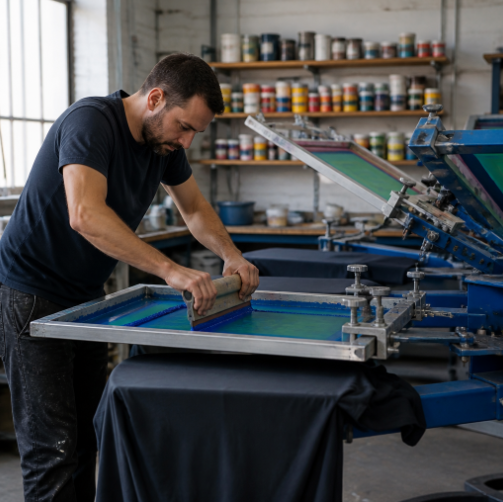
Screen printing produces a fundamentally different result than digital printing or direct-to-garment technology. The ink sits on top of the fabric as a discrete layer, creating opacity and vibrancy that holds up through repeated washing. Colours remain true to specification, whites stay bright against dark fabrics, and fine details hold their sharpness. This matters particularly for logos with specific brand colours or designs that include small text.
Print-on-demand services typically use direct-to-garment printers that spray ink into the fabric fibres. The process works well for complex, full-colour images and low quantities, but the hand feel differs—prints can feel heavier or stiffer—and colour matching is less precise. For one-off personal projects, this trade-off is reasonable. For staff uniforms or merchandise representing a business, the inconsistency becomes a liability.
Turnaround Times and Order Flexibility
Print-on-demand operates on a queue system. Orders enter a production line alongside thousands of others, with shipping times often extending to one or two weeks. Rush orders may be available for a premium, but they still move through the same centralized workflow. Local screen printers, by contrast, can accommodate same-day or next-day jobs when capacity allows, and they offer direct communication when deadlines shift.
This difference becomes critical for events, retail launches, or team sports where delivery dates are fixed. A delayed shipment from an online platform offers no recourse; a local printer can prioritize urgent work, adjust quantities on short notice, or solve problems in person rather than through a ticket system. The ability to walk in and discuss a project face-to-face eliminates the ambiguity that email exchanges often create.
Cost Structures for Bulk and Repeat Orders
Print-on-demand pricing is linear: each unit costs the same whether you order five shirts or five hundred. Screen printing operates on setup costs that are distributed across the run, meaning per-unit prices drop significantly as quantities increase. For a corporate order of fifty shirts, screen printing typically costs less per garment, and the savings compound with larger runs.
Repeat orders benefit further. Once screens are created for a design, subsequent runs require only ink and labour, reducing costs and production time. Businesses ordering uniforms quarterly or event organizers running annual conferences can maintain design consistency while controlling budgets. Online platforms do not offer this scaling advantage because each item is produced individually regardless of volume.
When Local Screen Printing Makes Strategic Sense
Certain projects demand the control and quality that local production provides. Corporate branding initiatives, where colour accuracy and durability reflect directly on the company, benefit from screen printing’s precision. Sports teams ordering uniforms need garments that withstand frequent washing without fading or cracking. Event merchandise for conferences or festivals requires reliable delivery dates and the ability to adjust quantities as registration numbers change.
For businesses in Phoenix looking to balance quality with fast turnaround, working with a local provider removes many of the uncertainties associated with online fulfilment. Fast Shirt Factory produces custom T-shirts, hoodies, and sweatshirts with no minimum order requirements and offers same-day production options, making it possible to secure apparel for last-minute needs without sacrificing print quality or colour accuracy. This model serves small businesses that lack bulk order volumes but still require professional results.
Another key scenario involves sampling and approvals. Many screen printing services allow clients to review physical samples before committing to a full run, particularly for larger orders. Print-on-demand platforms rarely offer this option; you approve a digital proof and hope the physical result matches. For apparel brands or businesses launching new merchandise lines, the ability to inspect a printed sample before production begins reduces risk and ensures the final product meets expectations.
Understanding the Design and Setup Process
Screen printing requires design preparation that differs from uploading a file to an online portal. Artwork must be separated into individual colour layers, and each colour requires its own screen. Simple designs with one to three colours are straightforward and cost-effective; complex designs with gradients or many colours increase both setup time and expense. Local printers typically assist with artwork preparation, ensuring files are print-ready and advising on colour choices that will reproduce well.
This hands-on approach helps avoid common mistakes. A design that looks crisp on screen may not translate cleanly to fabric if line weights are too thin or colours are too similar. Experienced printers identify these issues before production begins, saving both time and materials. Online platforms offer limited pre-flight checks, and errors are often discovered only after the order arrives. For detailed guidance on preparing artwork and understanding printing techniques, resources such as comprehensive garment printing guides cover the technical considerations that ensure designs print as intended.
Practical Considerations for Material Selection
Garment choice affects both print quality and wearability. Screen printing works on virtually any fabric type—cotton, polyester, blends, fleece—and accommodates various garment weights and styles. Local printers stock a range of blanks and can source specific brands or fits based on project needs. Print-on-demand services offer more limited catalogues, and substitutions occur frequently when items are out of stock.
Weight and construction matter for different applications. Lightweight shirts work well for summer events or retail merchandise, while heavier fabrics suit workwear or outdoor settings. Printers familiar with these distinctions can recommend appropriate options based on how the garments will be used, whether that involves daily wear, athletic activity, or short-term promotional use. This consultation adds value that automated ordering systems cannot replicate.
Making the Right Choice for Your Project
Print-on-demand serves a purpose for individuals testing designs, creators selling niche items with no upfront investment, or projects where shipping timelines are flexible. It removes barriers to entry and simplifies logistics. But for businesses and organizations where garment quality, brand consistency, and delivery reliability are non-negotiable, local screen printing remains the professional standard.
The decision hinges on priorities. If per-unit cost matters more than total cost, if you need control over colour matching and print durability, or if timelines are tight, screen printing offers clear advantages. If you are producing small quantities of highly detailed, full-colour designs and can wait for production and shipping, online platforms may suffice. Assessing your project against these criteria helps ensure the method you choose aligns with the results you need.